Technology and equipment from Tokyo
Mexico's Foreign Ministry has announced a comprehensive joint program with Japan to tackle the massive sargassum crisis affecting the country's Caribbean coastline, as the 2026 season breaks all historical records for seaweed accumulation.
The partnership comes as floating sargassum biomass in the Atlantic and Caribbean reached 40 million metric tons in May 2026, surpassing all previous records and covering nearly 4% of the monitored ocean surface. June saw the Caribbean hit 3.6 million metric tons and the Gulf of Mexico reach 5 million metric tons, both all-time highs according to NASA satellite data.
Japan will provide ocean-monitoring technology, specialized equipment including robotics and sensors, and financial cooperation to strengthen Mexico's response capacity. The Asian nation will also supply sargassum-collecting ships and vessels adapted for offshore collection, addressing a critical gap in Mexico's current capabilities.
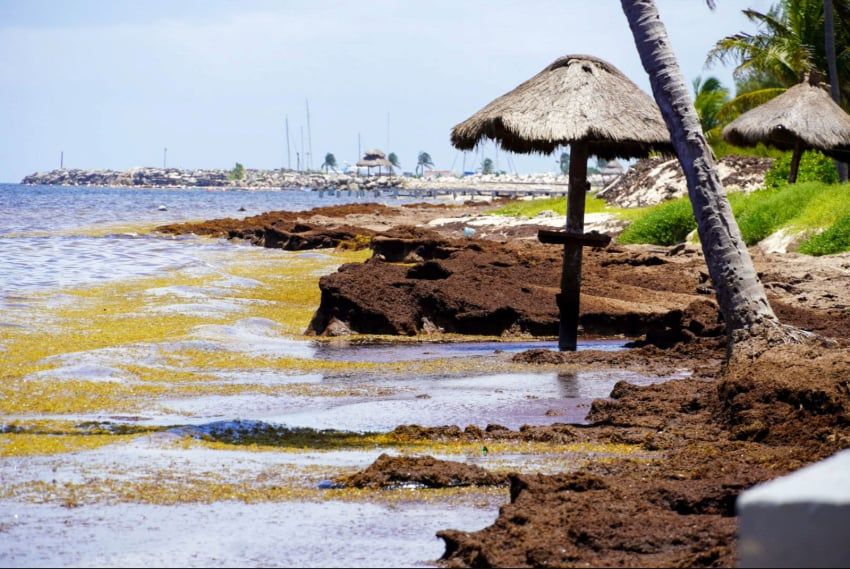
Government estimates indicate that up to 9,000 tons of sargassum reach Mexico's Caribbean coastline on the worst days, while current resources only allow collection of 1,200 tons per day. As of late July, Quintana Roo had accumulated 92,581.04 metric tons of collected sargassum this year, with Playa del Carmen leading cleanup efforts at 33,411.42 metric tons.
Japan brings established expertise to the partnership, having already invested $12.3 million in Caribbean sargassum management through UNDP since 2022, supporting five countries with equipment and technical assistance.
From problem to product
The collaboration will feature satellite monitoring, biological decomposition technologies and technical training programs through Japan's International Cooperation Agency, coordinated with Mexico's Agency for International Development Cooperation.
A key component focuses on converting sargassum into commercially viable products such as fertilizer, biofuels, building materials and soap. This approach builds on Mexico's pioneering decision to become the first country in the world to officially declare sargassum a fishery resource, opening doors for coastal communities to develop an emerging industry.
The project aims to boost marine conservation efforts, support integrated coastal management and mitigate negative impacts on fisheries, public health and tourism. The economic stakes are substantial, with the annual toll on Quintana Roo estimated at $2 billion and hotel booking drops of 30% to 40% reported during peak sargassum periods.
High-level diplomatic engagement
Foreign Minister Roberto Velasco and his Japanese counterpart, Toshimitsu Motegi, announced the initiative during an August 3 meeting, where they established a working group to advance bilateral cooperation in political, economic, scientific and technological spheres.
The ministers also launched a high-level economic dialogue to boost bilateral trade, which reached $9.9 billion from January to May 2026, representing a 4% increase over the same period last year.
Days earlier, President Claudia Sheinbaum had pledged 2 billion pesos ($115 million) in federal funds to battle the sargassum influx in Quintana Roo, directing resources toward control efforts spanning roughly 30 miles of beachfront including Cancún, Playa del Carmen, Puerto Morelos, Tulum and Mahahual.
International coordination expands
The Mexico-Japan partnership forms part of broader international efforts to address what has transformed from an unusual phenomenon in 2011 into a structural challenge. Large quantities of sargassum have washed ashore regularly since 2011, with 2018 marking the first year-round occurrence in the Caribbean.
The EU-Caribbean Global Gateway Investment Agenda has identified over €300 million in potential loans and €60 million in potential grants to address sargassum-related investments across the Caribbean region.
In October, Cancún will host the fourth EU-Caribbean Global Gateway Conference on Sargassum, following the third conference held in Brussels in October 2025. The event is expected to focus on regional cooperation, circular economy solutions and harvesting technology, further cementing Mexico's central role in regional sargassum diplomacy.