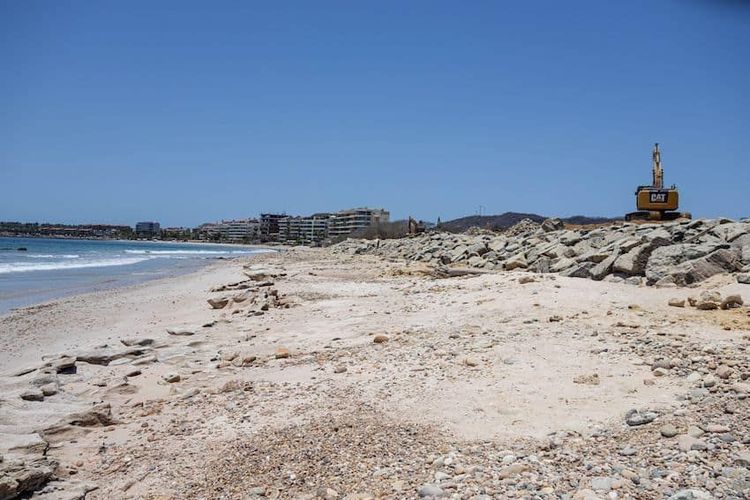

Mexico allocates 2 billion pesos to combat record sargassum crisis threatening Caribbean tourism
The Mexican federal government will invest over 2 billion pesos to strengthen its anti-sargassum strategy, Navy Minister Raymundo Pedro Morales Ángeles announced Thursday during President Claudia Sheinbaum's morning press conference.
The announcement comes as scientific monitoring indicates that floating sargassum across the Atlantic-Caribbean basin reached 33.6 million metric tonnes in June 2026, with the Caribbean Sea recording its highest June concentration since satellite monitoring began. The University of South Florida Optical Oceanography Laboratory has forecast that 2026 could potentially be the worst year for sargassum on record in the Mexican Caribbean.
Morales said the investment will be deployed in two stages. In the first phase this year, the Navy will spend 768.7 million pesos to increase its at-sea collection capacity to 1,870 tonnes per day from the current 1,227 tonnes per day. The Navy has already purchased two new tugboats and six sargassum-collecting vessels known as sargaceros.
The minister said approximately 50 kilometers of new anti-sargassum barriers will be installed along the Caribbean coast in critical areas including Playa del Carmen, Cancún, Tulum, Puerto Morelos and Mahahual. Currently, Mexican authorities and the private sector, including hotel employees, have the capacity to collect 2,177 tonnes of sargassum per day at sea and on beaches.
In the second stage in 2027, the Navy aims to increase collection capacity to 4,000 tonnes per day through the purchase of additional collection vessels, more barriers, and enhanced beach cleanup equipment.
Tourism industry at stake
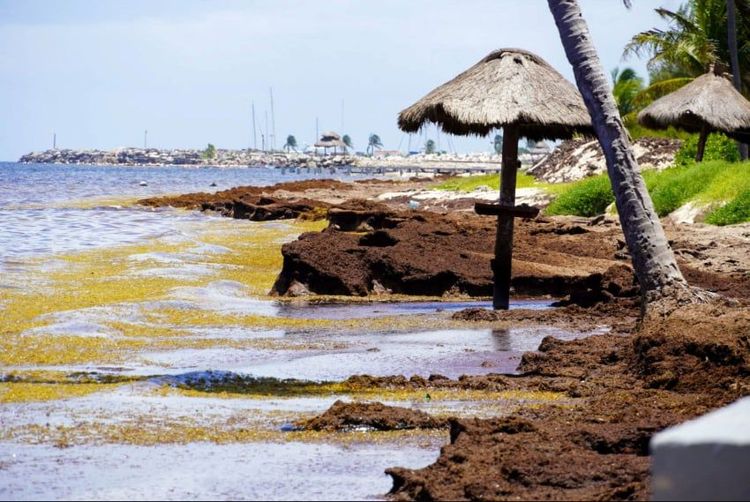
The massive investment reflects the critical importance of combating sargassum to Quintana Roo's economy. In 2023, the state received 21 million tourists, generating approximately $21 billion in tourism revenue. When sargassum decomposes on beaches, it releases hydrogen sulfide gas, creating a foul sulfurous odor that poses health risks to residents and drives tourists away.
The sargassum phenomenon has intensified since the Great Atlantic Sargassum Belt first appeared in 2011 and has recurred most summers since, driven by strong upwelling, high river discharge, and increased nutrient availability in the Atlantic Ocean. Sargassum season in the Mexican Caribbean typically runs from May to October, with the heaviest arrivals occurring in June and July.
Economic growth signals recovery
Sheinbaum also addressed preliminary data published Thursday by the national statistics agency INEGI showing the Mexican economy grew 1.5% in the second quarter of 2026 compared to the previous quarter and 2.1% on an annual basis.
"Very good news," Sheinbaum responded when asked about the figures. The data represents a significant rebound after Mexico's economy contracted 0.6% in the first quarter of 2026.
The president highlighted the strong performance of the primary sector, which includes agriculture, fishing, mining and hydrocarbon extraction. The sector expanded 7.3% annually in the second quarter after contracting in Q1, significantly driving overall economic growth. Sheinbaum noted this growth reflected both higher production volumes and elevated prices for gold and silver.
The tertiary sector, encompassing services, expanded 1.5% in Q2 compared to the previous quarter and 2.5% annually. The secondary sector grew 1.6% between April and June compared to Q1 and 0.8% on an annual basis.
The Finance Ministry is forecasting Mexico's annual GDP growth for 2026 to be between 1.8% and 2.8%, while the International Monetary Fund lowered its forecast to 1.2% from a previous 1.6% prediction.
Electoral authority rules on political language
Sheinbaum also weighed in on a National Electoral Institute (INE) ruling issued Wednesday that ordered the Institutional Revolutionary Party (PRI) and its national president, Senator Alejandro Moreno, to remove social media posts using the word narcogobierno to refer to the federal government and narcopartido to describe the ruling Morena party.
The INE's Complaints Commission ordered the removal of five publications by Moreno and four by the PRI that used various related terms including narcopolíticos, narcodictadura, and Cártel de Morena.
In a post to the social media platform X on Wednesday, Moreno said the ruling "strengthens censorship, limits political criticism, and protects MORENA, while Mexico continues to suffer violence, territorial control by organized crime, and impunity that grows every day."
Sheinbaum expressed satisfaction with the INE's decision, saying the electoral authority has the responsibility to ensure that political competition between parties is conducted "with facts." She added: "I think it's good that the INE is fulfilling its role."
A U.S. indictment unsealed in late April accuses various Morena party politicians, including Sinaloa Governor Rubén Rocha Moya, of drug trafficking in league with the Sinaloa Cartel. Rocha, who took leave as governor, and other officials have rejected the charges.