
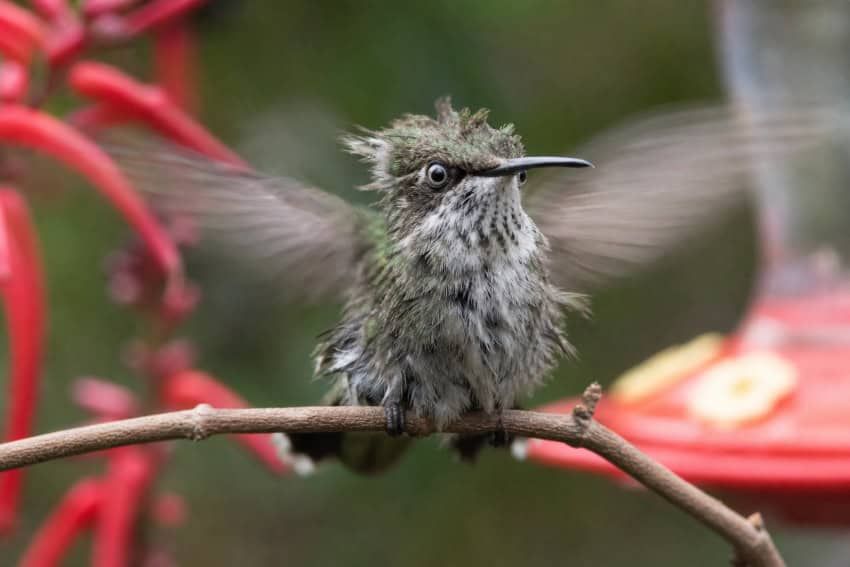
Health Ministry declares hummingbirds' sugar-heavy diet a 'public health emergency'
Mexico's Health Ministry issued an unprecedented public advisory Tuesday condemning what officials termed "a reckless, sugar-fueled epidemic" affecting hummingbirds across the nation's backyards, gardens and hanging feeders. The birds' nectar-heavy diet places them at risk for what the ministry describes as "a lifetime of poor nutritional choices."
When informed that hummingbirds evolved over 42 million years to metabolize nectar at extraordinary rates, Dr. Elena Paloma, chair of the advisory panel, dismissed the information as "exactly the kind of outdated thinking we've been trying to overcome."
The 312-page report, titled "Hummingbirds: The Hidden Dangers of Nectar Dependency," notes that hummingbirds derive nearly 99 percent of their daily calories from sugar water and flower nectar while consuming "woefully inadequate amounts of kale, quinoa and lean poultry."
"We're done pretending this is 'nature' and not a public health emergency," the report states.
Extreme metabolic demands fuel constant feeding
Hummingbirds consume up to 80 percent of their body weight in nectar daily, feeding every 10 to 15 minutes during daylight hours to sustain their extreme metabolic rate. Scientists have documented that these birds possess a unique ability among vertebrates to burn both glucose and fructose equally well for energy, allowing them to oxidize dietary sugars in real time to power their hovering flight.
Mexico is home to approximately 50 to 57 hummingbird species, with up to 13 species found nowhere else on Earth, making the country one of the world's most important hummingbird habitats.
The Health Ministry report expresses particular alarm that a hummingbird's heart can beat up to 1,200 times per minute. Officials attribute this not to one of nature's most extraordinary metabolic adaptations, but to "an all-carb diet finally catching up to them." The birds possess hearts that account for up to 2.5 percent of their total body weight — the largest heart-to-body-size ratio in the animal kingdom — compared to just 0.3 percent in humans.
What the report does not mention is that hummingbirds enter a state called torpor at night, during which their heart rate drops to as low as 50 beats per minute and their metabolism slows by up to 95 percent to conserve energy.
Scientific pushback and field trial failures
Environmental groups expressed concern that the report unfairly stigmatizes hummingbirds. "They flap their wings up to 80 times a second," said one ornithologist. "By lunchtime, they've burned enough calories to power a small drone."
The advisory acknowledges this extraordinary energy expenditure but maintains that "exercise alone cannot compensate for poor dietary habits," citing studies of office workers who occasionally use the stairs.
Recommended interventions include mandatory nutrition labels on nectar listing "added sugars" in bold red letters, a national campaign urging Mexicans to fill feeders with a "more balanced" ratio of sugar water mixed with electrolytes and vitamins, and warning labels on flowers reading, "This bloom may contribute to excessive wing-flapping."
Early field trials have yielded mixed results. "We filled our feeder with cucumber-infused electrolyte water," said one volunteer. "The hummingbirds looked at it for about three seconds and then flew across the street to our neighbor's house."
Several violet-crowned hummingbirds observed near a patch of trumpet vine declined to comment, choosing instead to hover silently before accelerating from zero to 30 miles per hour in approximately half a heartbeat.
Industry response and future targets
Manufacturers of hummingbird feeders have pledged to cooperate by adding warning labels that read: "Warning: Frequent consumption of sugar water may contribute to rapid wing movement, hyperactivity and an irresistible attraction to brightly colored tubular flowers."
The Health Ministry announced its next report will examine the dependence of monarch butterflies on milkweed, ocelots on tropical rodents and jaguars on peccaries, warning that "dietary diversity is essential, even when evolution strongly suggests otherwise."
Hummingbirds evolved the ability to taste sweetness through mutations in genes that originally allowed other birds to taste savory, protein-rich foods — an evolutionary innovation that makes it easier for them to assess the sugar content of flower nectar. There are currently 338 recognized hummingbird species worldwide, all found exclusively in the Western Hemisphere, with nearly half living within 10 degrees of the equator.