Another season of funding
The barrier was scheduled to come down this fall when funding for the structure and hauling collected trash to a local landfill ran out. Instead, the California State Water Resources Control Board approved up to $2 million on July 21, 2026, to support operation and maintenance through the 2026-2027 storm season.
The allocation, authorized by Resolution No. 2026-0026, comes from the board's Cleanup and Abatement Account and brings total state support to $6.7 million. The board said the project could not have continued without the additional funding.
Installed in 2024, the system began as a two-season pilot supported by a $4.7 million state general fund grant authorized under 2021 California Senate Bill 170. The Sacramento-based nonprofit Rural Community Assistance Corporation helps oversee it alongside Alter Terra, the binational environmental nonprofit founded by the barrier's designer, Oscar Romo.
The extension comes ahead of a "super" El Niño likely to bring heavy rain this winter. El Niño increases storm exposure in Southern California and Baja California, though it does not guarantee a wet, stormy season. The region has already experienced wetter weather and damaging high surf, with conditions expected to persist into early next year, according to the National Oceanic and Atmospheric Administration.
"We're nervous," Romo said. "Obviously, the valley requires maintenance and that hasn't been done. This would be a big test for the structure."
What the barrier can hold
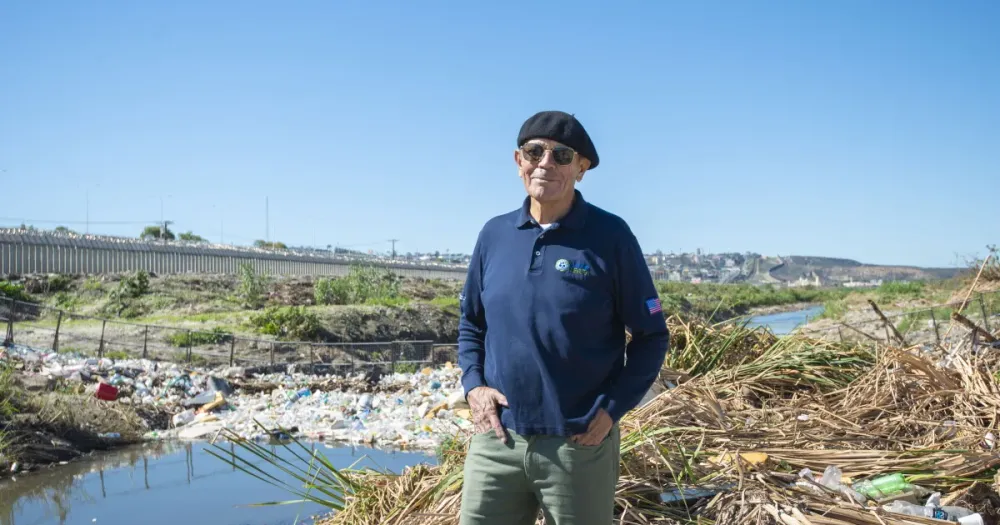
About a quarter mile north of the border, the horseshoe-shaped boom corrals debris in the Tijuana River canal before it reaches agricultural fields, equestrian trails, riparian habitat and a coastal estuary supporting hundreds of native and migratory birds.
"We have what I call the first line of defense," Romo said. He described a system stretching 1,000 feet from anchor to anchor, with linked shells made from ground high-density plastic recovered in Tijuana.
According to the Rural Community Assistance Corporation, the boom was engineered for a river that can shift from dry conditions to storm flows of up to 23,000 cubic feet per second. Its supports include 360 feet of anchor lines, a galvanized steel cable and 150 rigging attachments. The recycled plastic used in its construction was salvaged south of the San Diego-Tijuana border.
The 2,000 tons caught over the past two years weigh roughly as much as 1,000 cars. Romo said the system was designed to capture 4,500 tons annually and predicted that El Niño-driven storms would probably bring it to that capacity.
Rain in October left about 50 tons of trash behind the barrier. Among the debris Romo identified were a car's gas tank, refrigerators, a water heater, mattresses, furniture and demolition material. He said burned wood had washed in from illegal dumpsites.
A preliminary analysis by the Rural Community Assistance Corporation illustrates how the debris differs by size and weight. Plastic bottles accounted for 41% of the collected trash by volume, and Styrofoam accounted for 25%. By weight, organic trimmings made up 38% and lumber 18%.
Trash sources beyond the canal
Sewage is the most widely recognized part of the Tijuana River pollution crisis, but solid waste also reaches the valley and ocean. Tijuana produces about 2,000 tons of trash daily, and some enters the channel directly, said Sara González, co-founder of Proyecto Socioambiental del Río Tijuana.
González attributed that flow to long-standing systemic problems in Mexico. She said people have built homes on hillsides where the city does not provide waste collection because the settlements are not legally registered. She also discussed the lack of affordable housing policies in connection with informal settlement and illegal dumping downhill.
More than a thousand illegal dumpsites have been identified in Tijuana's canyons, many with direct paths into the river, according to the Rural Community Assistance Corporation. The river drains a binational watershed covering 1,750 square miles. The state water board says elevated bacteria levels regularly lead to beach closures reaching as far north as Coronado.
Beyond the boom project, the state board opened applications in June 2026 for $46 million in Proposition 4 grants to address transboundary pollution in the Tijuana River and the New River in Calexico. That separate application period ended August 31, 2026.
Storm preparations and a new prototype
Tijuana and Baja California leaders have announced plans to expand waste collection routes and clear sections of the river channel before winter storms. On the U.S. side, the International Boundary and Water Commission has cleared vegetation and repaired erosion damage.
Romo nevertheless warned that decades of accumulated trash remain embedded in the valley, where storms could dislodge it. He also described the landscape's resilience: vegetation removed three weeks earlier had already grown six or seven feet tall.
Romo and partner agencies are developing a more hydrodynamic trash boom prototype. For the coming El Niño season, he hopes the existing system will play a pivotal role.