One park, markedly different reef conditions
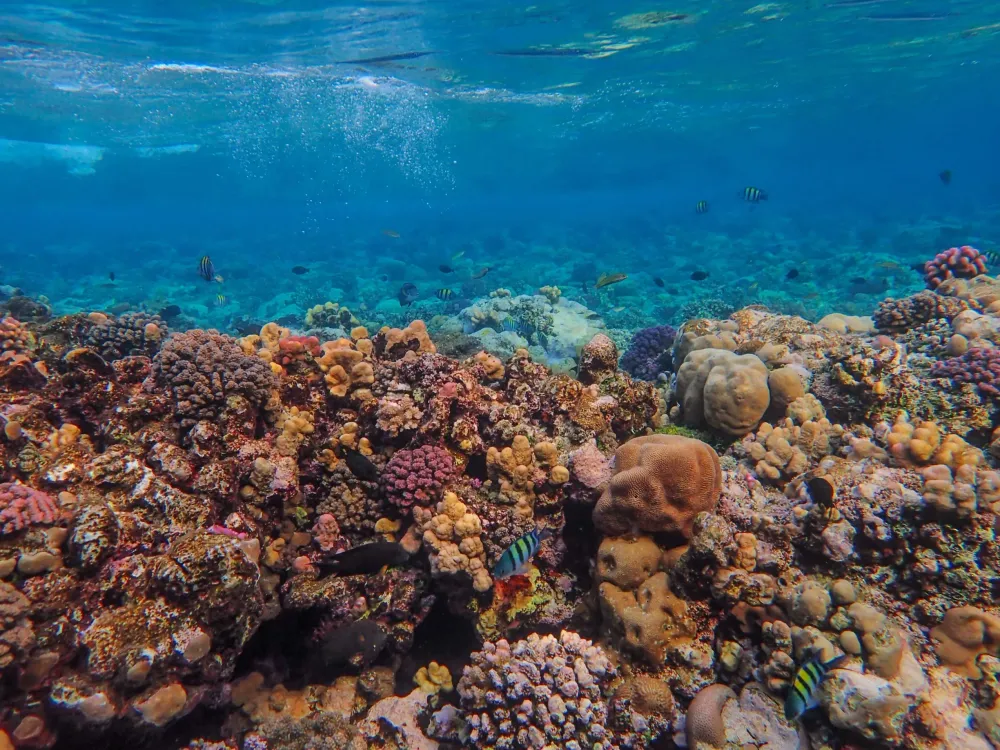
Limones accounted for the survey's highest coral cover. At this shallow back-reef site, 2 meters (7 feet) deep, hard coral covered an average of 18.5% of the bottom in the dry season, 24.33% in the rainy season and 16.5% during the cold-front season. Across the other three back-reef sites, seasonal means were just 0.22% to 1.06%.
The four fore-reef sites also differed. Seasonal mean hard coral cover ranged from 0.84% to 3.11% at Bonanza, 1.39% to 2.89% at Jardines Profundo, 2.94% to 6.22% at Tanchacté Profundo and 4.00% to 6.39% at La Pared.
For regional context, the Global Coral Reef Monitoring Network's 2025 Caribbean chapter reports median hard coral cover of 11.0% in 2020 to 2024, compared with 19.5% in 1980 to 2009. Limones was the only site in the new survey above the recent regional median. Differences in methods prevent a direct comparison.
Algae covered much of the surveyed bottom, but the dominant groups varied. At Jardines Profundo, turf algae mixed with sediment reached 45.83% cover in the dry season, while fleshy macroalgae reached 50.06% in the rainy season. Other recorded peaks were 26.78% for calcareous macroalgae at Bonanza and 29.22% for cyanobacteria at Tanchacté Somero, both during the rains. Crustose coralline algae reached their highest cover, 8.11%, at Picuda Norte in the cold-front season.
Seasonal change was a shift among groups
The statistical analysis detected seasonal differences in benthic composition, meaning the mix of organisms covering the bottom (PERMANOVA R² = 0.081, p = 0.045). Those seasonal patterns also differed between the back reef and fore reef (zone-by-season R² = 0.105, p = 0.016). Reef zone on its own did not significantly distinguish the communities (p = 0.232).
The seasonal and zone-by-season terms each accounted for roughly a tenth of the variation. The seasonal result was also close to the conventional p = 0.05 significance threshold, indicating a modest pattern rather than a sweeping seasonal division.
These changes did not amount to every algal group increasing together. Turf-sediment cover had negative model coefficients in both the rainy season, −0.62 (95% credible interval −0.89 to −0.35), and the cold-front season, −0.56 (−0.85 to −0.27). Fleshy and calcareous macroalgae were higher in both seasons. At Bonanza, for example, turf-sediment cover dropped from 37.45% during the dry season to 8.33% during the rains.
What the fish associations do, and do not, show
Herbivore assemblages varied among individual sites without a consistent seasonal or reef-zone pattern. When researchers examined their relationship with the overall seafloor composition using a constrained ordination, excavator parrotfish were the only group with a statistically significant association. The group comprised Scarus coelestinus, S. vetula and Sparisoma viride, and its envfit R² was 0.222 (p = 0.003).
Separate Bayesian models, which included site as a random effect, identified five associations with individual bottom-cover categories whose 95% credible intervals excluded zero. Three were negative: browser parrotfish with turf-sediment cover, −0.17 (−0.30 to −0.04); Echinometra sea urchins with calcareous macroalgae, −0.39 (−0.71 to −0.08); and Diadema antillarum with fleshy macroalgae, −0.24 (−0.45 to −0.02).
Two associations with fleshy macroalgae were positive: +0.16 (0.03 to 0.28) for excavator parrotfish and +0.12 (0.01 to 0.23) for browser parrotfish. None of the herbivore associations with crustose coralline algae or cyanobacteria had credible intervals excluding zero.
The authors caution that the positive associations do not establish that fish promote macroalgae. Nor do the negative associations demonstrate how much algae herbivores removed. The survey counted animals but did not record fish sizes, feeding rates or herbivore biomass, and abundance alone does not measure grazing intensity.
Other research has likewise questioned the use of total parrotfish numbers as a stand-in for their ecological effects. In a 2025 commentary, UNAM researchers Lorenzo Álvarez-Filip and Ana Lilia Molina Hernández argued that management has often treated parrotfish species as equivalent algae consumers. They noted that rising parrotfish numbers in Bonaire and Belize have not always coincided with less algal growth or greater coral cover.
A PLOS ONE study at Alacranes Reef found that estimated macroalgae consumption depended largely on medium-sized species, including Sparisoma aurofrenatum, rather than tracking total parrotfish biomass directly.
How the survey was conducted
Researchers from the National Autonomous University of Mexico, known as UNAM, sampled Parque Nacional Arrecife de Puerto Morelos during the three seasons of 2024. The paper defines the dry season as March through May, the rainy season as June through October, and the cold-front season, or "nortes," as November through February. It does not provide exact field dates.
The back-reef sites were Limones, Tanchacté Somero, Picuda Norte and La Bocana, at depths of 2 to 5 meters (7 to 16 feet). The fore-reef sites were Bonanza, Tanchacté Profundo, Jardines Profundo and La Pared, at 7 to 8 meters (23 to 26 feet).
At every site in each season, researchers filmed three 50-meter (164-foot) transects, for a total of 72. They held a GoPro approximately 40 centimeters (15.7 inches) above the bottom and classified 600 points per transect into six categories: hard coral, crustose coralline algae, turf algae mixed with sediment, cyanobacteria, calcareous macroalgae and fleshy macroalgae. Daytime counts of fish and sea urchins used belts measuring 50 by 2 meters (164 by 7 feet), an area of 100 square meters (1,076 square feet).
The study, "Linking benthic dynamics and herbivore assemblages across a chronically disturbed Caribbean reef," was written by Ángela Randazzo-Eisemann and Brenda B. Hermosillo-Núñez of UNAM's reef systems unit in Puerto Morelos, and David Arturo Ortega-Vargas of its Zaragoza faculty in Mexico City. UNAM's Institute of Marine Sciences and Limnology provided all fieldwork funding. The authors reported no conflicts of interest.
Heatwave evidence requires separate comparisons
The Frontiers survey covers only eight sites over one annual cycle, leaving the persistence of its patterns unknown. Without a direct pre-2023 baseline, it cannot attribute the observed communities to the 2023 bleaching event. The authors explicitly warn against interpreting them as that event's direct outcome. They also did not collect environmental measurements alongside the surveys, and daytime sampling may have undercounted sea urchins.
Separate research documents severe heatwave losses within a defined shallow-reef area at Puerto Morelos. A peer-reviewed drone-imaging study by UNAM's Lara Virginia Birkart and Lorenzo Álvarez-Filip, published October 9, 2025, in iScience, attributed 100% mortality of elkhorn coral, Acropora palmata, across roughly 170,000 square meters to the 2023 marine heatwave. About 57% had died by August 2023. Imaging detected no living A. palmata tissue by July 2024, a finding confirmed in the field in September 2024.
That study area accumulated 14.29°C-weeks of heat stress. The authors estimated that nearly 70% of reef crests across the Greater Caribbean experienced at least that much thermal stress in 2023.
The same iScience study described a different outcome at Limones, about 16 kilometers northeast of Puerto Morelos. There, a major share of the sexually mature A. palmata population survived despite satellite-derived heat stress above 14°C-weeks. The authors proposed two possible explanations: association with the heat-tolerant symbiont Durusdinium trenchii, or differences between satellite estimates and in-situ temperatures. They said the reason remains unknown.
Limones had previously been described as a coral refuge. A 2023 PLOS ONE paper by UNAM and Yucatán Center for Scientific Research researchers reported more than 30% coral cover and an abundant, healthy elkhorn population there. Although the new survey's figures are lower, the methods are not directly comparable. The Frontiers study also combines all hard corals into one category rather than reporting elkhorn separately.
A Research Square preprint by Álvarez-Filip and colleagues provides broader local heatwave observations from 13 sites within about 40 kilometers (25 miles) of the Puerto Morelos fringing reef. It reports near-universal bleaching across taxa and sites in 2023, with acute mortality concentrated in Acropora and Millepora. That work has not been peer reviewed and is under review at Coral Reefs.
Regional decline and unmeasured local pressures
Regional indicators also show why a single measure can give an incomplete picture. The 2024 Mesoamerican Reef Health Report Card assessed 286 sites and recorded an improvement in the Reef Health Index from 2.3 in 2021 to 2.5 in 2023, on a five-point scale. Yet 62% of sites remained in poor or critical condition, and just 10% were good or very good. Coral cover fell from 19% to 17%, while about 40% of corals experienced severe bleaching in 2023. Melanie McField and Israel Muniz of Healthy Reefs for Healthy People presented the findings at the One Ocean Science Congress 2025.
A separate study by Chris Perry of the University of Exeter and Álvarez-Filip examined reef carbonate balances. As described in The Conversation on May 5, 2026, between 70% and 75% of the surveyed Caribbean sites shifted from net carbonate growth to net erosion after the 2023 marine heatwave and stony coral tissue loss disease. Some sites were losing as much as 8 kilograms of calcium carbonate per square meter annually, although most Gulf of Mexico sites remained net positive.
The Puerto Morelos Frontiers survey did not measure nutrients or address sewage or tourism in its text. A separate 2023 study using coral cores at La Bocana found that average nitrogen isotope values in skeletal organic matter rose from 3.90‰ for 1972 to 1992 to 4.40‰ for 1993 to 2012. Its authors linked the increase to sewage associated with coastal development. With samples from three colonies at one reef and a correlational design, however, that study does not establish sewage as the cause.
Coastal protection, insurance and the next measurements
Puerto Morelos had 19,202 residents in 2020 and an economy driven by tourism. Its reef park received National Marine Park status in 1998. The Frontiers authors note that reef shape strongly affects how waves change as they approach the coast, influencing coastal protection. Losses of framework-building corals and structural complexity can also reduce carbonate production, though their survey did not measure that process.
The Nature Conservancy says reefs dissipate more than 90% of storm wave energy and estimates that reef degradation could triple storm losses to infrastructure.
Reef repair is one purpose of insurance funded through hotel taxes. Quintana Roo's Coastal Zone Management Trust purchases parametric coverage, which pays when hurricane winds meet a specified threshold. Hurricane Delta triggered approximately US$850,000 in 2020. According to SECORE, nearly US$800,000 went to nonprofits repairing reefs in four zones, including Puerto Morelos.
In July 2026, the Mesoamerican Reef Fund announced that Arrecife de Puerto Morelos National Park and Arrecifes de Cozumel National Park had joined its MAR Insurance Programme for its sixth annual placement. The program now insures 12 protected areas. Its 2026–2027 policy runs from June 1, 2026, through May 31, 2027; the Mexican Fund for the Conservation of Nature finances premiums for the two new Mexican sites through the Green Climate Fund's ACCIÓN project.
For the survey authors, the variation within Puerto Morelos shows that decades of disturbance have not left every site in the same benthic condition. It does not demonstrate resilience: much of the park still has little coral and extensive turf and macroalgal cover, and the study did not test recovery capacity.
They recommend sampling multiple locations across seasons and distinguishing herbivores by function, including scraping, excavation and browsing. Future monitoring should pair animal abundance and size structure with direct measurements of grazing and browsing, while also collecting information on benthic resources, sediment loads and environmental conditions.