Intercepting seaweed before it reaches shore
Mexico's federal government reported that crews had removed more than 123,400 metric tons of sargassum in Quintana Roo by September 8, 2026. According to Excélsior, that was the state's highest recorded total, surpassing the 92,782 metric tons collected during all of 2025 by more than 30,000 metric tons.
The Navy, known as Semar, is shifting the emphasis away from a response long centered on daily beach cleanup by hotel employees, municipal workers and specialized machinery. With those shoreline efforts unable to keep pace with the influx, the federal strategy gives priority to collecting the brown macroalgae before it enters shallow coastal waters.
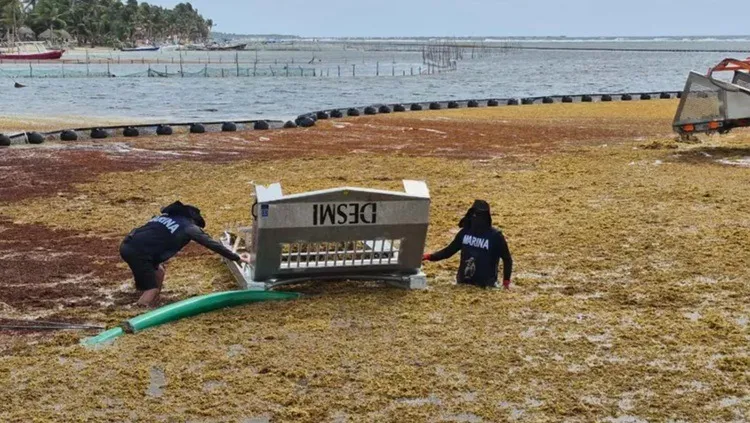
The ARM Natans and other equipped vessels collect seaweed offshore, while floating barriers trap and divert mats along coastal corridors including Cancún, Playa del Carmen, Tulum and Cozumel. Satellite observations and weather forecasts help commanders assess currents, winds and offshore seaweed concentrations, anticipate arrivals and position collection crews.
Fleet expansion extends into 2027
The deployment reported on September 8 included one ocean-going collection ship and 11 coastal vessels, each able to collect 20 metric tons. The Navy also had two amphibious collectors, 18 smaller boats and 13,230 meters of containment barriers in place.
Further capacity was still pending. As of September, the Navy was fitting out its second ocean-going sargassum ship, the Sargassum. The Navy said bringing it into service would increase total offshore collection capacity from 627 to 1,227 metric tons per day.
A separate expansion announced that month calls for 15 new vessels—seven coastal, six semi-oceanic and two oceanic ships—plus three dynamic barriers. The six semi-oceanic vessels are scheduled to begin joining the fleet between late 2026 and early 2027; the two oceanic ships are expected by mid-2027.
Federal investment and coastal pressures
President Claudia Sheinbaum presented the broader federal containment and management strategy on July 30, 2026, announcing an investment of 2,635.6 million pesos. The Navy, Quintana Roo's state government, Semarnat, Fonatur and the hotel sector are to carry it out, with new equipment concentrated along five coastal stretches: Cancún, Playa del Carmen, Puerto Morelos, Tulum and Mahahual.
Environmental scientists and economic analysts identify risks to both marine ecosystems and the region's multibillion-dollar tourism economy. Seaweed decomposing in large shoreline accumulations releases hydrogen sulfide, reduces oxygen in coastal waters and discourages international visitors.
The sargassum crisis in 2026 coincided with a sharp tourism decline in Tulum. Hotel occupancy dropped from 63% in the first week of August 2025 to 48% in October. Business groups cited by the Associated Press also estimated a 30% decline in Quintana Roo sales during the first half of 2026.
Research and plans for the collected biomass
The federal strategy also provides for sending collected seaweed to four sites for drying and pretreatment before production of biofertilizer, biochar and biogas. About 150 scientists are working with Semarnat and the Ministry of Science to investigate the unusually large 2026 volume and identify commercially viable uses. Researchers are also studying the climatic and nutrient-related drivers of the annual blooms.
Regional coordination was the focus of the fourth EU-Caribbean Global Gateway Conference on Sargassum, hosted by Cancún on October 1 and 2, 2026. The European Union financed the meeting, which was expected to bring together Caribbean countries and delegations from Brazil and Japan to coordinate containment efforts and develop uses for the collected seaweed.