Navy cleanup continues after the season's official end
The Secretariat of the Navy, known as Semar, announced its total on Nov. 23 during work by the Intersecretarial Commission for the Sustainable Management of Seas and Coasts (CIMARES). The Fifth Naval Region oversees the Navy's Sargassum Response Strategy, which combines offshore collection, aerial surveillance and beach cleanup to limit the seaweed's impact on ecosystems and tourism.
The Navy's tally is separate from the statewide collection figures released by Quintana Roo's Ministry of Ecology and Environment (SEMA). According to Mexico News Daily, SEMA recorded 156,631 metric tons in 2026, nearly twice the roughly 85,000 metric tons reported in 2025. The agency placed the official end of the Mexican Caribbean's 2026 season in early November, about a month later than the previous year.
Much of the collection took place away from the open ocean. Esteban Amaro, director of Quintana Roo's Sargassum Monitoring Center, estimated in November that open-ocean removal accounted for only about 16.4%, or 25,751 metric tons, of the Mexican Caribbean's 2026 total.
Amaro also reported that sargassum at its Northwest African source had increased by 10% to 15% from 2025, rising from about 900,000 metric tons to 1 million. He said 1% to 5% of that source volume reaches Mexico.
Tracking and intercepting seaweed
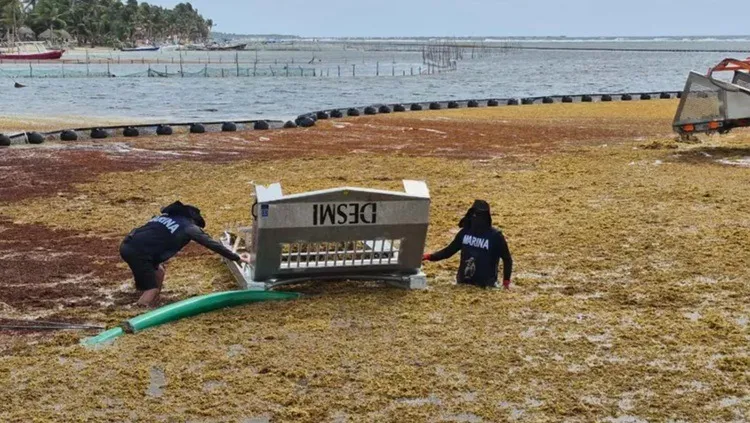
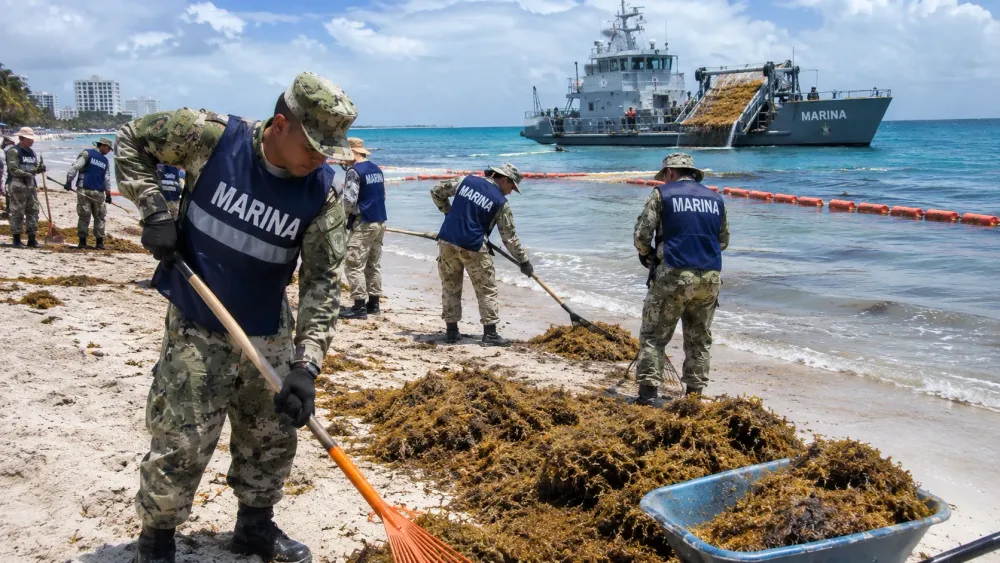
Naval crews are conducting surveillance, containment and collection around Isla Mujeres, Cancún, Puerto Morelos, Playa del Carmen, Puerto Aventuras, Tulum and Mahahual. Their equipment includes coastal and ocean-going collection vessels, amphibious sargassum boats and smaller craft. Drones locate coastal concentrations so crews can prioritize removal, supplementing patrols on the water.
The Navy's installed containment barriers now extend 13,635 meters, or more than 13.6 kilometers, along the coast. They intercept some sargassum before it reaches the sand, but shifting sea conditions require ongoing monitoring. Crews inspect the barriers underwater, repair them and adjust their configuration. The collection vessels and other containment equipment also receive preventive and corrective maintenance.
An earlier snapshot from Reuters shows the deployment as of late July 2026: 11 specialized coastal ships, one amphibious sargassum collector, 18 support boats, two barges and four drones. At that time, the Navy had installed more than 9,000 meters of barriers.
The strategy has an allocation of 2,600 million pesos, according to its Quintana Roo coordinator, Rear Admiral Topiltzin Tlacaelel Flores Jaramillo. In remarks reported by La Jornada Maya on Nov. 18, he said the funding covers personnel deployment, administrative permits for infrastructure and containment-barrier purchases guided by technical studies of currents.
Collection on shore
Civilians participate mainly through beach cleanup campaigns, while Emergency Beach Collection Groups (GREP) work with naval units to remove seaweed that reaches shore.
Among the local campaigns cited by the Navy were collections of approximately 20 tons at Playa Ventana al Mar in Puerto Morelos and another 39.69 tons elsewhere in that municipality. Crews also removed 25 tons at Playa Tam in Mahahual and 25 tons in Xcalak, in the municipality of Othón P. Blanco. Those amounts describe individual locations and campaigns, rather than separate coastwide totals.
Semar says its continuing operations across Quintana Roo fall under Mexico's National Policy for the Sustainable Management of Seas and Coasts.
Environmental risks and cleanup costs
The expense extends beyond the Navy's operation. Reuters reported in July that Governor Mara Lezama put Quintana Roo's annual sargassum-management cost at roughly 11% of state GDP, or about $2 billion. The Riviera Maya hotel association separately estimated that combating the seaweed costs roughly $150 million a year.
Marine scientists cited by Reuters warn that decomposing sargassum blocks sunlight from reaching underwater plants, reducing biodiversity, and can release arsenic and other heavy metals into beach sand. A 2025 study cited in the report also described itchy and burning skin, headaches, fatigue and nausea linked to the algae among workers who shoveled it from beaches.
Offshore barrier proposal faces further review
Agencies warned in November that the region could receive even more sargassum in 2027, depending on conditions including a "Super El Niño" and changes in Atlantic Ocean hydrodynamics, according to Mexico News Daily.
Quintana Roo's government aims to install an offshore barrier called GO 60 by 60 between Cozumel Island and Tulum. The proposal calls for six 10-kilometer sections positioned 60 kilometers offshore at a 60-degree northeast orientation. Before it can proceed, the project needs further analysis of strong currents in the Cozumel Channel and potential effects on marine life.