Nuclear dialogue, but no arms-reduction negotiations
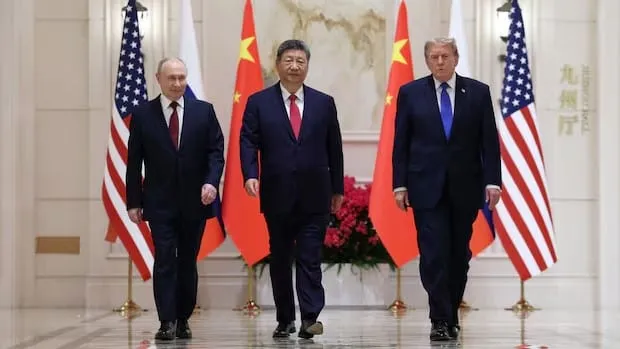
The declaration commits China, the United States and Russia to discussions aimed at lowering nuclear risks and preventing the spread of nuclear weapons. In the version released by the White House, the leaders also reaffirmed that a nuclear war cannot be won and must never be fought.
That commitment did not extend to negotiations on a three-country nuclear arms reduction treaty, Reuters reported. Trump has advocated such a treaty since his first term. China has consistently rejected the proposal because its arsenal is much smaller than those of the United States and Russia, and Beijing has long maintained that those two countries must reduce their stockpiles first.
Daryl Kimball, executive director of the US-based Arms Control Association, welcomed the reaffirmation as "positive" but said it was insufficient. "We need much more than rhetoric. We need action on disarmament diplomacy," he told Reuters.
The leaders also agreed to pursue UN reform to make the organization more effective in addressing global challenges and fulfilling its peace and security mission. On energy, they outlined plans to expand refined petroleum production and supplies for all nations while emphasizing the need for stable energy flows.
Court provisions draw scrutiny
The declaration places particular emphasis on state consent and officials' immunity, saying the International Criminal Court and comparable bodies "must not abuse their jurisdiction". Putin faces an ICC arrest warrant, and Trump's administration has pledged to dismantle the court "brick by brick".
Jonathan Eyal, international director at London's Royal United Services Institute, identified those provisions as especially significant. "The pushback against international norms and courts is the most interesting aspect," he told Reuters. "The big powers dictate, the small powers suffer." He also described Putin as a winner from the summit who "gained credibility and escape from pariah status".
The gathering raised concerns among smaller countries about exclusion from decisions affecting their interests, including the possibility that the three powers could discuss Ukraine's future without Kyiv or European governments.
European allies gathered in Berlin on Thursday to demonstrate support for Ukraine, Reuters reported. German Chancellor Friedrich Merz told reporters: "A Yalta format will not bring peace. The United States know without us there will not be peace."
Putin rejected comparisons with the 1945 Yalta Conference at his post-summit news conference. Rather than dividing the world into spheres of influence, he said, Yalta had "codified the existing reality". He added: "In today's conflicts, too, we will have to come to terms with the realities on the ground," according to Reuters.
Disputes remain over Ukraine, Iran and technology
Despite their joint commitments, the leaders remain divided over Ukraine, Iran, nuclear weapons and trade. Putin said they shared interests in resolving regional conflicts, including the war in Ukraine. Xi did not directly mention Ukraine or Iran, instead urging parties to conflicts to seek political and diplomatic settlements.
Trump said he and Xi strongly supported keeping oil moving through the Strait of Hormuz, where the war involving Iran has disrupted flows.
The Trump-Xi talks followed an extension of the two countries' trade truce earlier in November. At the same time, reports that Nvidia chips were reaching China through Southeast Asia were adding to tensions and raising questions about US export restrictions and China's future access to advanced technology.
Bilateral talks alongside the three-way meeting
The leaders' closed-door session at Kylin Villa ran for one hour and 20 minutes. It followed a series of bilateral meetings: Trump met Putin earlier on Thursday for the first time since August 2025 and called him his "friend", then met Xi for their third one-on-one discussion this year. Xi and Putin had held their own talks on Wednesday, their 50th meeting, according to Xi.
The venue is a state-owned resort beside Xili Lake in Shenzhen's Nanshan District. CNBC TV18 reported that it covers about 380,000 square meters and opened in June 1997 to accommodate senior Chinese officials traveling to Hong Kong for the handover. Its five main villas have French, Italian, Spanish, Hawaiian and American designs.
The three-way talks took place alongside the Asia-Pacific Economic Cooperation summit. China is hosting the APEC Economic Leaders' Meeting for the third time, following Shanghai in 2001 and Beijing in 2014, according to a Xinhua explainer. This year's theme is "Building an Asia-Pacific Community to Prosper Together", with openness, innovation and cooperation as its priorities.
Shenzhen's trade with other APEC economies totaled 3.23 trillion yuan, or about $484.2 billion, in the first three quarters of 2026. That represented a 40% increase from a year earlier and the highest total among mainland Chinese cities, CGTN reported, citing Shenzhen Customs.
Working-level coordination and a possible G20 reunion
Chinese Foreign Minister Wang Yi said officials from the three countries would continue coordinating after the summit. According to Reuters, he said the leaders had explained their strategic intentions directly to one another and established a "new paradigm" for relations among the powers.
Another meeting could follow within weeks. Trump is expected to host the Group of 20 summit at his Florida golf resort and meet Xi there, Reuters reported. Putin said he had discussed attending with Trump and would consider it, but his decision would depend on the situation in Russia.