California race draws a warmer response
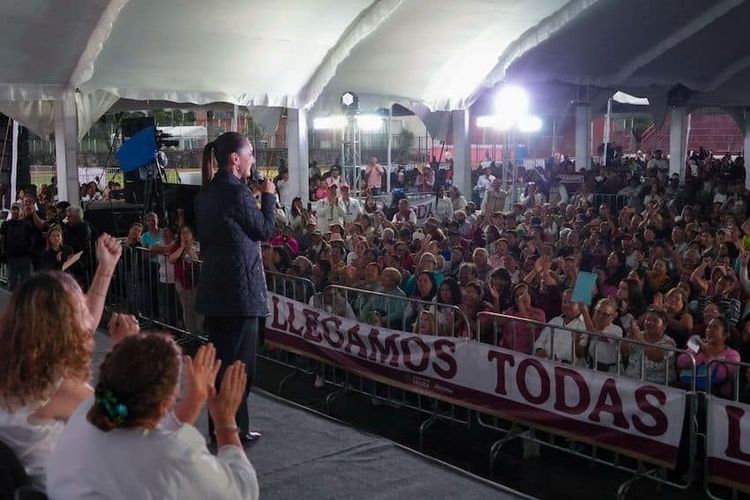
A reporter's question about the milestone a Becerra victory would represent prompted Sheinbaum to applaud. With about 39 million Mexicans and Mexican-Americans living in the United States, she said, it is "very good" for them to have political representation.
Becerra, the Democratic nominee, entered Election Day with a substantial polling advantage over Republican Steve Hilton, a British-born former Fox News host. A UC Berkeley Institute of Governmental Studies survey co-sponsored by the Los Angeles Times put Becerra at 61% among likely California voters and Hilton at 34%. Conducted Oct. 19-25, 2026, the poll showed a 27-point gap, slightly wider than the 25-point margin in the institute's September survey.
A victory would make Becerra the state's first popularly elected Latino governor, rather than its first Latino governor. Romualdo Pacheco held the office for about nine months in 1875 without having been popularly elected to it.
Becerra's career has included service in the state legislature and Congress, followed by posts as California attorney general and health and human services secretary in the Biden administration. Born in Sacramento in 1958, he is Mexican-American. His U.S. House biography says his father grew up in Tijuana and his mother in Guadalajara.
Congressional results and the trade talks
Sheinbaum offered no assessment when asked how Democratic control of both chambers of Congress might affect Mexico, particularly the USMCA trade agreement. "We don't express an opinion," she said. "The election is today. It's not our place to comment today."
She said Mexico would await the outcome: "We're going to wait for the result and we're going to respect the result whatever it is."
The congressional elections coincided with continuing U.S.-Mexico negotiations over trade disagreements. On July 1, 2026, the Trump administration declined to extend the USMCA for another 16-year term. That decision did not end the pact: Reuters reported that it remains in effect for another 10 years, with annual reviews before its expiration in 2036, unless the three countries agree to renew it with changes.
Reuters' July report said a third bilateral negotiating round with Mexico was scheduled for the week of July 20. In the two preceding rounds, Washington had sought a requirement that North American-built vehicles contain 50% U.S. content, which would raise the regional total to 82%.
Writing in The Hill last month, Duncan Wood and Ivan Zapien described two possible implications of the midterms: they "could give Mexico more allies in Washington who value a stable North American partnership," but "could also give its critics more platforms from which to demand change."
A separate question concerned "seven or eight Mexicans" accused of voting in the midterms without U.S. citizenship. Sheinbaum said she did not know about the charges and directed the question to Foreign Affairs Minister Roberto Velasco for further information.
Texas island claim meets a treaty objection
On the border dispute, Sheinbaum said the International Boundary and Water Commission (IBWC), not the Texas government, must establish where the nine disputed islands lie relative to the international boundary. The commission administers U.S.-Mexico boundary and water treaties and resolves disagreements over their application.
Sheinbaum allowed for the possibility of divided ownership: "If it's half and half, it's half and half." She also said she believed Texas' determination that the islands were state property was motivated by the approaching midterm elections.
Texas Land Commissioner Dawn Buckingham announced the claim last week. According to The Texan, the nine islands together cover about 66 acres. The Texas General Land Office (GLO) surveyed 20 islands; it did not determine the other 11 to be part of Texas at that time.
Buckingham's Oct. 26 letter described an earlier request from U.S. Customs and Border Protection to review 28 Rio Grande islands whose ownership had been considered unclaimed or undetermined, EL PAÍS English reported. The letter said the GLO concluded it could access, clear and patrol them.
In her Oct. 26 letters to the Texas Department of Public Safety and the Texas Military Department, Buckingham said the GLO had "not been alerted to criminal activity on these … islands." She nevertheless cited a broader concern, writing that "previous experience has demonstrated the exploitation of border islands by cartels and smugglers."
Texas had taken a similar step in 2023, when the GLO declared the 170-acre Fronton Island in Starr County to be state land. EL PAÍS English reported that the Department of Public Safety and the National Guard subsequently cleared vegetation there during Operation Flat Top to disrupt criminal activity.
Mexico's Foreign Ministry challenged Texas' authority in an Oct. 30 statement, saying the international border "cannot be modified by a decision of a state government." It said treaty criteria define the boundary and identified the IBWC as the body empowered by both countries to apply those rules and determine which side each island falls on.
The ministry cited the Boundary Treaty signed Nov. 23, 1970, according to EL PAÍS English. The treaty places the boundary along the middle of the Rio Grande's normal channel. Under Article IV, any proposed work or action on the islands requires consideration and approval by both sections of the IBWC, the ministry said.