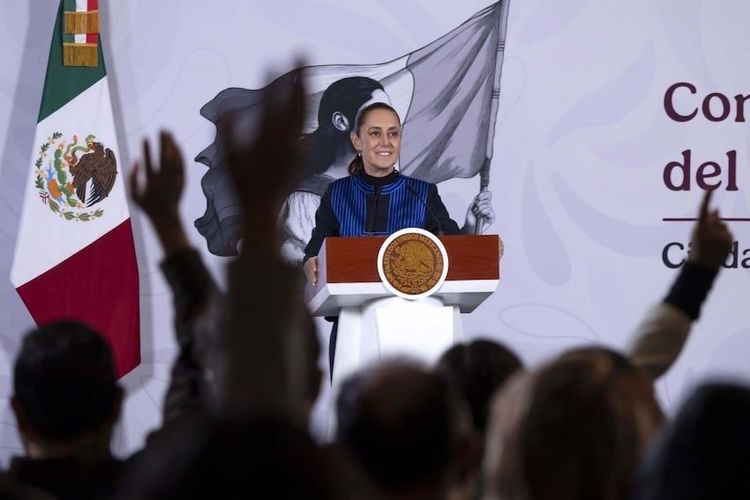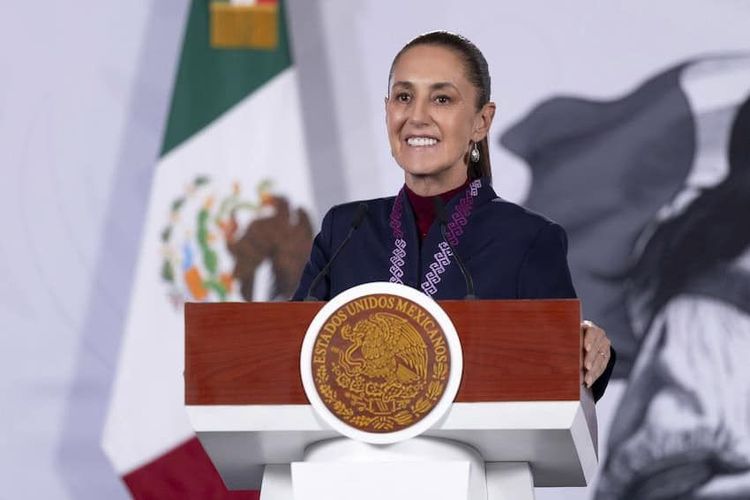
Sheinbaum rejects Milei's interference allegations
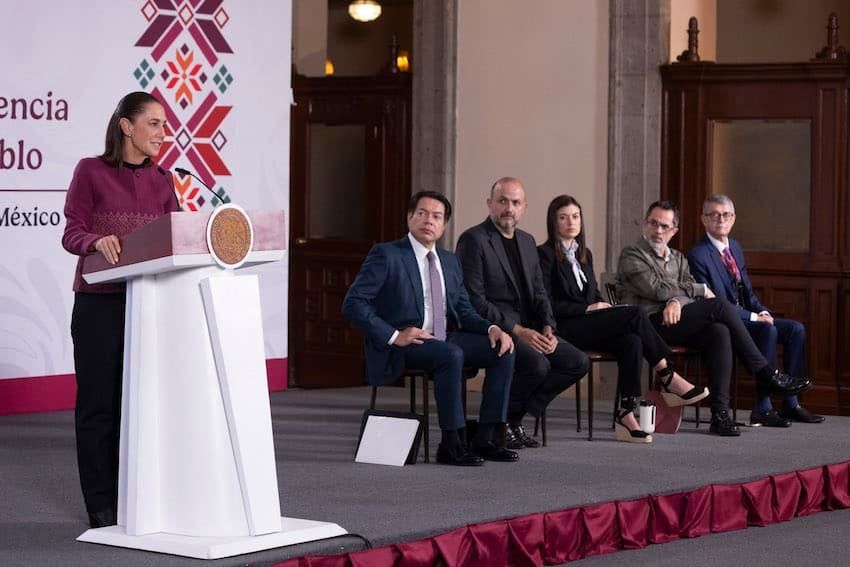
President Claudia Sheinbaum firmly rejected accusations Monday from Argentine President Javier Milei that Mexico had helped finance a campaign against his government, stating categorically that Mexico runs no campaigns against any country or government in the world.
Milei made the allegations Sunday on Buenos Aires-based Radio Mitre, claiming Mexico, Brazil and the U.S. Democratic Party had bankrolled what he called an "anti-Argentina campaign" aimed at undermining his administration ahead of elections. The Argentine president alleged Brazil funded 25% of the supposed operation and labeled Mexican and Democratic officials "progressive heads" seeking to derail his economic agenda.
The accusations came one day after Brazil recalled its ambassador from Buenos Aires following separate remarks by Milei at a São Paulo campaign event for Flavio Bolsonaro on July 25, where he called Brazilian President Luiz Inácio Lula da Silva a "convict" and "thief."
Sheinbaum's denial invoked Mexico's constitutional principle of self-determination in foreign affairs, enshrined in Article 89, Section 10 of the Mexican Constitution. This doctrine, derived from the Estrada Doctrine established in 1930, mandates non-intervention, self-determination and peaceful resolution of conflicts as core guidelines for Mexican foreign policy.
"If anything, here there is a campaign" against Mexico's own government from multiple fronts, Sheinbaum said, stressing that Mexico "doesn't tend to get involved with other countries."
The diplomatic tensions follow the April 2026 emergence of the "Hondurasgate" recordings—leaked audios in which Milei allegedly pledged $350,000 to fund a U.S.-based media campaign targeting leftist governments in Mexico, Colombia and Brazil. Forensic verification by Phonexia Voice Inspector confirmed the authenticity of those recordings, according to investigations by Diario Red and multiple international outlets.
Militarized school death prompts federal response
During Monday's morning press conference, Education Minister Mario Delgado addressed the death of 13-year-old Dafne Zapata Quintos Martínez, who entered the Academia Militarizada "Doenitz" summer camp in Tamaulipas on July 13 and died between July 16 and 17. Her death certificate classified the incident as homicide caused by asphyxia due to submersion.
Delgado reiterated that schools branded as "militarized" fall under neither Education Ministry (SEP) nor Defense Ministry (Defensa) jurisdiction, stating that military-style instruction in educational institutions is "incompatible with the constitutional aims, principles and objectives" governing Mexican education.
Authorities in Tamaulipas have identified five additional schools operating under similar models. An 18-year-old former student, Danna Yanina "N," was arrested July 23 in connection with the death. She had been serving as an assistant in the academy's female section at the time of the incident.
Delgado said he remains in contact with Tamaulipas state authorities and has attempted to reach Quintos's mother, Alejandra Quintos, directly.
President dismisses cartel threat video as fabricated
Sheinbaum declared that a video threatening Zacatecas Governor David Monreal is not authentic, saying federal Security Cabinet analysis determined the same day it surfaced that the audio track does not match the person shown speaking.
The roughly two-minute video, which began circulating July 21, shows nine masked, armed men posing behind a tenth who reads a message on camera. The speaker identifies the group as Los Mayos—a faction of the Sinaloa Cartel—and claims responsibility for killing ten people in Zacatecas on July 18.
The ten victims included an ex-mayor, public servants, businessmen, ranchers and a firefighter. Most died from asphyxiation or strangulation, with five bodies hung from a bridge near Pánuco. Zacatecas Attorney General Cristian Paul Camacho Osnaya stated that at least two victims were involved in a "circle of extortion," and investigators are examining 14 bank accounts possibly related to the crime.
"It's not a real video—the voice doesn't even match what the person is saying," Sheinbaum said, adding that federal authorities are investigating who produced and distributed the video and for what purpose.
The video's message asserted without evidence that the murders were carried out at the state government's request, then issued a direct threat against Monreal, warning him to "honor and respect the agreements his cabinet has with our organization" or face consequences extending to his family.
Zacatecas is a key transit corridor for drugs moving north to the U.S. border and has been the scene of bloody turf battles between the Jalisco New Generation Cartel (CJNG) and Sinaloa Cartel. The state has one of the highest per-capita homicide rates in Mexico.
Five suspects were arrested following the discovery of the bodies, according to state authorities. Sheinbaum said any evidence linking public officials to organized crime would be investigated under the law regardless of the video investigation's outcome.
Governor Monreal has not commented directly on the video but said separately that Zacatecas maintains permanent security operations involving the army, National Guard and state police.
Social media impact study presented
Sheinbaum also shared advances in her administration's investigation into the impact of social media and artificial intelligence on Mexican youth. Education Minister Delgado brought two experts—Lucía Magis Weinberg and Tania Jiménez García—to present findings on how excessive screen time and social media use affect young people's cognitive and emotional development.
"We are compiling this information so that it is available to parents, and so that, together, we make a series of decisions to protect children and adolescents during this formative stage of their lives," Sheinbaum said.
A recent survey indicated that 71% of parents consider it necessary for the government to regulate minors' cell phone use in schools.