From Mexico City to Manhattan's smart set
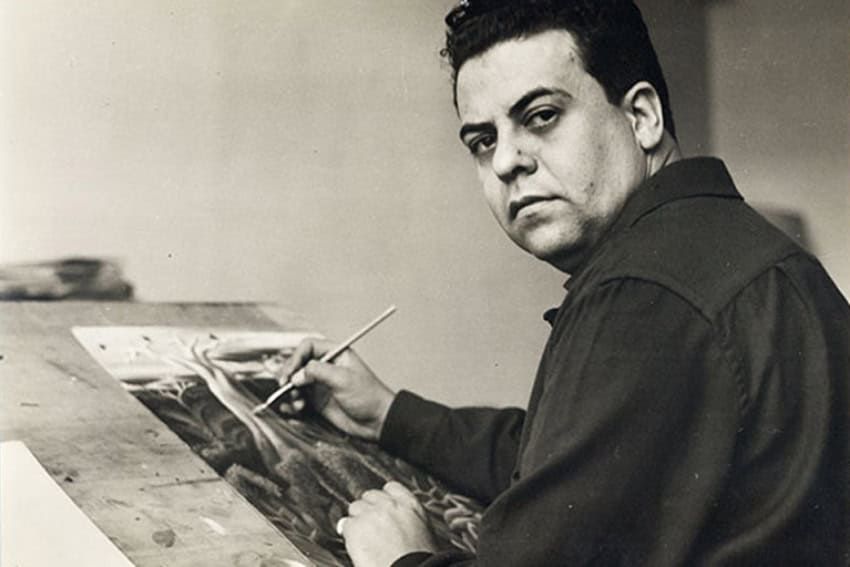
A 19-year-old Mexican artist who spoke almost no English arrived in New York in 1923. Within twelve months, Miguel Covarrubias Duclaud—known to everyone as "El Chamaco" or "The Kid"—had become one of Manhattan's most sought-after illustrators. By 21, he had published his first book of caricatures, "The Prince of Wales and Other Famous Americans." His subjects didn't just tolerate being drawn by him; in Jazz Age society, it became a mark of status.
Yet Covarrubias never stopped at illustration. Over three decades, he helped document the Harlem Renaissance for white audiences, co-discovered the Olmec civilization with American archaeologist Matthew W. Stirling, pioneered visual anthropology in Bali, and founded Mexico's national dance academy. Most people have never heard his name.
Born in 1904 to an intellectual Mexico City family—his mother brought French refinement, his father Mexican scientific curiosity—Covarrubias abandoned formal schooling at 14 and turned to drawing. By 16, he was creating political caricatures for major newspapers and government offices. Artists like Diego Rivera and José Clemente Orozco took notice, as did poet and diplomat José Juan Tablada, who secured him a government grant to study in New York.
The grant served Mexico's post-revolutionary soft power campaign: the new government needed to project stability and attract foreign investment. Covarrubias became an unexpected cultural ambassador.
In New York, critic Carl Van Vechten championed his entry into the cosmopolitan "smart set," introducing him to caricaturist Ralph Barton and, crucially, Frank Crowninshield, editor of Vanity Fair. The magazine, which reached circulation of 90,000 copies at its 1920s peak, published Covarrubias' first caricatures in January 1924. By March, he had a solo show at the Whitney Studio Club.
What distinguished his work wasn't just technical skill. His line blended Art Deco elegance with Cubist geometry and surgical social insight—streamlined forms and confident black washes that captured essence, not just likeness. He didn't merely draw the era's elite; he helped define how they were seen.
Visualizing Harlem for downtown audiences
The same eye that flattered the Rockefellers turned, remarkably early, toward Harlem. In December 1924, Covarrubias began illustrating African American artists, dancers and musicians for Vanity Fair—figures including Langston Hughes, Bessie Smith and Duke Ellington—not as caricature targets but as icons of modernity. Working with Afro-Caribbean writer Eric Walrond, he helped visualize the Harlem Renaissance for a downtown readership that would otherwise never have looked.
He wasn't free of his era's blind spots. But it took a Mexican artist—someone who understood what it meant to be flattened into stereotype—to bring Harlem's sophistication into a magazine built for old money. His outsider's vantage let him appreciate and gently challenge American racial dynamics simultaneously.
The Harlem Renaissance's heyday was cut short by the Stock Market Crash of 1929 and the Great Depression, which devastated African American-owned businesses and dried up financial support from patrons and foundations. Vanity Fair itself became a Depression casualty, merging with Vogue in March 1936.
The impossible interviews and prophetic satire
By the 1930s, Covarrubias was steering one of Vanity Fair's signature features: the "Impossible Interviews," pairing figures who could never plausibly meet—Clark Gable and the Prince of Wales, Mae West and Sigmund Freud—in imagined conversations scripted by humorist Corey Ford. It was satire with a velvet glove and, in hindsight, startlingly prophetic: a running joke about fame becoming untethered from achievement, decades before that became celebrity culture's defining condition.
Rosa Rolanda and lives in motion
In 1924, Covarrubias met Rosa Rolanda, an American dancer trained in photography by Edward Weston and Tina Modotti. They married in 1930. From then on, their lives moved in tandem across Europe, the Caribbean, Africa and eventually Bali, where Rosa's camera and Miguel's sketchbook became two instruments of the same project. Their Mexico City home later became a magnet for guests including Orson Welles, Georgia O'Keeffe, Luis Buñuel, Nelson Rockefeller, Henri Cartier-Bresson and Amelia Earhart.
The anthropologist who drew his way to understanding
Covarrubias didn't just want to draw other cultures—he wanted to understand them. Two Guggenheim Fellowships, in 1930 and 1942, funded the work. His 1937 book "Island of Bali" wove sketches, paintings, Rosa's photographs and genuine ethnographic text. It became a bestseller, helped ignite a "Bali craze" in American society, and is still cited as a foundational text in visual anthropology, mentioned alongside Margaret Mead and Gregory Bateson. Unlike many Western observers, Covarrubias didn't study from a distance. For him, drawing was conversation.
That same observational discipline, redirected homeward in the late 1930s, produced one of his most consequential contributions. Working alongside Alfonso Caso—"the father of Mexican archaeology"—and American colleague Matthew W. Stirling, Covarrubias helped identify the Olmec as Mesoamerica's foundational "mother culture." His training as an artist made the difference: he recognized recurring stylistic patterns across scattered artifacts before professional archaeologists had connected them. In 1942, Caso formally presented their findings on the "Olmec style" to the Mexican Society of Anthropology at a conference on the "Olmec problem" in Tuxtla Gutiérrez.
It's a small irony that a man dismissed by some as a mere illustrator ended up rewriting Mexican civilization's origin story because he was trained to notice recurring lines where others saw only unrelated fragments.
Mapping the Pacific and founding a dance academy
That pattern-recognition found monumental outlet in 1939, when Covarrubias painted six enormous murals—"The Pageant of the Pacific"—for the Golden Gate International Exposition in San Francisco. The murals mapped peoples, animals, trade routes and economies across the entire Pacific Rim, deliberately decentering Europe. It was cartography as argument: a world Covarrubias had spent a decade learning to see differently.
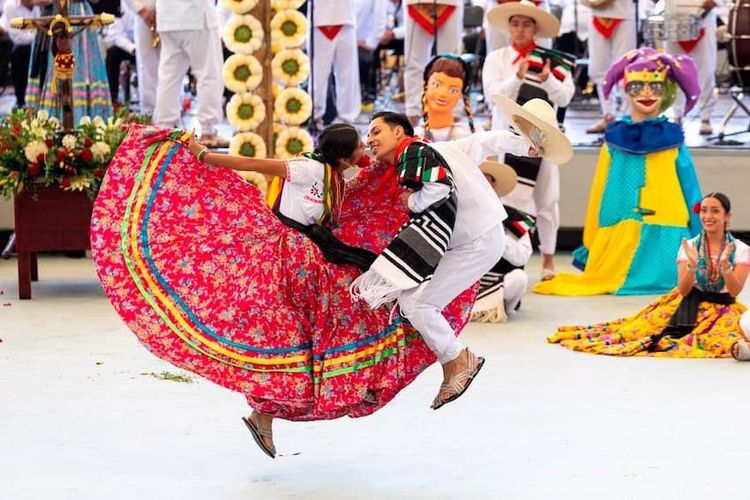
There is one more Covarrubias worth introducing: the dance impresario. Back in Mexico in the late 1940s, he taught ethnology at the Escuela Nacional de Antropología e Historia and was named artistic director for a new department at the Palacio de Bellas Artes, tasked with founding a national Academy of Dance. Rosa's background as a choreographer made her indispensable to the project.
Together they recruited José Limón, who had founded the José Limón Dance Company in 1946 with Doris Humphrey as artistic director. When the company debuted at New York's Belasco Theater in 1947, The New York Times hailed Limón as "the finest male dancer of his time." Bringing his company to Mexico for the Academy's inaugural 1950 season helped ignite what dance historians now call the golden age of Mexican modern dance.
The same curiosity that let him see Harlem as sophistication, read a Balinese temple carving as living culture, and spot an Olmec jaguar motif buried inside later Maya stone work told him that movement itself—bodies in space—belonged in the same national project as murals and museums. Covarrubias never separated the visual from the physical, the popular from the scholarly, or Mexico from the rest of the world. He simply kept looking and kept insisting that what he saw belonged in the official record.
A legacy in museums and memory
Covarrubias died in 1957, at 53, from complications likely related to diabetes or an ulcer. Friends said he seemed, toward the end, to lose his will to live—though by every account his mind kept generating new projects until the last moment. After his death, his extensive pre-Columbian art collection was transferred by the Mexican government to the Museo Nacional de Antropología in Mexico City, where it now forms a core part of the museum's collection.
In barely five decades, he left behind an inheritance that quietly reshaped how two nations saw each other: an American visual culture still carrying his fingerprints, a body of ethnographic work that helped found visual anthropology as a discipline, and an archaeological insight that permanently repositioned the Olmec at the root of Mesoamerican history. He was, before the term existed, a full-time cultural translator—someone who moved fluidly between elite salons and sacred ruins, between jazz clubs and faraway islands, between the pen and the choreographer's studio, always convinced that culture belongs to whoever is curious enough to go looking for it.