Mexican economy shows modest improvement in May with index score reaching 68.61
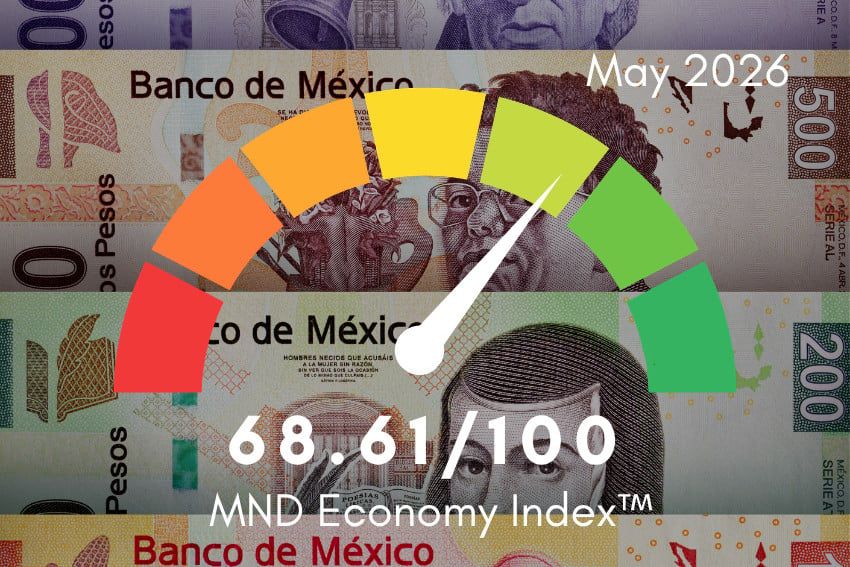
The Mexican economy demonstrated continued momentum in May 2026, with the MND Economy Index reaching 68.61 out of 100, an increase of 1.04 points from April's score of 67.55. This marks the second consecutive monthly improvement for the composite index, which tracks economic performance across ten key pillars.
The May score represents a significant gain from the first quarter of 2026, when the index hovered around 63 points. While the current reading falls into the "above neutral" category — indicating meaningful strengths with notable room for improvement — the upward trajectory suggests gradual economic strengthening across multiple dimensions.
Monetary policy and inflation lead performance
The strongest performer among the index's ten pillars was Monetary Policy, which scored 9.86 out of 10 in May, up from 9.35 in April. The Bank of Mexico reduced its benchmark interest rate to 6.50% in May following a 25-basis-point cut that took effect on May 8. However, the decision was not unanimous, with three board members supporting the reduction while two favored maintaining rates unchanged. Banxico indicated that holding the policy rate at the current level would likely be appropriate going forward, signaling a potential pause in the easing cycle.
The central bank's real interest rate — calculated as the benchmark rate minus annual headline inflation — moved closer to the neutral midpoint of 2.7%, reaching 2.56% in May compared to 2.30% in April.
Inflation showed continued improvement, with the Inflation pillar scoring 9.06 in May, up from 8.55 in April. Annual inflation eased to 3.94% in May from 4.45% the previous month. The Bank of Mexico maintains its forecast for inflation to reach the 3.0% target by the second quarter of 2027. June data released subsequently showed further improvement, with inflation falling to 3.37%, suggesting the pillar score is poised to strengthen further in the next index edition.
Mixed signals on economic growth
The Economic Growth pillar presented a more complex picture, scoring exactly 5.0 out of 10 — down from 5.4 in April. Mexico's annual economic growth rate moderated to 2.0% in May from 2.2% in April, according to final data from INEGI.
These figures follow a challenging start to the year. Mexico's first quarter 2026 GDP contracted at an annualized rate of 2.4% before rebounding with 1.2% growth in April, driven by a 2.1% increase in the goods-producing sector.
External forecasters have offered divergent views on Mexico's growth trajectory. The International Monetary Fund raised its 2026 GDP growth forecast to 1.6% in April, up from a previous estimate of 1.5%. In contrast, the consensus forecast compiled by Banco de México fell to 1.1% in May from 1.4% in April, reflecting broader uncertainty about the economy's momentum.
President Claudia Sheinbaum has predicted that economic activity will accelerate in the second half of 2026 as new public and private investment projects commence, with World Cup-related spending potentially providing additional stimulus.
Investment climate brightens
The Investment Climate pillar scored 8.25 in May, up from 7.65 in April, maintaining its position among the index's top performers. The S&P/BMV FIBRAS Total Return Index, which tracks Mexico's listed real estate investment trusts, grew 44.2% annually through the end of May, compared to 32.9% year-over-year growth at the end of April.
Foreign direct investment data remained steady, showing a 10.4% annual increase in the first quarter of 2026, marginally below the 10.8% growth recorded for full-year 2025.
Manufacturing sector weakens
The Manufacturing Sector Health pillar declined to 7.48 in May from 8.0 in April, falling from green-light to yellow-light territory in the index's performance rating system. While export revenue surged 25.4% annually in May — well above the 16.7% threshold for a maximum score — manufacturing output contracted 0.1% year-over-year, a reversal from the 1.9% annual growth recorded in April.
Sovereign risk concerns intensify
The Sovereign Risk pillar held steady at 7.45 in May, though underlying dynamics shifted. Moody's downgraded Mexico's credit rating to Baa3 in May, marking the third downgrade of Mexico's sovereign rating by the agency in recent years, following a reduction from A3 to Baa1 in April 2020 and from Baa1 to Baa2 in July 2022.
S&P maintained Mexico's BBB sovereign rating but revised its outlook from stable to negative in May. Moody's projects Mexico's public debt will reach 55% of GDP by 2028, up sharply from 40% in 2023, driven by structural fiscal deficits and sustained financial support for PEMEX. The state oil company received approximately $35 billion — equivalent to 1.9% of GDP — in government support during 2025.
Despite these rating actions, Mexico's 5-year credit default swap spread narrowed to 86.03 basis points in May from 89.70 basis points in April, reflecting a slight decrease in the market-implied cost of insuring against Mexican sovereign default. This improvement partially offset the negative impact of the rating downgrades on the overall pillar score.
Currency stability and labor challenges
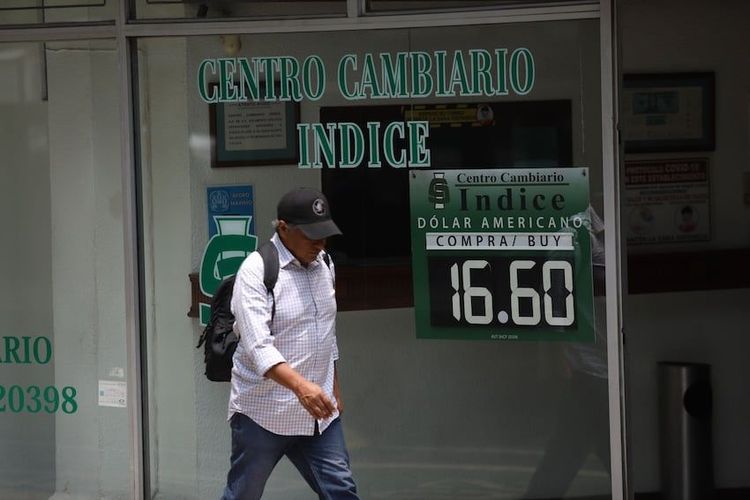
The Currency Stability pillar scored 6.77 in May, down marginally from 6.80 in April. The Mexican peso strengthened 0.7% against the US dollar during the month, closing at 17.34 pesos per dollar at the end of May. While volatility decreased — with the standard deviation of daily exchange rate movements falling to 0.42% from 0.47% — the appreciation moved the currency further from the index's 19.00 USD:MXN baseline. The index penalizes significant deviation in either direction, recognizing that an overly strong peso can erode export competitiveness and reduce the purchasing power of remittances.
The Labor and Employment pillar scored 6.02 in May, up slightly from 5.95 in April. Formal sector employment grew 1.5% annually for the second consecutive month, while nominal wages increased 6.6% year-over-year, down fractionally from 6.9% in April but well above the 3.5% benchmark.
However, Mexico's informality rate reached 55.2% in April 2026, with data showing that nearly all — 99.9% — of the 448,146 new jobs created that month were informal sector positions, while the formal sector workforce increased by just 608 people. The year-over-year growth in the informality rate moderated to 0.3 percentage points in May from 0.5 points in April, contributing to the slight pillar improvement.
Job quality indicators revealed additional concerns. The rate of critical occupation conditions — which captures workers in inadequate hours or earning below subsistence wages — climbed from 36.3% in May 2025 to 38.7% in May 2026, an increase of 2.4 percentage points. The segment earning up to one minimum wage grew by 737,000 people during this period.
External income shows resilience
The External Income pillar scored 5.53 in May, up from 5.20 in April. Incoming remittances grew 3.8% year-over-year, slightly above the 3.7% increase recorded in March. This modest growth represents a recovery from a difficult 2025, when remittances fell 4.6% to $61.8 billion from $64.7 billion in 2024, ending an 11-year growth streak. The decline was attributed to the slowest US labor market growth since 2020 and stricter immigration enforcement that removed over 146,000 Mexicans from the United States.
Tourism revenue continued to struggle, declining 0.3% annually in May. While this represented an improvement from the 2.3% annual contraction in April, the persistent weakness in this component weighed on the overall pillar performance.
Productivity remains weakest link
The Productivity pillar remained the index's poorest performer, scoring 3.2 out of 10 for the second consecutive month. INEGI's quarterly productivity measure showed annual growth of just 0.1% in the first quarter of 2026, significantly weaker than the 0.9% reading in the final quarter of 2025 and well below the 1.0% neutral benchmark. Updated productivity data for the second quarter will be published in early September and incorporated into the next index edition.
As Mexico approaches the second half of 2026, the economy shows signs of gradual strengthening, with monetary easing and moderating inflation providing support. However, significant challenges remain, particularly in productivity growth, labor formalization, and fiscal sustainability. The trajectory of these indicators in the coming months will determine whether the improvement observed in recent editions of the MND Economy Index can be sustained.