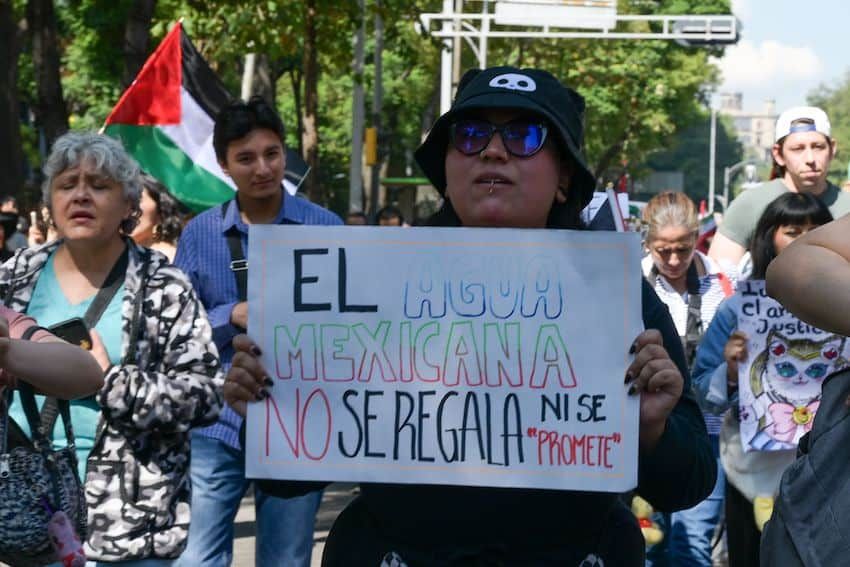
Why is Chihuahua working on water projects with Israel?
A water cooperation agreement between the Chihuahua state government and Israel's international development agency has become the focal point of growing social unrest as the northern Mexican state grapples with severe water scarcity.
On Saturday, protesters organized by Save the Hills of Chihuahua and the Feminist Assembly marched through the state capital, denouncing what they characterized as the promotion of business interests tied to Israel's treatment of Palestinians in Gaza. The demonstrations formed part of a nationwide day of action spanning at least 14 states, where participants demanded Mexico sever diplomatic and commercial ties with Israel.
The controversy centers on a February 2023 cooperation agreement between Chihuahua's Central Water and Sanitation Board (JCAS) and MASHAV, the Israeli Ministry of Foreign Affairs' development cooperation division. MASHAV, established in 1958, has trained more than 300,000 people from 140 nations in poverty alleviation, food security, and water management.
Valid through 2027, the agreement facilitates knowledge and technology exchange for designing, constructing and maintaining water systems under crisis conditions. It also covers improvements in treated water reuse, drinking water efficiency, sanitation infrastructure and sustainable agriculture practices. The agreement permits Israeli private sector involvement in water-related projects within Chihuahua.
Technical cooperation or privatization pathway?
Critics contend the arrangement opens doors for Israeli companies to secure contracts within the state's water infrastructure while circumventing proper legal channels. Activists argue the Chihuahua government failed to register the international agreement with Mexico's Ministry of Foreign Relations (SRE), potentially rendering it illegal under Mexican law.
Governor Maru Campos Galván and JCAS director Mario Mata Carrasco maintain the agreement represents a non-binding technical cooperation mechanism rather than a legally binding treaty. They assert it creates no legal obligations or benefits for either party and does not grant rights, concessions or control over state water resources, meaning SRE registration would not be required.
Under Mexican law, non-binding international agreements do not necessarily require the same registration procedures as binding treaties, though the SRE recommends similar registration practices for foreign policy consistency. Such agreements may not appear in the SRE's official treaty database.
State officials frame the cooperation as an opportunity to learn from Israel's water management experience, particularly relevant given the drought conditions affecting Chihuahua. Israel derives approximately 75% of its water from desalination plants and treats and reuses about 90% of its wastewater—the highest rate globally. The country's water sector encompasses over 130 companies specializing in desalination, smart water management, filtration and emergency solutions, with technology partnerships extending to China, India, Brazil, Mexico and the United States.
Broader water infrastructure efforts
The Israeli cooperation forms part of larger water infrastructure investments in Chihuahua. In early 2026, the state government reported investing more than 130 million Mexican pesos in sustainable water projects during 2025, supporting 32 public infrastructure initiatives across 14 municipalities and benefiting over 18,000 residents.
While Mexico nationally has seen drought conditions improve—with only 7.4% of the country experiencing drought in early 2026 compared to approximately 49% in May 2025—Chihuahua continues facing significant water stress. The situation reflects broader global water scarcity challenges. In January 2026, the United Nations University Institute for Water, Environment and Health warned the planet is entering an era of global water bankruptcy, with more than half the world's large lakes shrinking and around 70% of major aquifers in long-term decline.
Northern Mexico's water pressures have intensified due to nearshoring growth in the border region. Since NAFTA's introduction in 1994, the area has experienced steady industrial expansion, with sharp acceleration beginning in 2022, significantly increasing water demand.
The Chihuahua agreement comes as part of MASHAV's broader Latin American engagement. The agency conducts training programs in English, Spanish, French, Russian and Arabic, specifically designed to improve agricultural production in developing countries and promote food security through international cooperation.