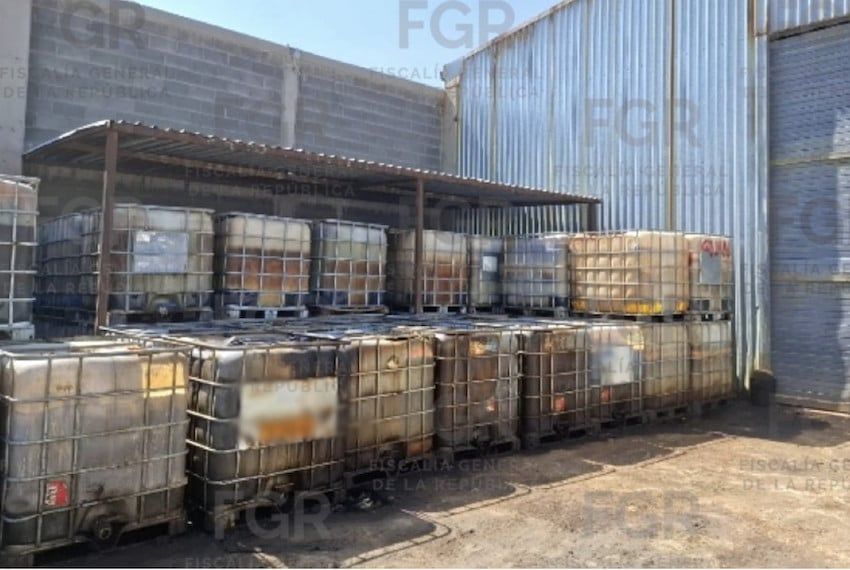
Federal authorities dismantle four illicit fuel processing centers across three Mexican states
Federal authorities dismantled four illicit fuel processing facilities across San Luis Potosí, Hidalgo and Morelos states, seizing over 1 million liters of petroleum products in a coordinated operation targeting Mexico's multibillion-dollar fuel theft industry.
The Federal Attorney General's Office (FGR) announced Tuesday that the raids were conducted in coordination with the federal Security Ministry, the National Guard and Pemex's logistics subsidiary. Two facilities were located in San Luis Potosí, with one each in Hidalgo and Morelos.
The operations were carried out based on intelligence gathering and anonymous tip-offs, though no arrests were reported. According to Reforma newspaper, the facilities were already abandoned when authorities arrived.
Major seizures at San Luis Potosí facilities
In San Luis Potosí city, federal agents executed a search warrant at a warehouse-style facility where tanker trucks were observed constantly entering. Authorities seized eight tanks with a combined capacity of 640,000 liters, along with between 500,000 and 600,000 liters of oil, various documents and a pickup truck.
At a second location in Laguna de San Vicente, a town in the municipality of Villa de Reyes near the Guanajuato border, investigators found 18 vertical tanks, two fuel production lines, approximately 40,000 liters of crude oil and diesel, a sulfuric acid sample and related documentation.
The sophistication of these operations reflects broader trends in fuel theft. In 2018, when President Andrés Manuel López Obrador deployed more than 4,000 soldiers and marines across 15 distribution systems to combat pipeline tapping, organized crime groups shifted toward more complex smuggling and processing operations. Today, thieves employ advanced techniques including underground tunnels and dual-tap systems that inject water with compressors to avoid triggering pressure alarms on pipelines.
Hidalgo and Morelos operations
In Tizayuca, Hidalgo—one of the top five Mexican states for documented pipeline taps alongside Jalisco, State of Mexico, Veracruz and Puebla—authorities discovered 32 containers with 1,000-liter capacity and 25 containers with 5,000-liter capacity. The raid also yielded 456,300 liters of suspected fuel or chemical products, documents and computer equipment.
The fourth facility was shut down in Cuautla, Morelos, after authorities received reports of a strong fuel and chemical odor emanating from the property, where tanker trucks escorted by pickup vehicles were frequently observed. Officials seized fuel samples from containers along with documents and check stubs, though the quantity of fuel confiscated was not specified.
Part of ongoing crackdown on fuel theft networks
The raids follow similar operations last month that dismantled two processing centers in Cadereyta, Nuevo León, and Reynosa, Tamaulipas. The Reynosa facility was located just 1.5 kilometers from National Guard barracks.
Earlier this year, authorities seized more than 100 tanker trucks and over 82,000 liters of petroleum products in Minatitlán, Veracruz, in February. In April, federal agents dismantled a criminal network smuggling up to 1.5 million liters of fuel weekly, resulting in multiple arrests—a relatively rare outcome in fuel theft operations.
The scale of the problem remains enormous despite enforcement gains. Pemex identified over 11,700 illegal pipeline taps in 2024, and in 2026, Mexico recorded one clandestine pipeline tap roughly every 51 minutes. The danger of these operations was tragically demonstrated by the January 2019 Tlahuelilpan pipeline explosion in Hidalgo, which killed at least 137 people when residents gathered to collect fuel gushing from an illegal tap before a spark ignited it.
Billions in lost revenue
According to a June 2026 alert from the U.S. Financial Crimes Enforcement Network (FinCEN), cartels are diverting tens of billions of dollars annually in tax revenue from legitimate Mexican and U.S. energy companies through fiscal fuel theft schemes. These operations primarily evade IEPS (Impuesto Especial sobre Producción y Servicios), Mexico's federal excise tax on fuel imports, using shell companies and false documentation.
The U.S. Treasury Department has stated that fuel theft and smuggling activities currently represent the most significant non-drug revenue source for Mexican cartels. Public reporting suggests that a quarter to a third of all fuel sold in Mexico may be illicit.
Mexican authorities have made some progress. Pemex's losses due to fuel theft declined almost 30 percent annually in the first quarter of 2026 to 3.81 billion pesos (US $220.7 million). Recent arrests include high-ranking Mexican Navy members and a Utah couple accused of smuggling 2,881 shipments of crude oil worth $300 million from Mexico to the United States between May 2022 and 2025, using false labels such as "waste of lube oils" to circumvent customs detection.
Last month, former Baja California Governor Ernesto Ruffo—Mexico's first opposition party governor in the modern era—was arrested on organized crime, fuel theft and tax evasion charges. Ruffo served as governor from 1989 to 1995 under the National Action Party (PAN) and later in the Mexican Senate from 2012 to 2018.
A legislative reform filed in April 2026 to strengthen penalties for fuel theft by amending the Federal Penal Code and the Federal Law to Prevent and Sanction Crimes Committed in Hydrocarbon Matters remains pending approval.