Navy seizes nearly 2 tonnes of cocaine off Pacific coast, arrests 6
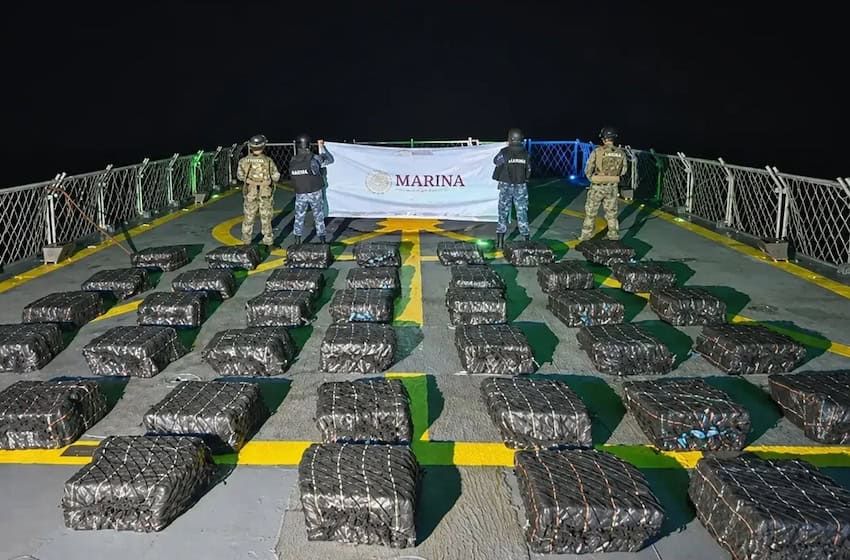
The Mexican Navy intercepted a drug-trafficking vessel in the Pacific Ocean last Friday, seizing nearly two tonnes of cocaine and arresting six men believed to be Ecuadorian nationals in one of several major busts this year.
During routine maritime surveillance operations, Navy personnel spotted a speedboat equipped with three outboard motors approximately 850 kilometers south of Acapulco. The vessel's configuration—designed for long-distance ocean travel—included 2,450 liters of fuel stored in 49 drums, three satellite communication devices, and two emergency beacons.
Initial reports indicated slightly more than one tonne of cocaine had been confiscated, but after the vessel arrived at port on Sunday, officials discovered the actual quantity was significantly larger at 1.9 tonnes.
Sophisticated trafficking operation
The vessel's equipment suggests a highly coordinated operation. The satellite communication systems and emergency beacons allow traffickers to navigate and maintain contact across vast ocean distances, typically indicating coordination from land bases or other vessels at sea.
Such speedboats with multiple high-powered motors and substantial fuel reserves can travel thousands of kilometers without requiring port stops. Ecuador has emerged as a major cocaine dispatch point, with established maritime routes from Ecuadorian ports including Esmeraldas and San Lorenzo directly to the Mexican Pacific coast. These journeys typically take seven to eight days and require multiple at-sea refuelings. Ecuador's strategic position between Colombia and Peru—two of the world's leading cocaine producers—has made it a critical transit hub, with cocaine moving through Ecuadorian ports for onward shipment to Mexico and the United States.
An estimated 90% of cocaine produced in the Andean region is transported by sea at some stage, making maritime interdiction a cornerstone of counter-narcotics strategy.
Increased enforcement under Sheinbaum administration
These actions combat drug trafficking, weaken the logistical capabilities of organized crime and strengthen Mexico's security
Admiral Raymundo Pedro Morales stated on Sunday.
Since President Claudia Sheinbaum took office in October 2024, her administration has intensified military-led security operations, marking a departure from her predecessor's approach. The Mexican Navy has seized more than 80 tonnes of cocaine at sea during her tenure, with multiple major interdictions recorded in 2026 alone, including a 4.4-tonne seizure in early August and a 7.2-tonne seizure earlier in the year.
Admiral Morales has identified the South Pacific region and the Revillagigedo Islands archipelago—located between 390 and 458 kilometers southwest of Cabo San Lucas—as primary concentration areas for maritime drug trafficking. The remote Revillagigedo Islands, designated a UNESCO World Heritage Site in 2016 and established as a Mexican marine reserve and national park in 2017, lie along key trafficking corridors.
International cooperation
U.S. Ambassador to Mexico Ronald Johnson commended the Navy for the interdiction in a Monday social media post, emphasizing that such operations
weaken cartels by striking at the operations that sustain them.
The confiscated materials and detained individuals were transferred to the Federal Attorney General's Office, which will conduct investigations and determine their legal status.
Media reports indicate that cartels are increasingly using smaller speedboats with foreign crew members for Pacific trafficking operations. On July 21, another interdiction 150 nautical miles southwest of Puerto Chiapas resulted in the seizure of 1.5 tonnes of cocaine from a vessel crewed by two Ecuadorians and three Guatemalans.
Colombia produces more than half of the world's cocaine supply, making the Pacific maritime corridor from South America to Mexico a critical trafficking route that law enforcement agencies prioritize for interdiction operations.