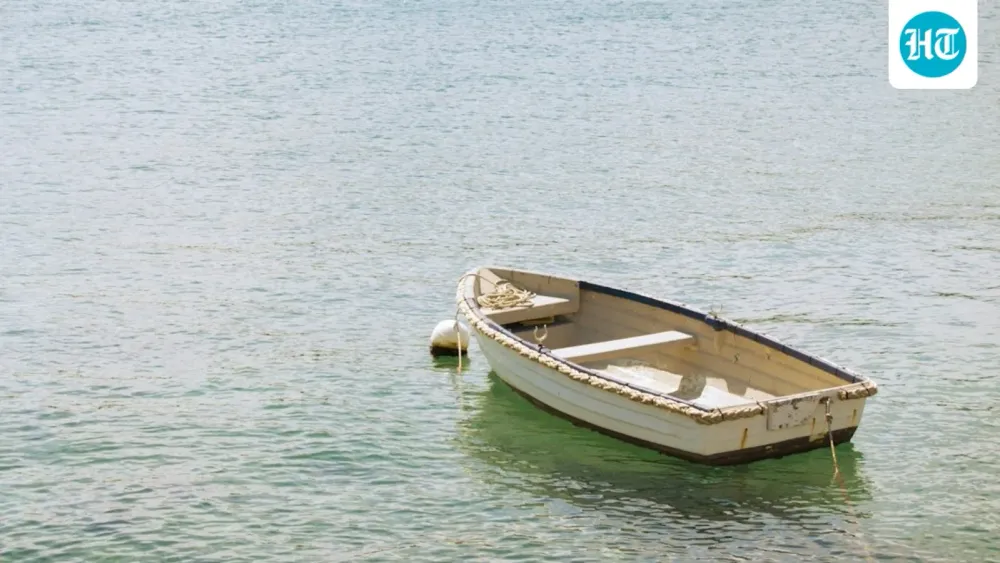
A one-hour crossing becomes a months-long ordeal
The group had reportedly set out to travel between Murilo and Ruo, a crossing expected to take an hour, when a storm swept them off course. According to the Associated Press, they drifted east across the Pacific before villagers found them near Fanning Island.
The U.S. Coast Guard in Guam said nine people were aboard when the skiff was reported missing on July 30 after failing to return to Ruo Island. Search crews covered 85,700 square kilometers over 10 days without finding the boat or its occupants.
ABC News in Australia named the five survivors as Wanis Weita, Wboy Weita, Akinis David, Paul Paul and Tedwin Paul. Two are children.
The local Uniting Church pastor took the survivors in and cared for them, ABC reported. The area's member of parliament, Kaotitaake Rakoroa, recommended that they catch the earliest flight to Kiritimati Island, the nearest urban center, for further medical treatment.
Chuuk State Governor Alexander Narruhn said he had asked the president of the Federated States of Micronesia to open diplomatic talks with Kiribati to arrange their return home.
Other recent rescues near Kiribati
ABC also reported two other recent ordeals involving people from Bougainville in Papua New Guinea. In late October 2026, rescuers found 18-year-old Luka Rahan between Tarawa and Maiana after 41 days at sea. His cousin had died during the journey.
The previous month, three other Bougainvilleans returned home after spending about 70 days adrift. They had been found near Kiritimati Island.
Pacific journeys lasting nine months or more
Among the longest documented cases is that of Japanese captain Oguri Jukichi and his sailor Otokichi. Guinness World Records lists their approximately 484 days adrift as the longest known survival at sea. A storm damaged their ship off Japan in October 1813; an American ship found them off California on March 24, 1815. By then, scurvy had killed 12 crew members.
Nearly two centuries later, Jose Salvador Alvarenga was rescued in the Marshall Islands in January 2014. He told the BBC that he had spent about 13 months in a small fiberglass fishing boat, traveling nearly 8,000 kilometers across the Pacific.
Alvarenga said a storm drove him off course after he left Mexico on a fishing trip in December 2012. He described drinking rainwater, urine and birds' blood to stay alive. The fisherman accompanying him, Ezequiel Cordoba, died before the rescue.
Three other Mexican fishermen, Jesus Eduardo Vidana, Lucio Rendon and Salvador Ordonez, spent about nine months adrift before a Taiwanese fishing vessel spotted them in the South Pacific on August 9, 2006. They had reportedly departed San Blas for a shark-fishing expedition in October 2005.
Strong winds carried their boat offshore, and they eventually exhausted their fuel, leaving ocean currents to carry them. They ate raw fish and birds and collected rainwater to drink.
Four months in small boats
For Samoan men Lapahele Sopi and Telea Paa, rescue came in Papua New Guinea in 2001, roughly 4,000 kilometers from home. They had spent four months in a small metal boat, catching fish and drinking rainwater. After they used their final flare, a villager in Milne Bay saw them and approached by canoe.
British couple Maurice and Marilyn Bailey endured 117 days in the Pacific in 1973. Their yacht, Auralyn, was reportedly hit by a whale off Guatemala in March. NPR reported that they escaped into a rubber dinghy when the yacht capsized.
According to The Sydney Morning Herald, several ships passed without noticing the couple before the Korean fishing boat Weolmi rescued them on June 30, 1973. They had drifted about 1,500 miles. Their food included raw turtle, seabirds and fish, which they caught by hand or with safety pins fashioned into hooks.
Survival on Atlantic life rafts
Chinese seafarer Poon Lim spent 133 days alone on a life raft in the South Atlantic during 1942-43. He was the sole survivor of the British cargo ship SS Benlomond, which the German submarine U-172 sank on November 23, 1942.
After a drift of about 750 miles, three Brazilian fishermen rescued him on April 5, 1943. King George VI later presented him with the British Empire Medal.
In 1982, American adventurer Steven Callahan survived alone for 76 days in an inflatable raft in the Atlantic. A whale reportedly struck his sailing vessel, sinking it. He caught fish and gathered rainwater during the drift.
Callahan recounted the experience in his best-selling 1986 book, Adrift: 76 Days Lost At Sea, and later advised the makers of Life of Pi.
American sailor Deborah Kiley also survived a raft ordeal in 1982. After a storm caught her boat off the U.S. coast, she and another crew member spent five days on a life raft. Her experience later inspired the film Two Came Back.