A nighttime flight from Ventura
A mayday call reporting a sinking boat off Ensenada, Mexico, reached the Coast Guard Air Station in Ventura, California, at about 1 a.m. that Friday. A helicopter crew prepared for the flight and headed to the scene, where the capsizing had left more than two dozen people in the Pacific.
Lt. Miyako Miller piloted the helicopter with a four-member crew. Wearing night vision goggles, she relied on the stars to navigate without moonlight. Once at the wreckage, she held the aircraft about 40 feet (12 meters) above the sea as the crew lowered Law on a cable.
One survivor at a time
Law, 24, was the only rescuer in the water during the two-hour operation. He worked in darkness amid 6- to 8-foot waves, spray and turbulence from the helicopter, and water cold enough to cause hypothermia.
To bring each person to the pickup point, Law used a technique called the "buddy tow": He turned the survivor onto their back, put an arm over them and kicked while pulling them through the water. As he made repeated trips, water gradually filled his dry suit to his knees, making it feel weighted down.
"With one hand, I'm holding the survivor. With the other, I am signaling to the helicopter and working with the device," Law said. He loaded the survivors individually into a rescue basket so the crew could lift them aboard.
"I was experiencing exhaustion at that point... what I was experiencing was nothing compared to what they were at that point," he said.
Medical care in the air and on shore
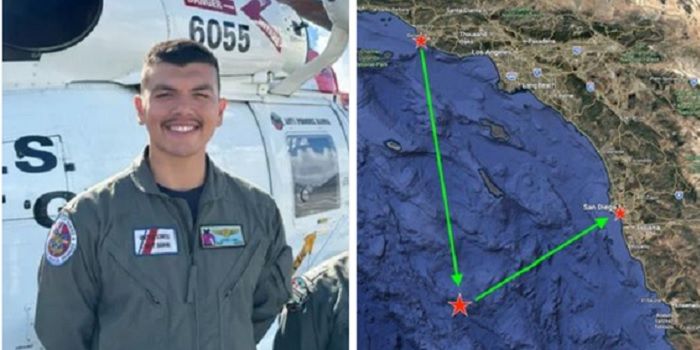
Running low on fuel, the crew headed for the Coast Guard station in San Diego, about 160 miles south of the Ventura station. Law treated survivors during the flight. According to the Coast Guard, three had injuries consistent with shark bites after the capsizing.
About 60 firefighters and emergency medical workers responded on shore, and 13 ambulances carried the survivors to San Diego hospitals. Those who were injured received treatment after landing.
The Coast Guard later confirmed that all 16 had been pulled from the water that Friday. All were Mexican nationals, and about half have since returned to Mexico.
Search ends with 11 still missing
The Coast Guard suspended the search on the evening of Sunday, Oct. 18, 2026. Working alongside Mexico and the U.S. Navy, rescuers had covered more than 2,441 square miles (about 6,322 square kilometers) over a combined 89 hours without finding the remaining 11 people.
Federal authorities are investigating whether the boat was involved in human smuggling. U.S. Customs and Border Protection was investigating and interviewing survivors, and the Coast Guard said the vessel had been traveling along a route normally used for illegal maritime smuggling.