Rehabilitation away from visitors
The rescued lions, tigers and jaguars came from across Mexico. Some were seized in operations against illegal wildlife possession and trafficking; others had suffered abandonment or mistreatment. Rescue sites included Baja California and the Golden Triangle, where Sinaloa, Chihuahua and Durango meet.
Many of the cats reached the park dehydrated, underweight or injured. They remain in a separate rehabilitation area, where they receive veterinary treatment and specialized feeding while they recover. Visitors cannot currently see them.
One is "El Chino," a male African lion about a year and a half old who is missing his left eye. He was found caged following a Mexican Army operation at a property in Badiraguato, Sinaloa, in the Sierra Madre Occidental. He arrived underweight and dehydrated, with a fresh facial injury.
Violence around Culiacán, Sinaloa, disrupted operations at Ostok Sanctuary, prompting the transfer of some animals to Mazatlán so their care could continue. Ostok's founder, Ernesto Zazueta Zazueta, spoke at the park's inauguration. He also serves as president of the Mexican Association of Zoos, Breeders and Aquariums (AZCARM).
What visitors can see
The public opening followed an inauguration on November 13. According to statements at that event, the first phase makes about 100 hectares accessible to visitors, with more than 400 hectares planned for the full development.
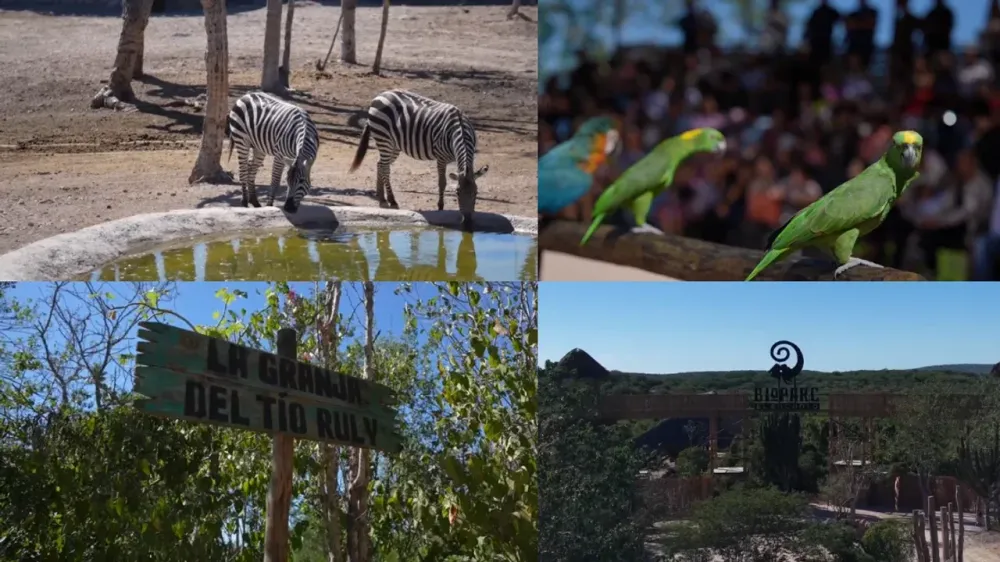
Safari-style routes run through five visitor habitats featuring giraffes, zebras, ostriches, deer and other wildlife. The park's promoters describe education and wildlife conservation as central aims, alongside protecting rescued animals and raising awareness of illegal animal trafficking.
Bioparc El Encanto is near Camacho, at kilometer 26 of the toll-free Mazatlán–Culiacán road. It is open daily from 9 a.m. to 5 p.m.
Three admission options are available: Aventura Bioparc at 490 Mexican pesos, Experiencia Educativa at 550 pesos and Experiencia Encantadora at 1,100 pesos. The last option is for groups of at least 10 people and includes a private vehicle, a personal guide, brunch and animal feed.
Investment and conservation plans
The development represents an investment of about 1.2 billion Mexican pesos. Developer El Encanto Desarrollos presented figures at the inauguration projecting around 4,200 direct and indirect jobs. Promoters also expect the park to support tourism and economic activity in the Mazatlán area.
Raúl Ricardo Villavicencio, the developer's director general, described Bioparc El Encanto as the most important project of its kind in Latin America.
Operators say ecological construction techniques used for the first phase leave 90 percent of the natural environment intact. Later phases are planned to add sanctuaries for animals including elephants, tigers and lions.
Statements at the inauguration also said the park's 400 hectares were joining Mexico's national network of Wildlife Conservation Management Units (UMA) and Wildlife Management Premises (PIMVS). That scheme covers 20 percent of the country's territory, according to those statements.
Promoters plan to bring American bison from Chihuahua's prairies to establish a germplasm bank intended to help recover the species. They said hunting and cattle ranching had caused bison to practically disappear from northwestern Mexico by the end of the 19th century.