
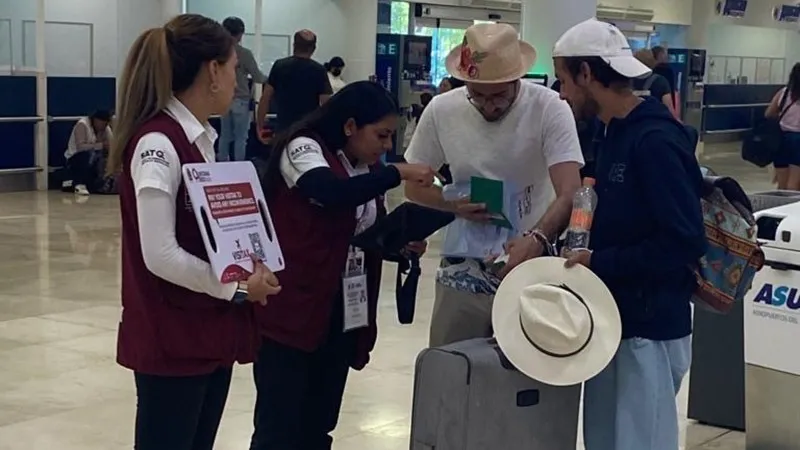
A shift toward digital collection
Governor Mara Lezama Espinosa announced the change last week, according to El Economista. Speaking in Spanish, she said airport collection should end because it was creating a poor visitor experience and that payment should be digital.
The announcement marks a change in her position. Less than three weeks earlier, View from the Wing had reported that Lezama considered airport collection the only workable way to enforce payment.
The tax remains 293 pesos per foreign visitor, or about $23, for travelers visiting Cancun, Playa del Carmen, Tulum and Cozumel. Tourism Secretary Bernardo Cueto Riestra told Grupo Animal that the state Finance Secretariat was developing a collection model intended to avoid harming the tourist experience. He also confirmed that Visitax would remain in place in 2027.
What will replace the booths is not yet settled publicly. The Cancun Sun reported that travelers might have their payment receipts scanned or digitally checked at a gate before security, potentially speeding up verification. State officials have not confirmed those details.
Separately, Lezama told Grupo Animal that Cancun airport had recently installed biometric electronic gates to speed up arriving travelers' entry as part of efforts to improve the visitor experience. The Cancun Sun also pointed to Baja California Sur's similar tourist fee, Embrace It, which uses the same underlying technology from Canadian company Travelkore without airport collection confrontations.
Charges above the official rate
Complaints have focused on Urquitem S.A. de C.V., the private operator of the airport collection booths. Palco Quintanarroense reported charges of up to 550 pesos ($42), including an additional 257 pesos labeled a "management fee." That left a family of four paying about $78 more than it owed.
The outlet also described collectors stopping passengers in airport corridors, providing misleading information and directing them toward a booth equipped with a card terminal.
Grupo Animal reported that Urquitem's commission exceeded 87% per tourist and put the total charge at 550 pesos per person. According to The Cancun Sun, the company specializes in digital security, not tax collection, and received the airport concession through a restricted tender.
The state has neither published the collection contract nor disclosed the company's earnings from it. The basis on which collectors were permitted to operate inside the terminal also remains unclear.
Tourism groups press for broader changes
David Ortiz Mena, president of the Mexican Caribbean Hotel Council, told El Economista that visitors who leave angry about an unexpected charge will not return. In his assessment, the damage to the region's reputation now outweighs the revenue Visitax generates.
Sergio Gonzalez Rubiera, president of the inbound tourism agency association Amatur, wants the tax eliminated entirely. Business groups are expected to take their position to Lezama at a meeting on airport issues later this month.
Visitax began in April 2021, during the final year of the previous state administration, with an initial charge of 224 pesos per foreign visitor, Grupo Animal reported.
The state's 2026 budget proposal projected Visitax receipts of 4,307 million pesos, up 209% from the 1,392 million pesos collected in 2025, according to El Economista's coverage of the budget package submitted to the state Congress.
El Economista reported that the proceeds are to go into a public trust with three allocations: 10% for tourism promotion and crisis control; 40% for sargassum control, beach cleaning and restoration; and 50% for strategic projects related to tourism.
The newspaper also noted that Mexico's Supreme Court, known as the SCJN, had ruled a similar proposed tourist charge in Puerto Vallarta unconstitutional because it did not clearly identify the services, goods or public spaces that justified the fee.
Earlier enforcement caught visitors off guard
Airport payment checks predate the current dispute. On December 2, 2024, Open Jaw reported that uniformed agents at Cancun airport were requesting QR-code receipts after years of limited enforcement, surprising many visitors.
Tim Scurry, founder and CEO of Travelkore, the official online payment platform, told Open Jaw at the time that visitors were reporting an increased presence of uniformed Visitax agents demanding proof of payment upon arrival.
"There's been a lot of moaning and groaning that physical enforcement of the tax wasn't there. But now it's appeared, and people are getting caught short and getting surprised," he said.
Open Jaw has requested further information from the Mexican Tourist Board.
How travelers can pay
For now, the state's guidance remains to pay through the official Visitax online portal before traveling. Travelers should have each person's full name and passport number available and keep a copy of every individual's QR-code receipt.
A lost receipt can be retrieved through the portal using a passport number. Travelers should avoid lookalike third-party websites that impose additional service charges.