What each batch record must contain
The standard covers Veltis's entire catalog, including BPC-157, NAD+, GHK-Cu and GLP-class compounds. The company serves laboratories and institutional research buyers across Mexico and requires the documentation before listing a compound for sale.
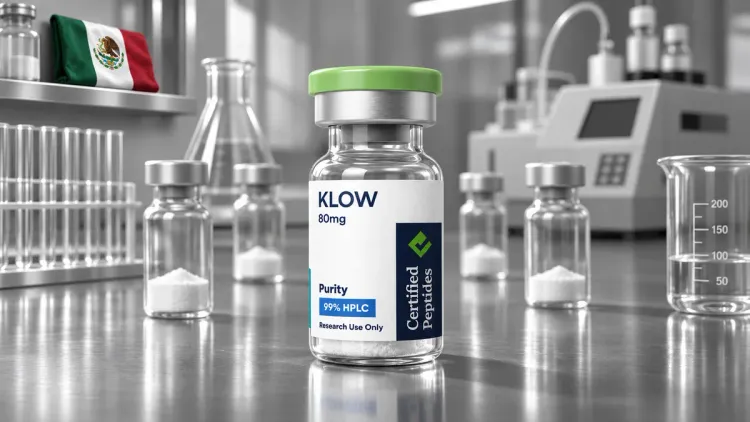
Each Certificate of Analysis (COA) must identify the manufacturing lot and analysis date, report purity by HPLC peak area, and include a mass-spectrometry check to distinguish the intended peptide from structurally similar sequences. A generic specification sheet cannot substitute for a batch-specific record.
A Veltis spokesperson said buyers need to connect a lot number to an actual analysis, describing a COA without a batch reference as "a PDF with a purity figure on it."
Veltis says its listings, technical sheets and COAs are strictly for research use only (RUO). They contain no human-use claims, dosing guidance or implied clinical applications.
Reading the analytical results
Veltis reports HPLC purity as the percentage of the area attributable to the relevant peak relative to all detected peaks. The company says it neither rounds the result nor treats one batch's measurement as a guaranteed minimum for later lots. When secondary peaks appear, it discloses them and provides buyers with the chromatographic results used by the lab, leaving researchers to evaluate those findings.
A 2026 quality-control overview from HHM Global identifies HPLC purity of at least 98% as the expected standard for most research uses and recommends including the chromatogram, rather than reporting a percentage alone. That industry benchmark is separate from Veltis's announced documentation requirements.
The overview also distinguishes the measurements: mass spectrometry checks molecular identity, not purity. Net peptide content measures something else again—the proportion of a vial's mass that is actually peptide. According to HHM Global, that share is commonly well below 100% and often receives too little attention.
A checklist beyond Veltis's catalog
Veltis is offering the requirements as a purchasing checklist for researchers evaluating other suppliers. Buyers should be able to trace a product to its lot, inspect its COA before purchase and find an identity check by mass spectrometry separate from the purity result. The checklist also calls for RUO labeling without claims about human use or dosing.
In the company's view, a supplier that cannot provide a COA matching the batch on request falls short of the baseline researchers should expect. Its spokesperson said the checklist responds to a question repeatedly raised by laboratories changing suppliers: how to verify what they are receiving.
Another Mexico-focused supplier, Certified PEP MEX, announced two websites on November 7, 2026: Péptidos Verificados and Péptido Retatrutida. Its announcement described 39 compounds in 48 presentations on Péptidos Verificados, with a separate COA for each batch.
Certified PEP MEX said its products are made in the United States at a cGMP-compliant facility and undergo independent laboratory testing, most often at Vanguard Laboratory in Olympia, Washington, which holds ISO/IEC 17025:2017 accreditation. Each vial also carries a QR code linking to its batch laboratory report, according to the announcement.
Mexico's regulatory context
RUO labeling does not provide a consumer-sales exemption under COFEPRIS rules, according to an August 6, 2026, regulatory snapshot from Peptidepedia. The source also reports that the regulator issued an April 2026 alert specifically warning against promoting unapproved peptide products on social media.
Grey Peptides reported that, as of October 3, 2026, research peptides including BPC-157, TB-500, CJC-1295, ipamorelin, GHK-Cu, melanotan II and epitalon lacked COFEPRIS sanitary registration in Mexico. Its account places those products outside both the medicine and supplement categories of the Ley General de Salud.
The same source describes a bill introduced in July 2026 by Deputy Ivonne Aracelly Ortega Pacheco of Movimiento Ciudadano. The proposed Article 215 Bis would prohibit selling, distributing and marketing those products to the public, including through digital platforms and social media. As of October 3, 2026, the proposal remained a bill, not law.