Documentation before a product is listed
The requirements cover the entire Veltis catalog, which serves laboratories and institutional buyers and includes BPC-157, NAD+, GHK-Cu and GLP-class compounds. The company says the required documentation must be in place before a compound goes on sale, rather than offered only for selected products.
Each Certificate of Analysis, or COA, must identify the manufacturing lot and analysis date, report purity by HPLC peak area, and include mass-spectrometry confirmation that distinguishes the intended peptide from structurally similar sequences. A general specification sheet used for multiple batches does not meet the standard.
A Veltis spokesperson said laboratories want lot numbers that connect products to actual analytical results, describing a COA without a batch reference as "a PDF with a purity figure on it."
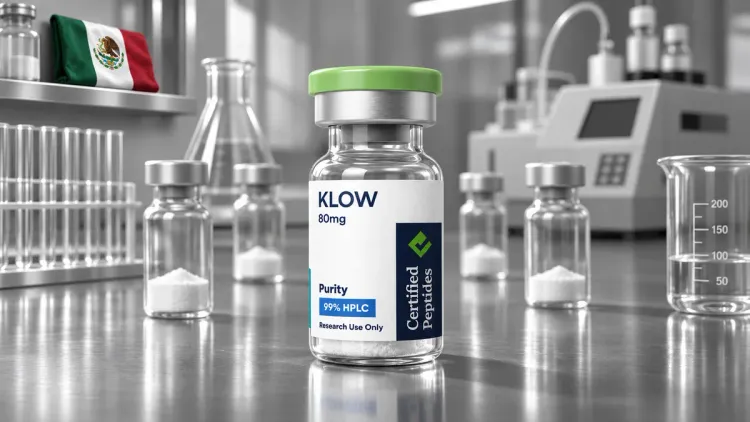
Veltis also requires research-use-only labeling throughout its listings, technical sheets and COAs. The company says those materials contain no claims of human use, dosing guidance or implied clinical applications.
What the HPLC result measures
Under the standard, Veltis reports the measured HPLC area percentage without rounding it or treating it as a minimum guaranteed for subsequent lots. When secondary peaks appear, the company says it discloses them and gives buyers the chromatographic results used by the laboratory, leaving researchers to evaluate those peaks.
Area-normalized HPLC purity is the main peak's area divided by the total area of the integrated peaks. It detects only substances that absorb at the measurement wavelength, typically 214 or 220 nm; it does not account for water, inorganic salts or trifluoroacetate counterions.
That limits what the percentage says about a sample's composition by mass. Analytical-services provider Creative Proteomics says a sample with a reported HPLC purity of 98% may be only 75–85% peptide by mass after those non-UV-active components are taken into account.
Traceability and independent testing
Veltis is offering its requirements as a checklist for assessing other suppliers as well. Researchers should be able to trace a product to its lot, inspect a published COA before buying, verify identity through mass spectrometry separately from the purity result, and find research-use-only labeling without human-use or dosage claims. In Veltis' view, a supplier unable to provide a COA matching the batch on request falls short of the baseline buyers should expect.
Who performs the testing is a separate consideration. Creative Proteomics says supplier-generated COAs create a conflict of interest because the seller both produces the purity result and benefits commercially from a high number. It says that conflict is eliminated when independent, ISO/IEC 17025-accredited laboratories receive samples blind and issue third-party COAs. The provider also says journals including Nature and the Journal of Biological Chemistry now routinely expect independent verification of peptide purity and identity in supplementary experimental data.
HPLC and mass spectrometry also appear in a distinct regulatory setting: the FDA's 2021 guidance for synthetic peptide drug applications using the ANDA pathway. That guidance requires individual identification of peptide-related impurities above 0.10% of the active pharmaceutical ingredient and bars the pathway when a new impurity exceeds 0.5% of the drug substance. It references validated HPLC testing for purity and mass spectrometry for identity.
Another Mexico-focused supplier, Certified PEP MEX, announced the Péptidos Verificados and Péptido Retatrutida websites on November 7, 2026. Its offering covers 39 compounds in 48 presentations, each with a batch-specific COA, with FedEx delivery across Mexico. The company says its peptides are made in a U.S. cGMP-compliant facility and tested by independent laboratories, most often Vanguard Laboratory in Olympia, Washington, which holds ISO/IEC 17025:2017 accreditation. A QR code on each vial opens the corresponding batch report.
Mexico's research-use regulatory context
According to Peptides.io's research dated September 2026, research peptides including BPC-157, TB-500 and GHK-Cu occupy a regulatory gray zone in Mexico. They are not expressly banned, but they lack COFEPRIS approval for human use and cannot legally be marketed for human consumption.
COFEPRIS, Mexico's federal health-risk regulator under the Secretaría de Salud, regulates these substances through the Ley General de Salud. Article 226 of that law divides medicines into six prescription categories.
A bill filed in Mexico's Congress in July 2026 argues that unregistered research peptides fit neither the medicine nor dietary-supplement category. Under the bill's reasoning, they lack the COFEPRIS registration and proven efficacy needed to qualify as medicines, while injectable products cannot qualify as supplements under Article 215 of the Ley General de Salud. The proposal is an initiative, not law; it would need to be passed before taking effect.