Mexican economy scores 73.1 in July, marking strongest performance since MND Index launch
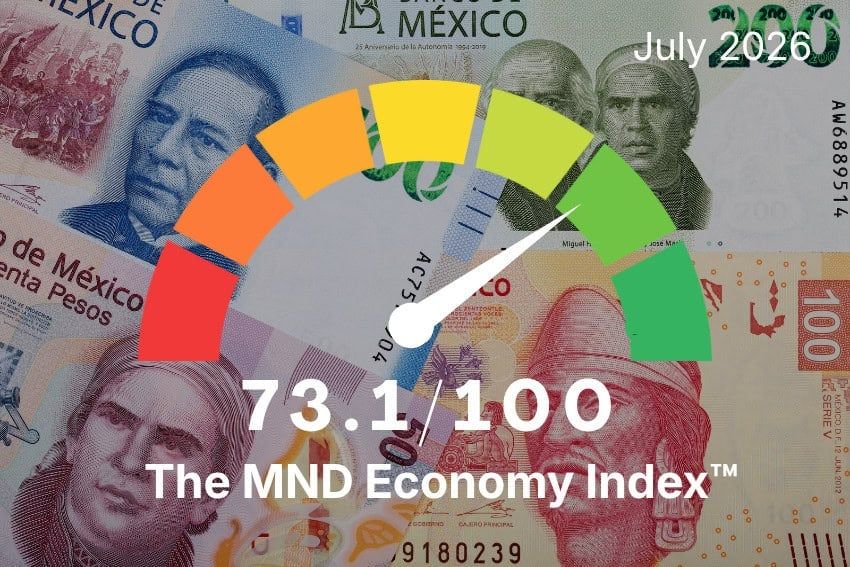
Mexico's economy scored 73.1 out of 100 in July 2026 according to the MND Economy Index, marking the strongest performance since the composite indicator's launch and representing a significant 6.2-point increase from the previous month.
The fifth edition of the MND Economy Index, which tracks economic performance across 10 pillars and 19 indicators, showed improvements in several key areas. For the first time since monthly publication began, none of the index's pillars registered a concerning red-light score, signaling broad-based economic strength.
Inflation remains well-controlled near central bank target
The inflation pillar achieved the highest contribution to the overall score at 9.68 out of 10, up from 9.33 in June. Annual headline inflation eased to 3.12% in July from 3.37% the previous month, positioning the rate just 0.12 percentage points above the Bank of Mexico's 3% target.
Despite the favorable July reading, the central bank projects inflation will reach 3.5% by year-end and does not expect the rate to return to the 3% target until the fourth quarter of 2027. The Bank of Mexico anticipates a gradual decline throughout next year as the central bank maintains its cautious approach to monetary policy.
Central bank maintains steady monetary policy stance
The monetary policy pillar scored 9.32, down slightly from 9.57 in June. The Bank of Mexico's benchmark interest rate remained at 6.50% throughout July, unchanged from the previous month. The central bank has now held rates steady for three consecutive meetings through September 2026, with all five board members voting unanimously to maintain the current level at the most recent decision.
Mexico's real interest rate—calculated as the benchmark rate minus headline inflation—stood at 3.38% in July, compared to 3.13% in June. The higher real rate reflects the widening gap between the policy rate and falling inflation.
Manufacturing sector shows renewed vigor
The manufacturing sector health pillar jumped to 7.9 from 6.9, driven by a strong rebound in industrial output. Manufacturing production grew 1.6% year-over-year in July, a marked improvement from the 2.4% contraction recorded in June.
Export performance remained robust, with export revenue surging 43.7% annually in July, well above the 16.7% threshold required for a perfect score in that component. Manufactured goods accounted for nearly 94% of Mexico's total export revenue during the month.
Economic growth accelerates sharply
The economic growth pillar registered one of the month's most dramatic improvements, climbing to 7.6 from 4.4 in June. The Mexican economy expanded 3.3% annually in July according to final data from national statistics agency INEGI, nearly double the 1.7% growth rate recorded in June. Month-over-month growth reached 1.4%.
The strong July performance followed solid second-quarter growth of 1.9%, a significant acceleration from the 0.4% annual expansion in the first quarter. The improved momentum prompted the Bank of Mexico to raise its full-year 2026 GDP growth forecast to 1.5% in August from a previous estimate of 1.1%, establishing a new forecast range of 1.0% to 2.0%.
Private sector analysts have also revised their projections upward, with forecasts now ranging between 1.1% and 1.4% for 2026 according to surveys by Banxico and Citi. These estimates remain below the government's official projection of 2.3% but represent a meaningful upgrade from earlier in the year.
The improved 2026 outlook marks a recovery from weak 2025 performance, when Mexico's economy grew only 0.8%—the slowest expansion since the pandemic—down sharply from 1.4% growth in 2024.
Mixed signals in labor markets and investment
The labor and employment pillar edged down to 6.18 from 6.21, reflecting competing dynamics in Mexico's job market. Formal sector employment growth slowed to 1.5% annually in July from 2.0% in June, while nominal wages rose 6.7% year-over-year, up from 6.4% the previous month.
Informal employment remains a persistent challenge, with 56.2% of Mexican workers operating in the informal economy in July. The second quarter of 2026 saw the informality rate reach 55.1%, representing 33.1 million workers—an increase from 54.8% in the first quarter. Reducing informality continues to be a major policy priority for the Mexican government.
The investment climate pillar improved slightly to 6.58 from 6.56, supported by 27.4% annual growth in the S&P/BMV FIBRAS Total Return Index, which tracks listed real estate investment trusts.
Foreign direct investment reached a record $34.97 billion in the first half of 2026, representing a 2.1% increase year-over-year. However, the composition of investment flows reveals underlying challenges: new investment declined 13.4% as 88.5% of the total came from reinvested earnings by existing companies rather than fresh capital inflows.
Currency stability and other indicators
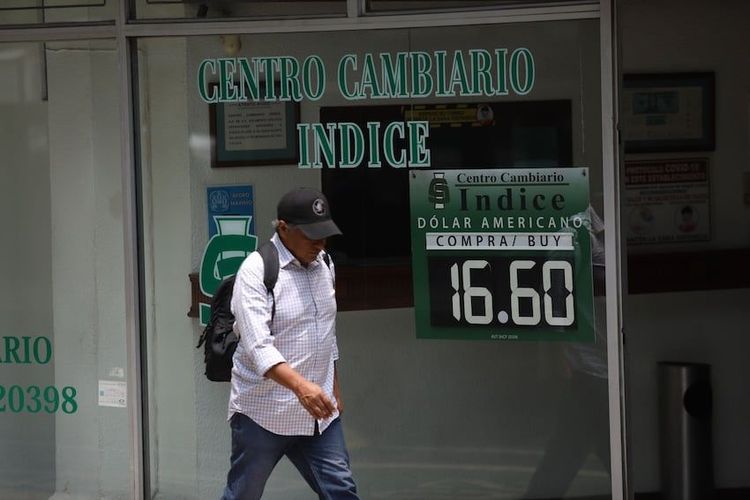
The currency stability pillar registered 6.79, down marginally from 6.8 in June. The peso strengthened 1% against the US dollar during July to trade at 17.32 per greenback at month-end. Daily exchange rate volatility decreased, with the standard deviation of daily movements falling to 0.40% from 0.49% in June.
The productivity pillar showed substantial improvement, rising to 6.4 from 3.8 after INEGI reported 1.7% annual productivity growth in the second quarter, a significant acceleration from the 0.1% gain in the first quarter.
External income sources weakened, with the pillar score falling to 5.26 from 6.52. Remittances grew 3% year-over-year in July, down from 4.2% growth in June, while tourism revenue declined 1.3% annually following a 5.9% increase in June when Mexico hosted most FIFA men's World Cup matches.
The sovereign risk pillar remained essentially stable at 7.41, with no changes to Mexico's credit ratings from major agencies and only a modest widening in the country's credit default swap spread to 87.19 basis points from 86.87 basis points.
Since the MND Economy Index began tracking Mexico's economic performance in March 2025, scores have ranged from a low of 56.9 to July's high of 73.1—a spread of 16.1 points. The index has climbed nearly 10 points between March and July 2026, reflecting substantial improvement in the Mexican economy's performance across multiple dimensions.