President Sheinbaum projects optimistic growth outlook as 2027 budget targets fiscal discipline
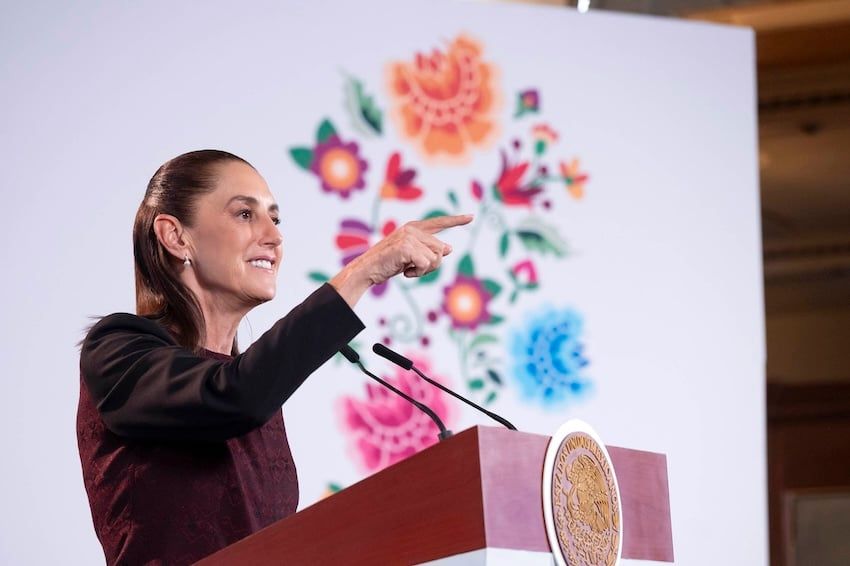
President Claudia Sheinbaum conveyed optimism about Mexico's economic trajectory during her Wednesday morning press conference, a day after Finance Minister Édgar Amador Zamora submitted the government's proposed 10.5-trillion-peso ($621 billion) budget for 2027 to federal Congress.
While the official forecast projects economic growth between 1.5% and 2.5% for next year, Sheinbaum suggested stronger expansion is achievable given pending public and public-private infrastructure initiatives. She also cited the prospect of improved trade relations with the United States and Canada as a potential catalyst for accelerated growth.
The president emphasized that no new taxes or fuel price increases are included in the budget proposal, despite the government's commitment to combat tax evasion.
There are no new taxes, that's the first thing. There are not going to be new taxes. Nor are there going to be gasolinazos.
Five pillars anchor fiscal strategy
Finance Minister Amador outlined the budget's framework around five core pillars:
- economic growth
- protection of government priorities
- strengthening of revenue
- more efficient spending
- fiscal discipline
The proposed package maintains government welfare programs while projecting a reduction in the public sector deficit to 3.9% of GDP in 2027 from 4.1% this year.
The budget projects total public debt, measured by the Historical Balance of Public Sector Borrowing Requirements, will reach 55.0% of GDP in 2027, compared with 54.0% estimated for year-end 2026. Headline inflation is forecast to finish 2027 at 3.0%, aligned with the Bank of Mexico's official target.
Amador pledged greater efficiency in tax collection while stressing that tax rates will remain unchanged.
Republican austerity measures are moving forward,
Strategic spending reductions and investment priorities
The budget reflects significant shifts in government spending priorities. State oil firm Pemex is allocated 81.1 billion pesos ($4.80 billion) for debt payments in 2027, a sharp decline from 263.5 billion pesos in the previous budget. This reduction demonstrates the government's commitment to fiscal discipline and more efficient resource allocation.
Sheinbaum stressed that the budget maintains all incentives for new investment, particularly those offered through Plan Mexico, the administration's economic development initiative. Launched in January 2025, Plan Mexico targets attracting $100 billion per year in foreign direct investment, positioning Mexico among the world's top 10 economies by 2030, and creating 1.5 million additional manufacturing jobs. The plan also seeks to increase the investment-to-GDP ratio above 28% by 2030.
Recent data supports the government's optimistic outlook. Mexico received a record $23.6 billion in foreign direct investment during the first quarter of 2026, representing a 10.4% increase compared to the same period in 2025, according to the Business Coordinating Council.
Trade relations and regulatory efficiency
Sheinbaum's confidence in improved trade stability comes as Mexico continues bilateral discussions with the United States on commercial matters. The USMCA trade agreement remains fully in force following the July 1, 2026 review, though it now faces annual reviews until 2036. Without an extension agreement among the three member countries during those reviews, the pact would expire on July 1, 2036.
President Sheinbaum and Economy Minister Marcelo Ebrard are scheduled to hold a video conference Wednesday with U.S. Commerce Secretary Howard Lutnick, who was confirmed by the Senate in February 2025 and leads the Trump administration's tariff and trade agenda. Mexico's central objective in these discussions is securing reductions in U.S. tariffs on Mexican vehicles, steel, and aluminum.
To facilitate investment, Plan Mexico includes streamlined approval processes. Mexican authorities have a maximum of 30 days to approve or deny strategic projects exceeding 2 billion pesos ($117 million) in the electronic, pharmaceutical, aerospace, energy, or technology industries, with a 90-day deadline for other sectors.
We're optimistic about what will happen in 2027 and we're also very satisfied with the economic package,
Our idea is that the economy could grow more,