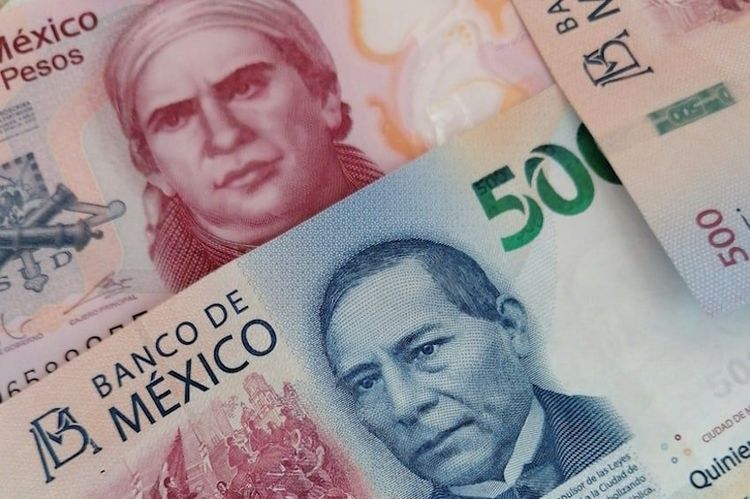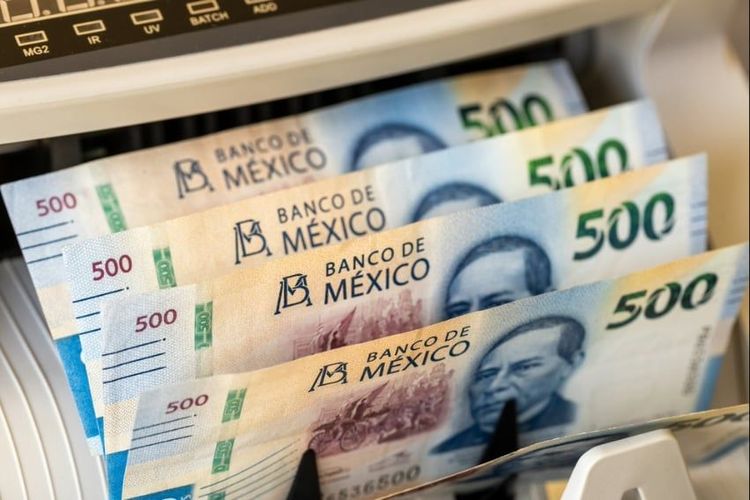
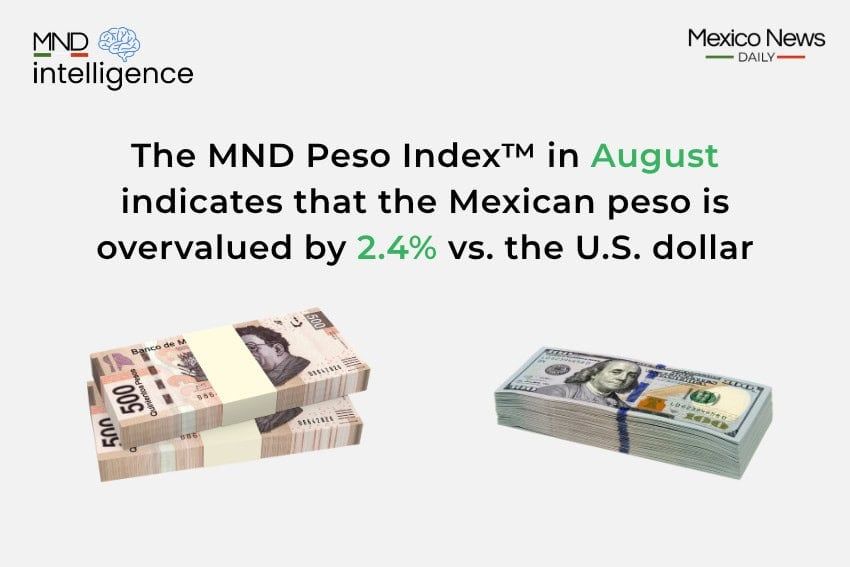
Is the peso punching above its weight? The results of our latest MND Peso Index™
The Mexican peso was overvalued against the US dollar by 2.4% in early August 2026, according to the latest MND Peso Index, a monthly purchasing power parity measure that compares the prices of 20 standardized goods and services in Mexico and Dallas, Texas.
The assessment marks a decrease from the 2.9% overvaluation recorded in late June, reflecting both peso appreciation and shifts in comparative pricing between the two markets.
Purchasing power parity, an economic theory credited to economist Gustav Cassel in the 1920s, compares the prices of a fixed basket of goods and services across countries to measure the relative value of currencies. When a currency is overvalued according to these metrics, it means that converting economic output at current exchange rates gives an overestimate of the true size of that economy, as goods and services cost more than they should relative to another currency.
How the index works
The MND Peso Index collected prices on August 6, 2026, when the Banxico FIX rate stood at 17.22 pesos per dollar. The Banxico FIX rate is the official exchange rate published by the Bank of Mexico and serves as a key benchmark for currency conversions and financial transactions in Mexico.
The index calculated an MND Peso Rate of 17.64 pesos per dollar, representing the simple average of implied exchange rates for all 20 items in the basket. The 42-centavo gap between this rate and the official Banxico rate indicates the peso's overvaluation.
In practical terms, if the exchange rate reflected the purchasing power of the peso for the basket's contents, it would be 17.64 rather than 17.22 to the dollar.
Narrowing overvaluation
The peso's overvaluation assessment declined between June and August due to changes in both the official exchange rate and the implied purchasing power rate. The MND Peso Rate fell by 37 centavos from 18.01 in late June to 17.64 in early August, while the Banxico FIX rate declined by 28 centavos over the same period.
Seven of the 20 items in the basket showed changed implied rates. Four products saw declining implied rates: diapers and motor oil due to price reductions in Mexico, and hoses and eggs due to price increases in Dallas. Three items showed rising implied rates: dog food and Costco rotisserie chicken due to Mexican price increases, and pet grooming due to a Dallas price reduction.
The peso has now been found overvalued in all four assessments conducted in 2026, with overvaluation rates of 2.8% in late April, 4% in late May, 2.9% in late June, and 2.4% in early August.
Peso appreciation continues
The peso has appreciated 5.4% against the dollar so far in 2026, building on a nearly 16% appreciation in 2025 that defied expectations of many economists and analysts. The currency closed 2025 at 18.00 to the dollar and stood at 17.08 on August 11, 2026.
The peso's strength in 2026 has occurred against a backdrop of fluctuating exchange rates. The currency reached its strongest point on February 22 at 17.10 per dollar and its weakest on March 29 at 18.14 per dollar, with an average rate of approximately 17.47 throughout the year.
The Bank of Mexico held its benchmark interest rate steady at 6.50% in July 2026, signaling it would maintain this level for an extended period due to uncertainty related to geopolitical conflicts and global trade policies. The central bank, whose primary mission is to preserve the value of the peso through monetary policy adjustments, projects headline inflation will converge to its 3% target in the fourth quarter of 2027. This target sits at the midpoint of a tolerance band ranging from 2% to 4%.
Inflation easing in both countries
Both the Mexican and US baskets of goods and services showed slight price decreases in early August compared to late June, each declining by 1%. The Mexican basket cost 5,650 pesos on August 6, down 59 pesos from June 29, while the Dallas basket cost $350.68, down $3.50 over the same period.
Mexico's annual headline inflation rate fell to 3.12% in July from 3.37% in June, while core inflation stood at 3.95%. Service-sector pressures persisted despite the overall decline, though the government attributed the improvement partly to measures stabilizing fuel prices and containing food costs, particularly tomatoes.
In the United States, the annual headline inflation rate eased to 3.4% in July from 3.5% in June.
Despite the peso-denominated price decline for the Mexican basket, its dollar-equivalent cost increased from $326.21 on June 29 to $328.12 on August 6 due to the peso's appreciation during this period.