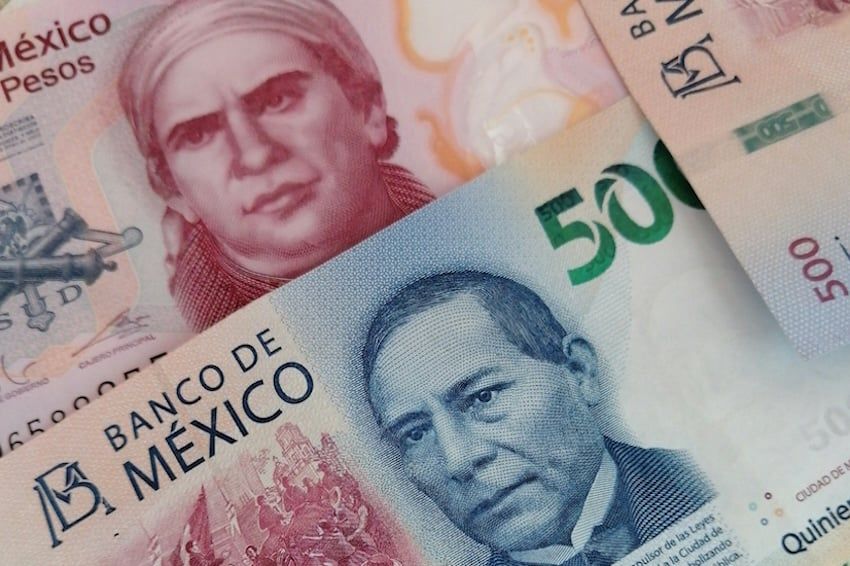
Mexican peso strengthens past 17 per dollar amid global market shifts
The Mexican peso broke through the psychologically important 17-to-the-dollar barrier Friday morning, trading at around 16.98 per U.S. dollar in wholesale transactions before rising slightly above 17 by midday.
The exchange rate reached 16.9965 pesos per dollar before 8 a.m. Mexico City time, representing a 0.20% appreciation for the peso, according to financial portal Bloomberg. By midday, the rate had edged up to 17.0389 to the dollar.
This marks the first time the intraday exchange rate has fallen below 17 since June 3, 2024, when President Claudia Sheinbaum and the Morena party secured a landslide electoral victory. The peso had previously touched similar strength levels on August 11, when it briefly traded near 17.08 against the dollar.
The currency closed Thursday at 17.0431 pesos per dollar, appreciating 0.13% from Wednesday's close. Over four consecutive sessions heading into Friday, the peso gained 0.9% and has now appreciated 5.2% for the year. This represents a dramatic recovery from the peso's weakest point in 2026, when it touched approximately 18.14 per dollar in late March.
Global factors and monetary policy
"The return of the super peso is due to the global weakness of the dollar amid increased uncertainty in the U.S. economy," Banamex analyst Paulina Anciola told El Universal newspaper.
The peso's strength reflects several converging factors. Recent U.S. consumer inflation data indicated price pressures had been temporarily contained, while global market volatility has subsided. The U.S. Federal Reserve has maintained its federal funds rate at 3.50%-3.75% through July, with the most recent decision on July 29 producing a divided 9-3 vote as three regional presidents dissented in favor of raising rates.
Meanwhile, Mexico's central bank, Banxico, has held its benchmark interest rate at 6.50% since a May 7 cut from 6.75%, signaling the likely conclusion of an easing cycle that began in March 2024. Since that cycle's start, Banxico has reduced rates by a cumulative 475 basis points across 15 meetings, with more than 60% of those cuts occurring in 2025.
This creates an interest rate differential of roughly 450 basis points favoring Mexico over the United States, a gap that has attracted international investors to Mexican assets. Anciola noted this differential, combined with greater global appetite for emerging market investments, has reinforced the peso's attractiveness.
Banxico projects headline inflation will converge to its 3% target by the second quarter of 2027, with forecasts of 3.5% for the fourth quarter of 2026.
Trade and fiscal uncertainties
Despite the peso's recent strength, Mexico faces ongoing uncertainties in both trade and fiscal policy. On July 1, 2026, the United States formally declined to extend the U.S.-Mexico-Canada trade agreement (USMCA) for another 16-year term, triggering an annual review process that will continue through 2036 unless the three countries agree to an extension. The agreement, which governs approximately $1.9-2 trillion in annual trilateral trade, remains fully in force during this period.
Additionally, S&P Global Ratings revised Mexico's sovereign credit outlook to negative from stable on May 12, citing weak fiscal results, rising debt levels and sluggish economic growth, while affirming the country's BBB rating.
"It would seem that the foreign exchange market has already internalized a significant part of the domestic uncertainty, both related to adjustments to the sovereign rating outlook, as well as in the trade arena in the face of the scenario of annual reviews of the U.S.-Mexico-Canada trade agreement and so far there have been no episodes of high volatility," Anciola said.
Market outlook
According to central bank data, Thursday's interbank exchange rate fluctuated between a maximum of 17.07 and a minimum of 17.03 pesos per dollar.
The private sector consensus forecasts a wholesale exchange rate of 17.90 pesos to the dollar by year-end, according to the latest Citigroup survey of 35 banks, brokerage firms and analysis groups.
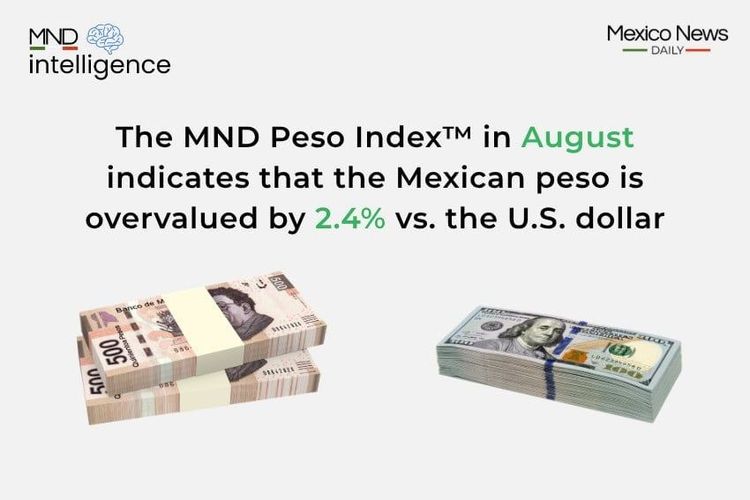
However, evidence suggests the peso may be overvalued. The most recent MND Peso Index™, which compares prices of a basket of goods and services in Mexico and Dallas, Texas, found the peso overvalued against the dollar by 2.4% in early August.