A traditional delicacy on a resort menu
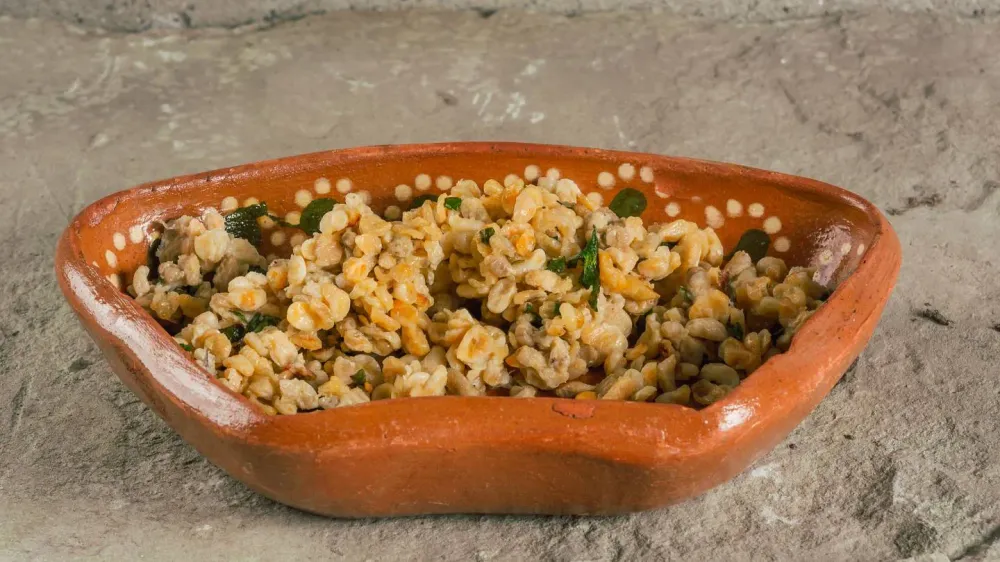
Despite the nickname "Mexican caviar," escamoles aren't fish eggs. They also go by "the caviar of the desert" and were valued by Aztec emperors long before their appearance on contemporary high-end tasting menus. Their name combines the Nahuatl words azcatl, or "ant," and molli, or "stew."
At Dos Almas, the resort's Mexican restaurant, the escamoles were sautéed and tucked into a warm corn tortilla with toasted pepitas and epazote, a pungent Mexican herb. The pumpkin seeds complemented their buttery, nutty taste.
The Mental Floss writer had previously eaten ground chicatana ants in the chile mayonnaise accompanying baby corn at Pujol, the Michelin-starred Mexico City restaurant. Eating recognizable escamoles in a taco made the experience of eating insects more immediate.
The caviar comparison also invites a price distinction. Mental Floss puts an ounce of mid-tier fish caviar at about $200, while escamoles can sell for upward of $100 per pound. For the ant delicacy, the difficulty of gathering it is central to its value.
Inside the harvest
Collectors known as escamoleros work in the underground nests of Liometopum apiculatum, the venomous velvety tree ants of central Mexico. The nests lie among agave and maguey roots. Traditional spring harvesting involves carefully scraping out the larvae; sustainable collection leaves the ants and their nest intact.
The Slow Food Foundation's Ark of Taste entry describes a brief availability window: 10 to 12 weeks between February and April, with each nest producing escamoles three to five times during that season. A 2025 study in Agricultura, Sociedad y Desarrollo reports a longer collection period, starting in the second half of February and potentially lasting until June when nests are well managed. Under poor management, the study says, collection ends in May.
Protecting a nest means preserving something that takes years to mature. According to Slow Food, a Liometopum apiculatum nest begins growing in its second or third year, at about 1.5 kg, and matures in its fifth or sixth year, when it weighs 5 to 6 kg. Its lifespan can reach about 20 years, depending on collectors' care and technique. The foundation specifies that sustainable harvesting removes no more than 70% of a nest's escamoles.
Prices and pressure on ant populations
The peer-reviewed 2025 Agricultura, Sociedad y Desarrollo study reports that rural communities in central Mexico are overexploiting the escamolera ant, that its populations have declined, and that regulation is lacking. It also notes a proposal to list the species under Mexico's NOM-059 standard as "Subject to Special Protection" (SSP), rather than an existing designation.
Interviews conducted for that study in north-central Mexico offer a separate view of prices at the collector level. Respondents reported escamol prices of about $16 to $42 per kilogram in U.S. dollars. Their reported annual earnings from gathering three insects—escamol, red worm and white worm—ranged from roughly $351 to $1,580 per person.
Nutritional content and frozen storage
Slow Food reports that a 100 g serving supplies about 157 kcal, 42 g of protein, 11 g of fat and 3 g of fiber, as well as numerous amino acids.
The foundation also cites laboratory tests on storage beyond the harvest season. Those tests found that raw or cooked escamoles could remain frozen at -10 to -15 °C for as long as two years without losing flavor or nutritional value.
The rest of the tasting
Escamoles were one course in a meal built around Mexican flavors. A crisp taco dorado combined a pork-and-potato filling with hamachi tartare and green onion oil. A smoky taco brasero featured lobster and chipotle mayonnaise, while another course served pork belly with Oaxaca-style manchamantel mole.
The writer's favorite was steak in a flour tortilla crusted with queso and finished with charred avocado. Regional spirits accompanied each course, with pairings ranging from mezcal to licor de elote, or corn liqueur.
The experience challenged expectations formed during the writer's first Cancun-area all-inclusive stay more than a decade earlier, when disappointing food had seemed part of the bargain. For this trip, booked through Apple Vacations, the anticipated benefits were convenience, bundled flights and airport transfers—not a memorable tasting menu.
The writer also pointed to Indigenous history and culture elsewhere on the property. Its year-round "Roads Through Mexico" program features regional folk art, live music and local food. Experiencing the program during Día de los Muertos reinforced the writer's impression that a resort stay could include meaningful encounters with the surrounding culture.