The kidnapping of Mexican cartel leader El Mayo Zambada: Competing accounts from López Obrador and Ken Salazar
The capture of Ismael "El Mayo" Zambada on July 25, 2024, has become a flashpoint in U.S.-Mexico relations, with newly published memoirs from former Mexican president Andrés Manuel López Obrador and former U.S. ambassador Ken Salazar offering starkly different accounts of what transpired. The operation, which delivered one of Mexico's most wanted criminals to American authorities, has left fundamental questions unanswered about Washington's role in an event that triggered a devastating wave of violence in Sinaloa state.
Zambada, who had evaded capture for more than four decades in drug trafficking and was one of the few old-guard cartel bosses never to see the inside of a prison, was taken into custody under circumstances that remain disputed. The U.S. government had offered a $15 million reward for information leading to his arrest, underscoring the priority Washington placed on bringing him to justice.
What is not in dispute is that Joaquín Guzmán López, son of imprisoned cartel boss Joaquín "El Chapo" Guzmán, orchestrated his godfather's handover to U.S. authorities. Court documents from Guzmán López's December 2025 guilty plea revealed that armed men entered through a window to ambush Zambada, who was then drugged and loaded onto a plane. The betrayal by Los Chapitos, the cartel faction led by El Chapo's sons, against their father's former partner has sent shockwaves through Mexico's criminal underworld.
The ambassador's account
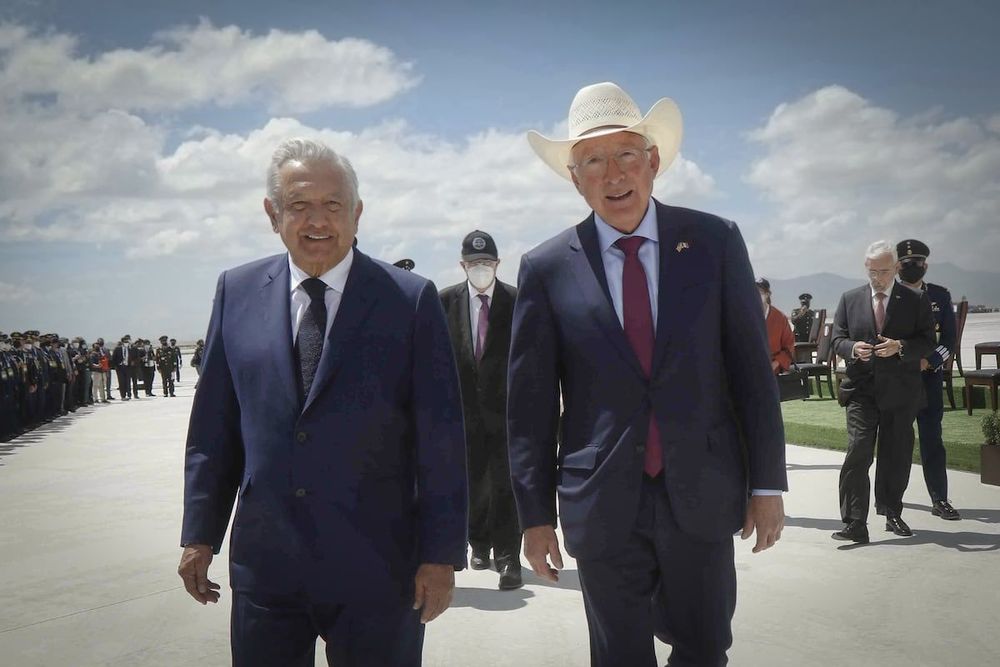
In his memoir Borderlands, presented in Mexico City this week, Salazar — who served as U.S. ambassador from September 2021 to January 2025 — insists the United States provided no resources for the operation and learned of it only after the Beechcraft King Air carrying Zambada had already taken off from Culiacán and was approaching the border.
According to Salazar's version, the aircraft switched off its tracking systems and reappeared near U.S. territory. "A call was put out to U.S. law enforcement" only then, he writes. When agents boarded the plane in Santa Teresa, New Mexico, they found "a heavily sedated figure zip-tied in his seat" — Zambada himself.
The former ambassador says he moved quickly to reassure López Obrador that Washington "had not been directly involved in any way" and that "under no circumstances had we conducted an unsanctioned operation on Mexican soil, which would have been a grave violation of their sovereignty." Salazar characterizes the operation as a "betrayal" by Guzmán López and describes it as coming as "a complete surprise" to U.S. authorities.
The president's accusation
López Obrador, whose six-year term ended in September 2024 — shortly after Zambada's capture — offers a sharply different narrative in his newly published book Pueblo. He directly accuses the U.S. State Department and security agencies of reaching an agreement with El Chapo's sons "in an irresponsible, clandestine and extraterritorial manner" to "kidnap and transport Zambada to the United States on a private aircraft."
The former president cites a letter that Salazar sent to then-attorney general Alejandro Gertz two days after the operation. According to López Obrador's account, that letter contradicts Washington's categorical denials of prior knowledge. "Ambassador Ken Salazar wrote in writing on July 27 that 'law enforcement' in his country 'had been informed on several prior occasions that Joaquín Guzmán López was considering surrendering to U.S. authorities,'" López Obrador writes.
The letter, as quoted by López Obrador, further stated that on the morning of July 25, U.S. authorities were informed Guzmán López would surrender that day, and that at 2:40 p.m., "once the aircraft was already in the air, they were informed again that Ismael Zambada might also be on board."
López Obrador says he immediately asked the heads of Mexico's Attorney General's Office, National Guard and Armed Forces whether there had been "any possible involvement" on Mexico's part, receiving "an unequivocal no." He describes the Zambada affair as "the only serious incident or disagreement" with the Biden administration.
The human cost
Beyond the diplomatic dispute lies a humanitarian crisis. The internecine war between La Mayiza — the cartel faction loyal to Zambada — and Los Chapitos has now raged for more than two years. Mexico's Secretary of Defense reported at least 30 deaths in shootouts between the rival factions beginning September 9, 2024, just weeks after the capture.
The violence has only intensified. A CNN analysis of public data found that the rate of killings in Sinaloa surged by more than 400 percent following Zambada's arrest. As of September 2025, approximately 1,800 people had been killed and hundreds more had disappeared in the conflict.
López Obrador argues in his book that if Zambada had been arrested by Mexican security forces instead, "the odious revenge would have been avoided." The former president laments that respect for Mexico's sovereignty was disregarded in the operation.
Legal outcomes and cooperation deals
The legal proceedings that followed have only added complexity to the story. Zambada pleaded guilty on August 25, 2025, to racketeering conspiracy and running a continuing criminal enterprise. He was sentenced to life in prison on July 20, 2026.
Meanwhile, evidence has emerged of cooperation agreements between U.S. authorities and members of Los Chapitos. Ovidio Guzmán López, known as "El Ratón" and another of El Chapo's sons, pleaded guilty on July 11, 2025, to drug trafficking and organized crime charges in Chicago. As part of his deal with prosecutors, 17 members of his extended family crossed into the United States in May 2025 to be placed under protection.
Documents in the case against pilot Mauro Alberto Núñez Ojeda, who flew the aircraft, requested that the indictment remain sealed "to protect the safety of cooperating witnesses" and "to ensure the safety of additional witnesses and their family members."
A broken friendship
The capture and its aftermath fractured what had been a cordial working relationship between Salazar and López Obrador. The Mexican president never responded to Salazar's July 27 memorandum and did not meet with him again. "The open door I'd enjoyed with the Mexican president appeared to have been slammed shut," Salazar writes, noting that the two ceased to be "friends."
Claudia Sheinbaum, who succeeded López Obrador as Mexico's president on October 1, 2024, becoming the country's first female head of state, inherited a relationship strained by unresolved questions. The FBI's decision in July to display the Beechcraft King Air in a museum reignited controversy in Mexico, with critics viewing it as an insensitive celebration of an operation many Mexicans see as a violation of their nation's sovereignty.
As the violence in Sinaloa continues and the competing narratives remain unreconciled, the full truth of what happened on July 25, 2024, may never be fully known. What is certain is that the operation — whether a spontaneous betrayal or a coordinated effort — has left deep scars on both sides of the border.