Mexico reports 53% drop in daily homicides as security strategy shows results
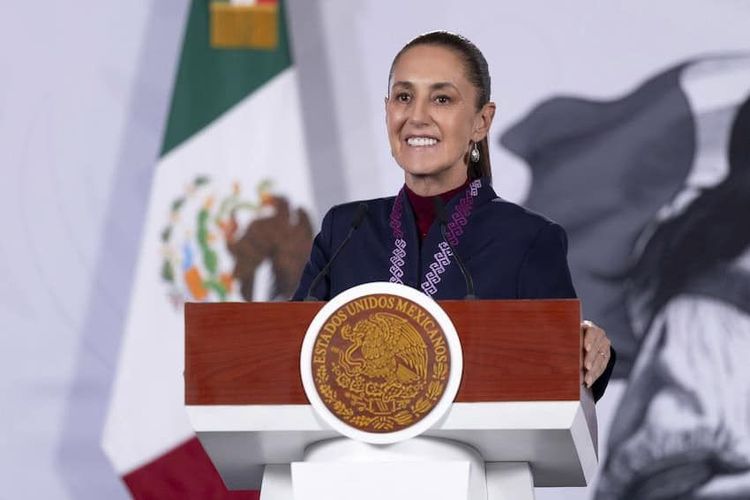
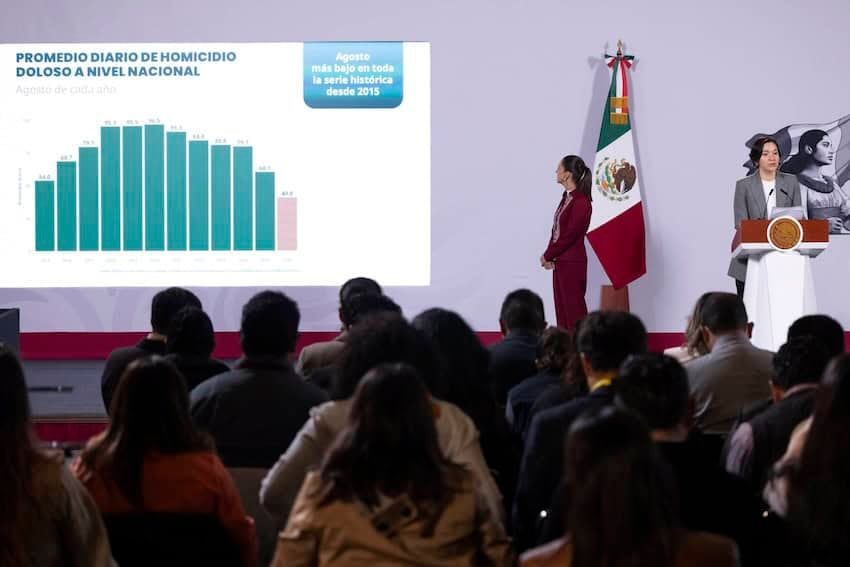
Mexico's National Public Security System (SESNSP) reported Tuesday that daily homicides averaged 40.8 in August 2026, a 53% reduction compared to September 2024 when the rate stood at 86.9 per day. The figures, presented during President Claudia Sheinbaum's morning press conference, mark the lowest monthly average since she assumed office in October 2024.
SESNSP chief Marcela Figueroa highlighted that August was the least violent eighth month of the year since 2015, with homicides declining 32.1% compared to August 2025. The preliminary annualized per capita homicide rate for 2026 stands at 12.9 per 100,000 people, down 38.6% year-over-year.
Data methodology and discrepancies
However, Mexico tracks homicides through two distinct systems that produce different tallies. While SESNSP reports monthly homicide investigations opened by state prosecutors, the national statistics institute INEGI counts deaths from death certificates and civil registries. INEGI's figures consistently run higher because they capture homicides never formally investigated, though they are released with a longer time lag.
For context, SESNSP data showed Mexico recorded 23,609 intentional homicide victims in 2025 at a rate of 17.7 per 100,000 people, representing a 21.5% drop from 2024. The first five months of 2026 saw 7,617 victims, down 29.8% versus the same period in 2025.
The current administration inherited significant security challenges. During former President Andrés Manuel López Obrador's six-year term from 2018 to 2024, more than 199,000 homicides were registered across Mexico.
Regional breakdown of violence
Between January and August 2026, Mexico recorded 11,586 homicides nationwide. Nearly half of these murders occurred in seven states: Guanajuato (983), Baja California (970), Chihuahua (924), Sinaloa (866), México state (702), Guerrero (652), and Morelos (618).
Thirty of Mexico's 32 states registered year-over-year declines in homicides during this period. The sharpest reductions came in San Luis Potosí (down 79.8%), Nayarit (down 65.3%), Quintana Roo (down 59.9%), Baja California Sur (down 53.8%), and Zacatecas (down 51.3%). Only Oaxaca and Coahuila failed to show improvement.
Security Minister Omar García Harfuch acknowledged the progress while cautioning against complacency.
The reduction in homicides doesn't mean the job is done. There are still regions that require ongoing attention as well as crimes we face every day.
Operation Swarm and arrests
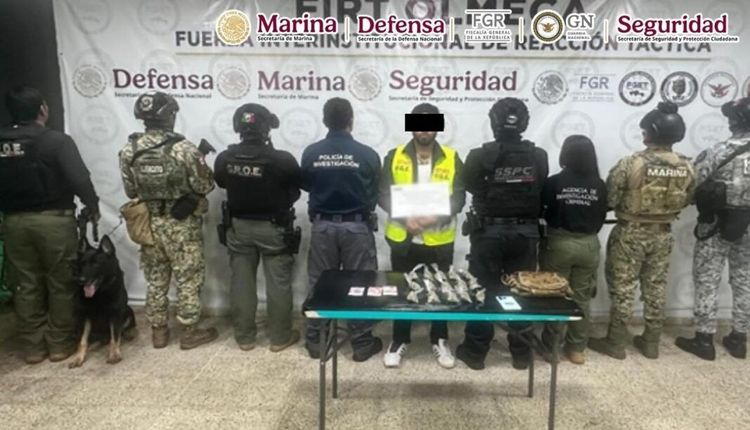
García Harfuch reported that 67,253 people were arrested between October 2024 and August 2026 for allegedly committing high-impact crimes. Among those detained were 111 public officials, including mayors, as part of Operación Enjambre (Operation Swarm), a federal initiative targeting collusion between organized crime and municipal authorities.
The operation, launched in November 2024, has resulted in 147 public servant arrests across seven states by May 2026, including at least 16 sitting or former mayors. The effort has yielded 20 convictions totaling more than 1,146 years in prison for crimes including homicide, kidnapping, extortion, and forced disappearance.
The president's instruction is zero tolerance of corruption and zero impunity without concern for a person's position or political affiliation,
Weapons seizures and drug confiscations
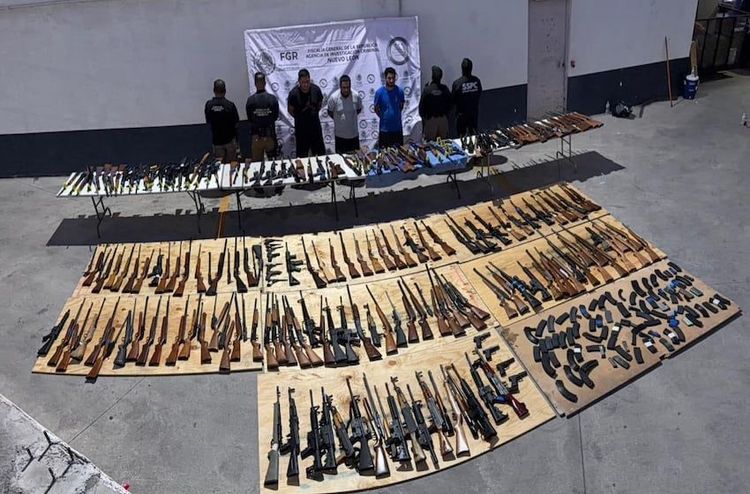
Authorities seized 34,353 firearms between October 2024 and August 2026, with 80% originating from the United States. Long guns comprised 61% of confiscated weapons, with significant concentrations in Sinaloa, Sonora, and Baja California.
The Mexican Navy confiscated 88 tonnes of cocaine at sea during this period, while land-based operations seized 534.8 tonnes of drugs.
High-profile arrests and cartel operations
High-profile arrests during Sheinbaum's tenure include Jalisco New Generation Cartel (CJNG) leader Nemesio Rubén "El Mencho" Oseguera Cervantes, who was fatally wounded during a February 2026 operation in Jalisco. The operation triggered immediate nationwide retaliation, with violence erupting in at least 20 states through narco-roadblocks and arson attacks. The confrontations resulted in 62 deaths, including 25 National Guard members killed in armed clashes in Jalisco.
The pressure on CJNG leadership preceded El Mencho's death. In August 2025, Mexico conducted one of its largest mass extraditions of drug lords to the United States, including Abigael González (alias El Cuini), the cartel's alleged financial mastermind and El Mencho's brother-in-law. In September 2024, El Mencho's son Rubén Oseguera González (El Menchito) received a life sentence in U.S. court for drug trafficking.
A notable decline in Mexico's daily homicide rate occurred in April 2025, dropping from an average of 75 to 66 daily killings. This shift came roughly one month after authorities extradited 29 high-level drug traffickers from Mexican jails to the United States in March 2025, with analysts observing that jailed drug lords often continue directing operations from Mexican prisons.
Government security strategy
The federal government attributes the declining violence to its four-pillar security strategy addressing root causes of crime. The fourth pillar focuses on coordination between federal, state, and local security institutions, requiring alignment among the Security Cabinet—which includes the president's office, Security Ministry, Interior Ministry, army and navy—and close coordination with state authorities.
Figueroa emphasized that the results
reflect the impact of ongoing coordination
between the federal Security Cabinet and state governments.
High-impact crimes averaged 391 reports per day in August, down 39% from October 2024 and 35% from September 2024. This category encompasses homicides, femicides, kidnappings, extortion, violent robberies, and rape.
Persistent concerns and skepticism
Despite the overall statistical improvements, violence against specific groups remains elevated. According to the Mexican NGO Common Cause, 56 politicians were killed in 2025, including seven sitting mayors, underscoring persistent security vulnerabilities.
President Sheinbaum and federal officials maintain that homicide reductions validate their security approach. However, National Action Party Senator Ricardo Anaya voiced skepticism about the accuracy of government homicide figures during a speech responding to Sheinbaum's second annual government report last week.
Sheinbaum rejected claims of data manipulation in a July 14 statement.
Homicide is homicide, there is no manipulation,