Public construction and economic growth
During the Saturday inspection, Sheinbaum pointed to third-quarter economic growth of 3.2% year over year, citing the National Institute of Statistics and Geography (Inegi). Earlier estimates had put growth at no more than 1%, she said.
"I always said: they're not counting the public works and the housing we're building. And it's showing its results," Sheinbaum said, according to La Jornada.
The president put the length of railways now under construction nationwide at at least 2,500 kilometers. About 300 kilometers are for freight, while the remainder will carry passengers. She said the passenger routes would connect cities and provide metropolitan transportation, comparing that role to building metro systems.
Construction advances on the Querétaro-Irapuato route
Andrés Lajous, who heads the Agency of Trains and Integrated Public Transportation (ATTRAPI), reported overall progress of 24.71% on the approximately 102-kilometer Querétaro-Irapuato section. The project includes 10 viaducts and a tunnel in Celaya, with stations serving Apaseo, Celaya, Cortazar, Villagrán, Salamanca and Irapuato. Lajous said construction is supporting 3,365 direct jobs and 5,700 indirect jobs.
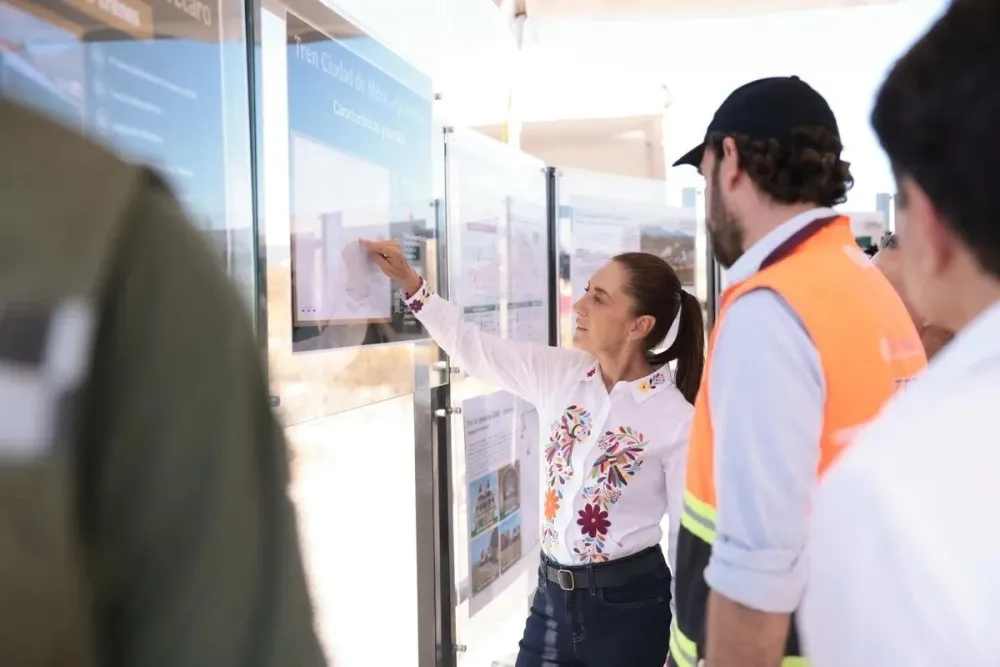
One of the more advanced structures is the viaduct over the municipal garbage dump, which was 86.15% complete at the time of the visit. Previously known as the "Garbage Dump Viaduct," it is the project's second-longest structure: 1,096 meters, extending to nearly 1.5 kilometers when its two access sections are included. Sheinbaum requested a new name and later told reporters it would be called the Apaseo Viaduct. She also said she and Guanajuato Governor Libia Dennise García had agreed to close the dump.
The project's longest structure, the Celaya Viaduct, measures 1.84 kilometers before its access sections and was 19.37% complete. Its construction requires changes to freight tracks and industrial sidings to allow local industry to continue operating.
Work on the Celaya box tunnel had reached 14.18%, according to ATTRAPI construction unit head Efraín Deschamps Gutiérrez de Velasco. Crews had installed 1,319 of the planned 1,719 piles. The tunnel itself is about 1.5 kilometers long, or roughly 1.9 kilometers including access ramps.
Initial service plans and train production
ATTRAPI plans to begin the Querétaro-Irapuato line's first stage of service between Querétaro and Celaya. Work priorities include the Apaseo and Celaya stations, along with workshops, depots and a refueling area in Celaya. Lajous said authorities estimate the project will benefit about 2 million people in Mexico's densely populated central region.
For the México-Querétaro line, Lajous said the first train is due to arrive in June 2027, allowing testing to begin. The Presidency's April 27, 2025 announcement outlined a 226-kilometer, double-track route designed for speeds of up to 200 km/h. The plan aims to reduce the Mexico City-Querétaro journey from as much as six hours to about two, with stations at Huehuetoca in the State of Mexico, Tula in Hidalgo and San Juan del Río in Querétaro.
Alstom has begun manufacturing 47 diesel-electric passenger trains for the new corridors at its Ciudad Sahagún plant in Hidalgo, Lajous said. The 100-meter units can be coupled to accommodate greater demand and will have configurations for short- and long-distance trips.
Governors back the project as land concerns await talks
Guanajuato Governor Libia Dennise García Muñoz Ledo and Querétaro Governor Mauricio Kuri, both members of the PAN, welcomed the project and emphasized the regional connections it would provide.
"We are from different political parties, but that has nothing to do with it when we work together for the good of the people," Sheinbaum said.
Separately, Guanajuato state government secretary Jorge Jiménez Lona said a meeting was planned for the following week with farmers, ejidatarios and residents of communities in Purísima del Rincón. Those groups oppose the passenger train's preliminary route because of its expected impact on their land. Federal and municipal authorities were also scheduled to participate.