New rates and a request for exemptions
Under Resolution DDG-AR1-2026-00009, the annual vehicle circulation tax, known as the marbete, is RD$2,000 for vehicles manufactured in 2021 or earlier and RD$4,000 for those manufactured in 2022 or later. The increases to the two fixed rates are RD$500 and RD$1,000, respectively.
Pérez Figuereo, president of the National Central of Unified Transporters (CNTU), asked the government to spare vehicles more than 20 years old from the increase. He said their owners are mostly transport workers who cannot afford another tax burden.
In an interview, he proposed a gradual increase and an exemption for vehicles manufactured in 2006 or earlier. He said the announcement surprised the transport sector at a time of rising fuel prices and living costs.
Drivers describe mounting expenses
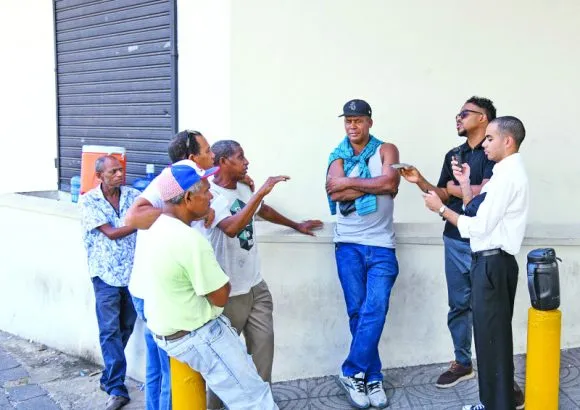
At José Reyes Street and Mexico Avenue, drivers on the 25 de Febrero route complained that the higher tax would add to already difficult working conditions.
Route controller Ángel Antonio Ferreiras, who said he had spent more than three decades in the job, described drivers struggling to bring home enough money for food. He said they felt abandoned and were working without pay.
Ferreiras blamed the government for higher gas prices and pointed to other operating expenses: RD$3,000 for a tire and RD$400 for oil that previously cost RD$150.
Private vehicle owners also objected. César Morillo, speaking while running errands on Mexico Avenue in the National District, said the increase was excessive when salaries had not changed and owners already had to cover fuel and oil changes.
For Job Batista Ramírez, a father living in Santo Domingo Este, the age categories raised a fairness issue. He objected to charging the same amount for a 1990 vehicle as for a 2021 model, saying owners do not all have the same means to maintain a vehicle in good condition.
Transport representatives split over fares
Ferreiras warned that drivers might respond by raising fares. To avoid that, he proposed having Intrant conduct a census of every route and providing gas bonuses to all drivers.
Juan Carlos, president of the route, said current conditions justified higher fares but that drivers would not act without authorization from the National Central Movement of Transport Drivers (Mochotran).
Pérez Figuereo opposed passing the burden to passengers. He described union leaders who propose fare increases whenever the sector encounters difficulties as out of touch, saying Dominicans already face substantial economic pressure. He urged transport representatives to pursue solutions that would not impose further hardship on the public.
Mario Díaz, general secretary of the National Federation of Christian Social Transport Workers (Fenattransc), defended the tax increase. He considered an additional RD$1,000 insignificant relative to transport operators' and private drivers' expenses and said the government needed more revenue because of the economic crisis.
Pérez Figuereo also called for a nonviolent approach to drivers operating outside unions and other transport organizations. Although he said the CNTU did not support informal or disorganized services, he favored inviting those drivers into unions and transport companies. He said the CNTU was open to people who needed work and wanted to join an organized operation.
DGII cites inflation; opposition challenges the policy
The DGII said the fixed marbete fees had last been adjusted in 2016. With accumulated inflation reaching 58.1% between September 2016 and September 2026, the agency said a full inflation adjustment would have produced fees of RD$2,372 and RD$4,743, rather than the RD$2,000 and RD$4,000 it adopted.
For the 2026-2027 season, the agency projects that the update will lift vehicle circulation tax receipts from about RD$3,525 million to RD$4,700 million, generating an estimated RD$1,175 million in additional revenue.
The DGII described the change as a complementary step in its effort to strengthen public revenue, consistent with the objectives of Law 30-26 on Pro-Growth Economic Measures, Fiscal Simplification and Mitigation of the International Crisis.
The opposition party Fuerza del Pueblo challenged that rationale through economist Haivanjoe Ng Cortiñas. He characterized the policy as asymmetric, saying the government was recognizing 84% of inflation immediately when raising the marbete, but only 73% when protecting workers' income, with the latter adjustment deferred until 2027.
How the fixed fees developed
According to Diario Libre, the previous increase took effect on October 3, 2016, during Magín Díaz's tenure as DGII director. The lower rate went from RD$1,200 to RD$1,500, a 25% increase, while the higher rate rose from RD$2,200 to RD$3,000, or 36.4%. Those amounts remained in place for a decade.
Revenue nevertheless grew by about 132% in nominal terms over that period, Diario Libre reported. Collections totaled roughly RD$1,288 million from 978,176 renewals in the 2015-2016 campaign, compared with RD$2,986.7 million from 1,784,234 on-time renewals in 2025-2026.
The newspaper also traced changes in the tax's legal basis. Law 495-06, enacted in 2006, combined vehicle age and value, charging 1% of value for vehicles up to five years old. Law 225-07 subsequently established fixed fees of RD$1,200 for vehicles more than five years old and RD$2,200 for newer vehicles. Law 253-12, enacted in 2012, again established a tax of 1% of vehicle value, although the fixed fees continued to be applied.
Renewal deadlines and penalties
The payment deadline is January 31, 2027, but renewals through the DGII website and DGII Móvil app close earlier, on January 17. The agency reported 2,136,468 vehicles eligible for renewal in the 2026-2027 season and said service would be available through 55 financial institutions with 845 branches nationwide.
Vehicles not renewed by the current deadline face a RD$2,000 penalty. For vehicles whose 2025-2026 marbete was not renewed, the penalty is RD$2,100: a RD$2,000 non-renewal sanction plus RD$100 for administrative cessation.
Vehicles with unrenewed marbetes from 2024-2025 or earlier face a RD$3,100 penalty, comprising a RD$3,000 sanction and the RD$100 administrative cessation charge.