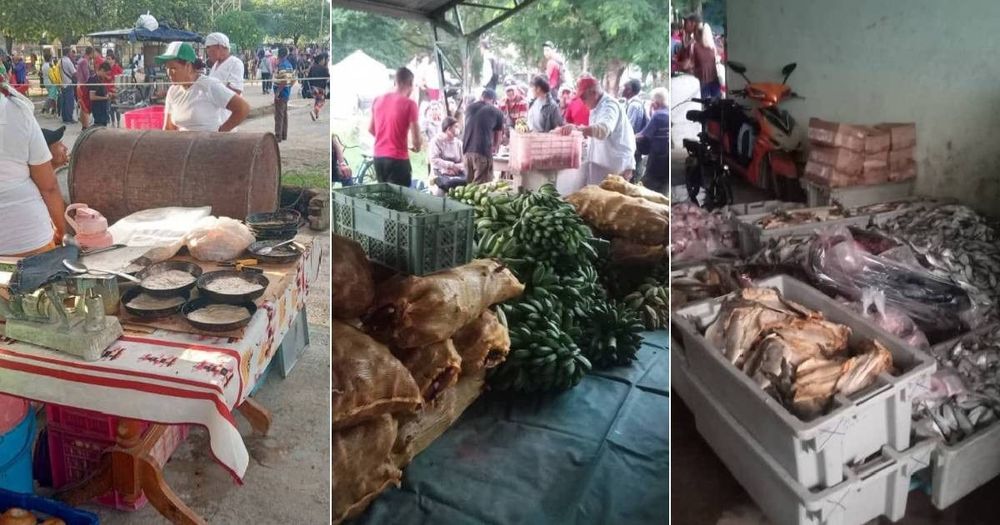
Shoppers challenge the fair's offerings
Tiempo 21 praised the "quality, variety, and costs" of goods supplied by the Provincial Food Industry Enterprise. Facebook comments described shoppers arriving too late to find what they needed. "There's supposedly everything, but by the time you get there, nothing's left," one resident wrote.
Bananas drew particular criticism: residents reported a price of 60 pesos apiece at the fair, compared with prices of 35, 40, 45 or 50 pesos at informal markets. Some also complained about their quality, describing the fruit as "nothing but peels."
Access depended on payment options as well as availability. Several residents said sellers often refused electronic payments. One shopper recounted a fish vendor saying, "we accept it, but I forgot the QR code." Another said repeated payment problems had discouraged them from making the long trip, only to leave exhausted and without purchases.
A commenter blamed the lack of purchase limits for allowing customers with cash to buy up supplies early amid strong demand for the recurring events. Others questioned whom the fair served: one accused officials of attending for photographs and called it "mere publicity," while another described its prices as "unattainable for state workers earning starvation wages and retirees with meager pensions."
Food prices outpace household incomes
The average monthly state salary is about 7,074 pesos, against independent estimates of 50,000 to 96,000 pesos a month to cover one person's basic needs.
Official figures also show steep food inflation. According to the National Office of Statistics and Information (ONEI), cited by Tiempo 21, consumer prices in September 2026 were 28.44% higher than a year earlier, with a cumulative increase of 24.85% from January through September. Food and non-alcoholic beverages rose 42.66% year over year and accounted for 73.39% of the monthly inflation contribution.
Tiempo 21's October reporting put a 30-egg carton at roughly 4,500 Cuban pesos (CUP) on the informal market. Powdered milk cost 4,000 to 4,500 CUP per kilogram, while vegetable oil in quantities of about one liter or 900 milliliters cost 2,200 to 3,500 CUP. Brazilian rice exceeded 950 CUP per kilogram. In the preceding weeks, the informal exchange rate ranged from 780 to 810 CUP per US dollar.
The regulatory backdrop changed earlier in the year. Resolution 150/2026, dated June 21, removed price caps on several basic products. CiberCuba linked that decision to worsening inflation while most Cubans' earnings were already insufficient to meet basic needs.
Earlier fairs faced price and supply problems
Saturday's criticism followed months of complaints and disruptions. The provincial government canceled the fair in May because it lacked fuel to transport goods from the municipalities. That same month, dozens of buses were mobilized in Havana for a Communist Youth Union political event supporting Raúl Castro.
At June's Father's Day fair, yogurt sold for 490 pesos and ice cream for 1,460 pesos. A carton of eggs cost 2,600 pesos in July, equivalent at the time to about 85% of the minimum monthly pension. Tiempo 21 called the July event "a challenge to resilience"; some residents instead called it "the fair of misery" and "a charade."
CiberCuba reported that state agricultural entities from five of the province's eight municipalities supplied more than 800 quintales, or hundredweight units, of root crops, vegetables, fruits and greens for the July 4 fair. But electricity outages stopped production at the provincial dairy and meat companies, preventing their normal participation.
Those production problems occurred during severe nationwide power shortages. In early July, CiberCuba reported an electricity deficit of 2,206 MW, just below the historic record of 2,208 MW set on June 25. Blackouts affected up to 70% of the island, with some areas losing electricity for 20 to 24 hours a day.
Poverty and food assistance
Research by sociologist Mayra Espina, published in September 2026 and reported by Infobae, estimated that 66% of Cuba's population lived in economic poverty because their incomes could not cover a basic food basket calculated at about $14 a month. The study identified 1,365,000 people in vulnerable circumstances, compared with the 876,000 officially recognized by the government in July.
The state-run System of Attention to Families, established during the crisis of the 1990s, operates more than 4,400 food-service units and provides three subsidized meals daily to more than 66,000 economically vulnerable people, according to Infobae. Beneficiaries said portions and offerings had deteriorated during 2026: beans had become infrequent, and chicken had been distributed only once so far that year.
Infobae also reported that the World Food Programme approved more than $116 million in June 2026 for support to Cuba through 2030. Its programs are intended to strengthen food security, assist social protection structures and support local production.