Federal and Jalisco governments unite to address water crisis affecting 5.6 million in Guadalajara metro area
The federal and Jalisco state governments have announced a collaborative effort to resolve the long-standing water contamination crisis affecting the Guadalajara metropolitan area, home to approximately 5.6 million residents. The initiative will focus on rehabilitating deteriorating infrastructure, cleaning up polluted waterways, and enforcing regulations against industrial polluters.
At President Sheinbaum's morning press conference Thursday, Efraín Morales López, director general of the National Water Commission (Conagua), confirmed the federal government's technical support role in addressing water quality issues across the metropolitan zone.
We are doing our part from the Federation to provide technical support so that the project is a real solution to the problems experienced in the city of Guadalajara as well as its metropolitan area.
Aging infrastructure demands urgent attention
The crisis stems largely from the deteriorated condition of the Chapala aqueduct, which carries water from Lake Chapala to Guadalajara. Lake Chapala supplies approximately 60-65% of the city's water, with local aquifers providing the remaining 30-35%, making it the region's critical water source.
The aqueduct system, with components dating back to 1953, has suffered from decades of inadequate maintenance. Morales explained that the pipeline now faces severe internal corrosion, frequent leaks, and reduced capacity, increasing failure risks and allowing sediments and contaminants to enter the distribution network.
The rehabilitation project will modernize this essential infrastructure to ensure safer, more reliable water delivery to the metropolitan area.
Tackling industrial pollution at its source
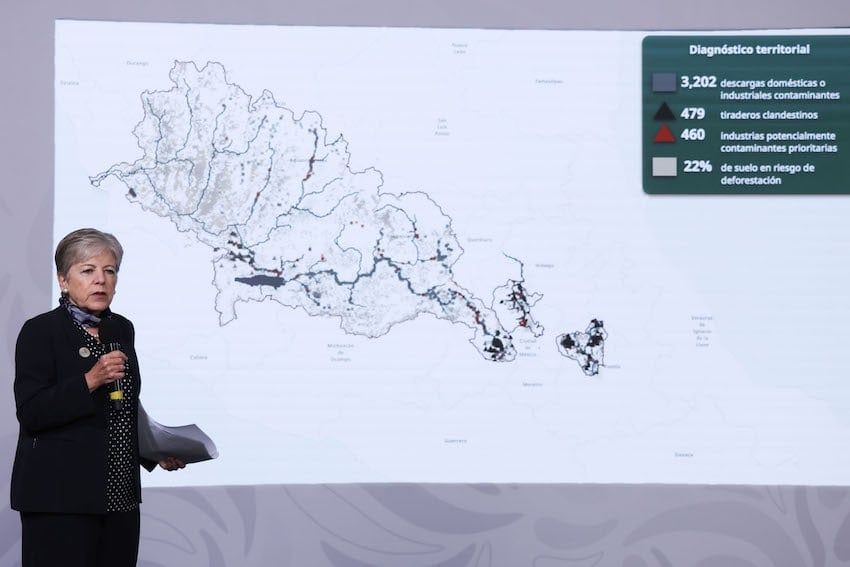
Environment Minister Alicia Bárcena addressed another major contributor to the water crisis: industrial contamination of the Lerma-Santiago river basin. The basin covers over 52,000 square kilometers across five Mexican states and more than 100 municipalities, making it one of the country's most important watersheds.
Industrial discharge is crucial as that's where heavy metals and truly toxic products come from, and Lerma is one of the rivers presenting such a problem.
The National Water Commission has declared the Upper Lerma-Santiago river water unfit for human consumption, with dissolved oxygen levels near zero during dry season and biological oxygen demand exceeding 100 mg/l. The pollution stems from decades of industrialization; the region transformed into a major industrial hub during the 1970s, with rapid growth leading to severe contamination from uncontrolled emissions and inadequate waste management.
Bárcena confirmed that companies suspected of illegally discharging industrial waste have been identified and are under inspection. Those found violating environmental regulations will face penalties.
National Water Plan funding
The cleanup effort forms part of the 2024-2030 National Water Plan, which allocates 20 billion pesos (US $1.15 billion) for 2025. The six-year plan includes approximately 122.6 billion pesos in total water infrastructure investments, with priorities including river cleanup programs and new wastewater treatment plants for the Atoyac, Lerma-Santiago and Tula river basins.
The cleanup of these three rivers, identified as Mexico's most polluted waterways, represents Commitment 92 of President Sheinbaum's 100 campaign commitments, underscoring the administration's prioritization of environmental restoration.
Local strategy remains essential
While the federal government has pledged technical assistance and regulatory enforcement, experts maintain that resolving Guadalajara's water crisis will also require robust local strategies and sustained coordination between all levels of government.
The joint initiative represents a significant step toward addressing a crisis that has threatened public health and quality of life for millions of residents in Mexico's third-largest metropolitan area.