Sheinbaum Index drops to 67.9 as security and employment challenges persist in August
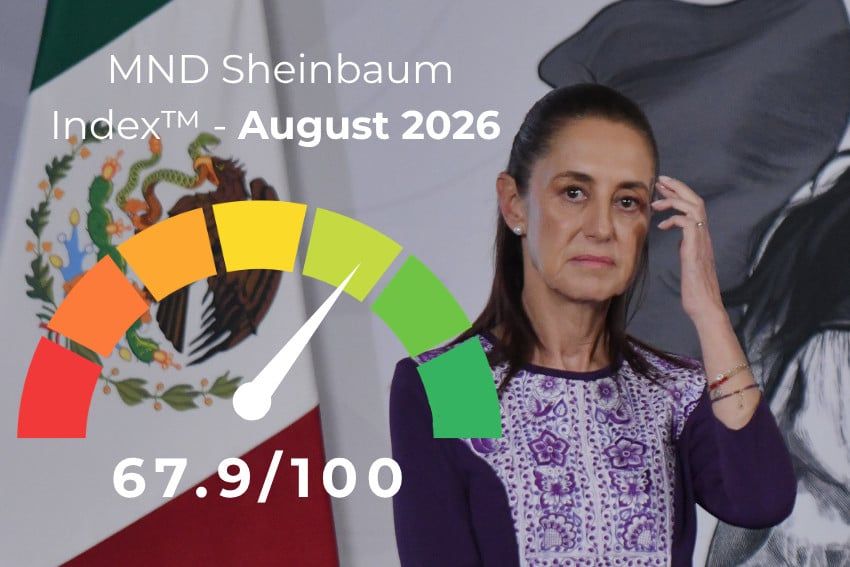
President Claudia Sheinbaum's performance index declined to 67.9 out of 100 in August 2026, marking the first drop since April after three consecutive months of gains, according to the latest MND Sheinbaum Index™ released this week.
The 1.4-point decrease from July's score of 69.3 reflects challenges in security and employment that weighed on the administration's overall performance, despite continued strength in controlling inflation. The index, which evaluates Mexico's progress across eight key areas, suggests the president is performing "quite good, but room for improvement" according to its rating scale.
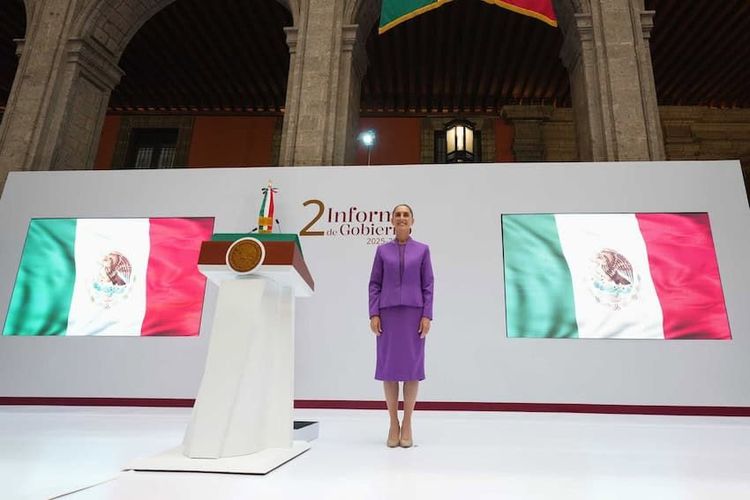
Sheinbaum, who was sworn in as Mexico's first female president on October 1, 2024, has now completed exactly two years in office. Her historic presidency—she is also the nation's first Jewish leader—comes at a critical juncture as Mexico grapples with persistent security and labor market challenges inherited from previous administrations.
Security pillar shows concerning slowdown
The security pillar score dropped to 9.37 out of 12.5 in August, down from 9.84 in July, as the pace of homicide reduction decelerated for the first time since April. The year-over-year decline in homicides was 32.1% in August, compared to a 34.8% reduction in July.
Despite the slowdown, Mexico's security situation has improved dramatically from its darkest period. The country's homicide rate roughly tripled between 2006 and 2018, driven largely by wars between drug cartels, reaching a peak of 29.1 per 100,000 people in 2018. In 2025, Mexico recorded 23,612 homicide victims, representing a 21.5% decline from 30,061 in 2024—the largest single-year decline on record.
According to preliminary data for 2026, Mexico's annualized homicide rate stands at 12.9 per 100,000 people, representing a 38.6% year-over-year decrease from 2025. August 2026 recorded 40.8 homicides per day compared to 86.9 in September 2024, underscoring the sustained improvement despite the recent deceleration.
Employment challenges intensify
The employment pillar scored just 6.63 out of 12.5, declining 0.37 points from July as both unemployment and informality trends deteriorated. Mexico's unemployment rate rose to 3% in August from 2.9% in July, while the informality rate increased 0.2 percentage points year-over-year compared to a 0.1 percentage point increase in July.
The informal employment sector reached 34.1 million workers in July 2026, representing 56.2% of the workforce—the highest level since December 2021. More troubling, 82% of job growth in the second quarter of 2026 came from the informal economy, with 494,607 informal jobs added versus only 104,727 formal positions.
The prevalence of informal work carries significant economic consequences. Mexico's informal sector generates only 25.38% of GDP despite employing more than half of all workers, according to 2024 INEGI data, representing a substantial drag on potential economic growth.
Inflation control remains bright spot
For the fourth consecutive month, inflation was the top contributor to the overall index score, even as the pillar score declined slightly to 11.85 from 12.2 in July. Mexico's annual headline inflation rate rose to 3.26% in August from 3.12% in July, but remained close to the Bank of Mexico's 3% target.
The current inflation performance represents remarkable progress from recent years. Mexico's annual inflation in 2025 was 3.82%, down from 4.72% in 2024 and significantly lower than the 7.9% peak in 2022. The Bank of Mexico maintains an inflation target of 3%, with a tolerance band of plus or minus one percentage point.
However, data for the first half of September indicates the inflation pillar score will likely decline again in the next index edition, as INEGI reported the annual headline rate reached 3.42% in the first 15 days of September.
Economic growth maintains modest pace
The economic growth pillar score slipped to 8.75 from 9.25 in July, as year-over-year economic growth in August was 2.5% according to preliminary INEGI data, down slightly from July's 2.7% reading.
Despite the modest decline, professional forecasters remain cautiously optimistic. A September 2026 Banxico survey of 42 analysts raised Mexico's expected 2026 GDP growth forecast to 1.4% from 1.3%, while expected year-end inflation was revised down to 3.87% from 3.90%.
Trade negotiations could boost business confidence
The business confidence pillar remained unchanged at 5.33 out of 12.5—the index's poorest performer. Mexico's business confidence score measured 48.2 in August, below the neutral benchmark of 50 and down from around 52 when Sheinbaum took office.
However, ongoing trade negotiations with the United States could provide a catalyst for improvement. Following a July 1, 2026 USMCA review meeting, bilateral discussions have focused on reducing Section 232 tariffs on steel (50%), aluminum (50%), and automobiles (25%). The negotiation agenda has expanded from 54 issues to nearly 90 topics, with officials aiming to reach an agreement before the U.S. midterm elections in early November.
A successful trade deal could significantly boost business sentiment in the final months of 2026, potentially improving one of the administration's weakest performance areas.
Other pillars show stability
The labor poverty pillar maintained its score of 10.25, remaining the second-largest contributor to the overall index. The labor poverty rate stood at 31.9% in the second quarter of 2026, an annual decline of 3.2 percentage points, while real incomes rose 8% annually.
The tourism pillar improved slightly to 7.16 from 6.91, as international arrivals increased 2.9% year-over-year in July, up from 2.1% growth in June. The approval rating pillar held steady at 8.56, with Sheinbaum's average approval rating remaining at 68.5% in August.
With four years remaining in her six-year term ending September 30, 2030, Sheinbaum faces the challenge of accelerating progress on employment and sustaining security improvements while maintaining economic stability. The next index, focusing on September data, will reveal whether the August decline was temporary or signals a broader trend.