Supreme Court ruling lets Indigenous communities speak in constitutional trials for the first time
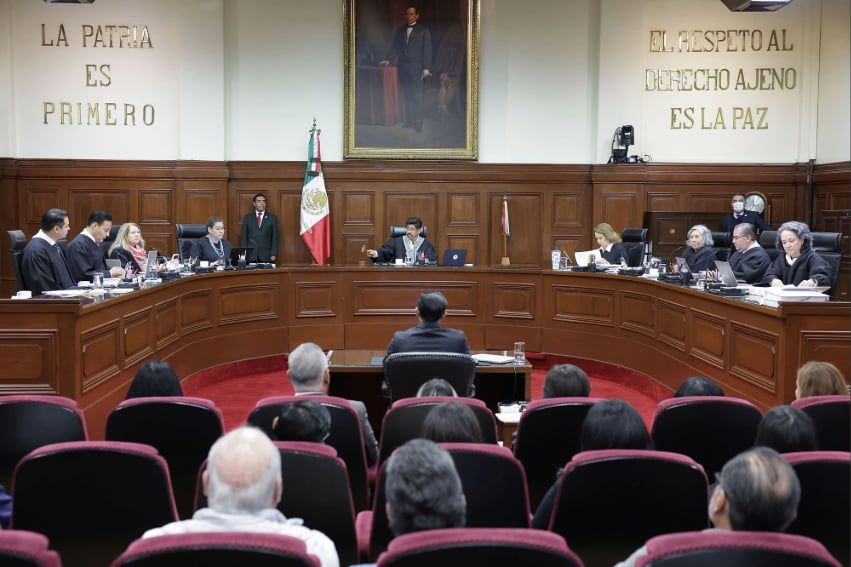
Mexico's Supreme Court ruled 5-4 on Tuesday to allow Indigenous and Afro-Mexican communities to participate in constitutional disputes as interested third parties for the first time, marking what Chief Justice Hugo Aguilar Ortiz called an attempt to correct "200 years of exclusion and racism" from the nation's judicial system.
The landmark decision originated from a case involving the Mazahua community of Crescencio Morales in Zitácuaro, Michoacán. The community sought to join constitutional controversies filed by the municipal government over control of the autonomous community's budget and regulations related to prior consultation on Indigenous self-government.
Constitutional controversies are jurisdictional processes before the Supreme Court to resolve conflicts of constitutionality or legality arising from competence disputes between different government levels or stemming from the principle of separation of powers. Until this ruling, only government entities, powers, or governing bodies could act as interested third parties in such proceedings.
"Today is a historic day. We are attending this appointment with history to see if we can correct in some way 200 years of exclusion and racism, and, among them, the judicial exclusion of Indigenous peoples and communities."
Chief Justice Aguilar Ortiz, who is of Mixtec Indigenous origin, made this statement following the ruling.
Constitutional basis for the ruling
The court grounded its decision in Articles 2 and 17 of the Mexican Constitution. The recent constitutional reform to Article 2, published on September 30, 2024, and entering into force on October 1, 2024, recognized Indigenous and Afro-Mexican peoples and communities as subjects of public law with legal personality and their own assets. This recognition means they can exercise collective rights, receive and manage public funds directly, and demand compliance before competent authorities.
The reform fulfilled a demand that Indigenous movements had been making for three decades, first articulated in the 1996 San Andrés Accords. The Mexican Congress has until March 30, 2025, to issue implementing legislation for the constitutional changes.
Minister Arístides Guerrero García explained that the court concluded the Mazahua community "must be recognized as an interested third party, in order to remove obstacles to its effective access to justice and ensure its full participation in a process whose resolution may directly affect its collective rights and interests."
Combined with the right of access to justice under Article 17, the Supreme Court determined that Indigenous and Afro-Mexican groups should have a procedural voice when constitutional controversy outcomes affect their legal sphere. This decision represents part of an ongoing evolution in Mexican constitutional law; a 2021 reform had previously expanded standing in constitutional controversies to autonomous constitutional bodies.
The Mazahua community at the center of the case
The Mazahua are an Indigenous people primarily inhabiting the northwestern portion of the State of Mexico and small parts of Michoacán and Querétaro. Their name derives from Nahuatl, meaning "the owners of deer." The Crescencio Morales community, with approximately 1,925 residents including 1,386 people living in Indigenous households and 479 speakers of Indigenous languages over age five, is among the first Indigenous communities in Michoacán to exercise communal self-government recognized under state legislation.
Established under a 2021 reform, the community has its own Indigenous Communal Self-Government Council with roots dating back to pre-Hispanic times. The municipality of Zitácuaro, where the community is located, borders the State of Mexico, and the name Zitácuaro itself comes from the Mazahua language word "Tsitákuarhu," reflecting the area's deep Indigenous heritage.
Dissenting voices
Three ministers voted against the ruling, arguing it exceeded the court's authority. Minister Espinosa Betanzo contended that granting recognition not explicitly provided in the Constitution "directly implies an overreach of powers" and amounts to legislating. "This decision breaks the separation of powers," the minister said.
Minister Ríos González, who also opposed the ruling, clarified that voting against it did not reflect opposition to Indigenous peoples' rights but rather concerned the procedural and constitutional implications of the decision.
The debate over Indigenous participation in constitutional proceedings has deep historical roots in Mexico. In 2001, when a previous constitutional amendment on Indigenous rights was passed, over 330 municipalities filed constitutional controversies with the Supreme Court. However, the court ruled it lacked authority to review the amendment, creating what academics described as a rule of law crisis and leaving Indigenous communities without recourse to challenge the legislation.
The new ruling now provides Indigenous communities with the ability to consult case files, submit arguments, and defend their rights when joining constitutional controversies promoted by government authorities, though they still cannot initiate such disputes themselves.