Engineering an aquatic metropolis
The metropolis now known as Mexico City has been a center of cosmopolitan exchange for over 500 years. Today's landscape of diverse neighborhoods, multilingual streets, and cultural crossroads mirrors what existed in pre-Hispanic times, when the city was called Tenochtitlán.
Before Spanish forces arrived in 1521, Tenochtitlán already ranked among the Americas' most significant urban centers. With a population estimated between 150,000 and 200,000 inhabitants, it surpassed contemporary European cities like Venice and London in size. The conquest transformed the physical city, but its amphibious character and metropolitan spirit endured.
As the commemorative plaque at Tlatelolco states:
On August 13, 1521, heroically defended by Cuauhtémoc, Tlatelolco fell to Hernán Cortés. It was neither a triumph nor a defeat; it was the painful birth of the mestizo people that is the Mexico of today.
Engineering an aquatic metropolis
Anyone familiar with Mexico City's rainy season knows that navigating downtown becomes an odyssey. While the weather patterns remain unchanged from ancient times, the city's relationship to water has undergone a radical transformation.
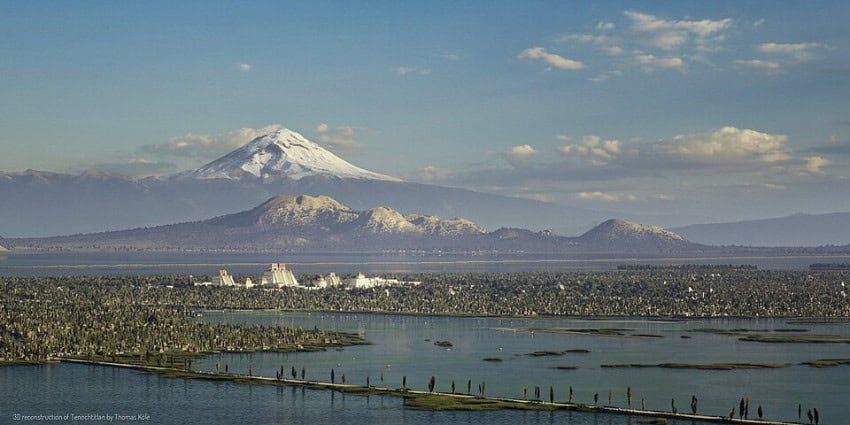
Tenochtitlán's location on an island in Lake Texcoco, which varied from approximately 2,000 to 3,000 square kilometers as part of an interconnected system of five major lakes, demanded innovative solutions. The Mexica people developed sophisticated technology that remains remarkable today, including chinampas and an intricate freshwater management system comprising approximately 95 hydraulic structures.
The chinampas proved extraordinarily productive, capable of yielding up to seven harvests annually at peak functionality. Covering about 120 square kilometers across the Valley of Mexico, these artificial agricultural islands supported population growth and established a symbiotic relationship between urban life and the natural environment. The engineering feat made them one of the most intensive and productive farming systems ever developed.
Central to this system was the Nezahualcoyotl dike, constructed around 1450. Stretching approximately 16 kilometers long, standing eight meters high and 3.5 meters wide, this massive structure protected Tenochtitlán from high water levels while separating fresh water from salt water in Lake Texcoco. What modern residents view as problematic weather was essential to this carefully balanced ecosystem, bringing storms that nourished crops and maintained lake levels.
A treasure of organization
Researchers Antonio Rubial and Jessica Ramírez conducted extensive studies on the city's transformation, identifying what made Mexico-Tenochtitlán unique among major American cities where Spanish colonizers established themselves.
Tenochtitlán's impressive organization made it particularly attractive to Spanish settlers. The city already possessed a coordinated political, social, economic and cultural framework that the colonizers could leverage.
Unlike Peru, where Lima, the Spanish city, and Cuzco, the Indigenous one, occupied two distinct sites, the founding of Mexico City on top of Tenochtitlán created a dual society within the same space: a Spanish center and an Indigenous periphery,Rubial and Ramírez explain in their book, Amphibious City: Mexico-Tenochtitlan in the 16th Century.
Beyond precious materials, Spanish conquistadors discovered something more valuable: an organized society they could exploit to extract resources from unfamiliar territory. This organized metropolis became the direct ancestor of today's city.
Radical transformation
Tenochtitlán's grid layout reflected careful hierarchical planning. Neighborhoods featured their own markets, schools and workshops. Canals facilitated the transport of people and goods, while causeways and bridges connected the entire urban network.
According to Ramírez, contemporary challenges stem from the dissolution of environmental dynamics that locals maintained before the conquest. The transformation was profound and began almost immediately.
Massive logging to provide wood for colonial construction fundamentally weakened soil that had historically supported lighter, balanced structures. Agricultural fields became sites for cathedrals within a century.
Mismanagement of water systems played a crucial role in altering the ecosystem. The destruction of the Nezahualcoyotl dike proved particularly devastating, eliminating a mechanism essential for separating fresh and salt waters. The draining of Lake Texcoco began with the Nochistongo cut in 1607 and continued for three centuries, only reaching completion with the Deep Drainage tunnels in 1967. Without this system, food production changed completely.
The environmental consequences continue today. NASA satellite data reveals that Mexico City is sinking at approximately 9.5 to 10 inches per year, with some areas subsiding up to 35 centimeters annually, making it one of the world's fastest-sinking cities.
Enduring identity
Despite dramatic transformations over five centuries, the identity of Mexico-Tenochtitlán persists.
More than 500 years after the fall of Tenochtitlán, chinampas survive in the city's outskirts, though only approximately 80 families continue farming using traditional techniques in Xochimilco. This represents a dramatic reduction from pre-conquest times when chinampas covered about 235,000 acres, yet it demonstrates remarkable cultural persistence. Markets remain filled with dozens of languages, and a city once thriving over a lake continues to defy ever-growing urban development.
Ancient canals transformed into avenues now traversed by thousands of vehicles, while public squares still serve as gathering spots for surrounding communities. The physical structure changed, but the spirit endured.
Finding the ancient city
As the Tlatelolco plaque reminds visitors, the fall of Tenochtitlán was
neither a triumph nor a defeat; it was the painful birth of the mestizo people that is the Mexico of today.
This relationship between death and birth reflects classic Mesoamerican philosophy. Deities of death must be fed to create life. In this symbiotic relationship, something always remains.
Evidence of old Tenochtitlán appears not only in museum collections but as archaeological windows throughout the city. The Museo de la Ciudad de México is guarded in one corner by a pre-Hispanic Quetzalcóatl, while the Centro Cultural de España en México contains an underground calmécac, a school for young nobles.
Though much of the ancient city was consumed by conquest, its roots run deep underground like its ancient waterways, while simultaneously reflecting on the city's surface. These traces remind residents and visitors of the duality that defines the amphibious Mexico City.