
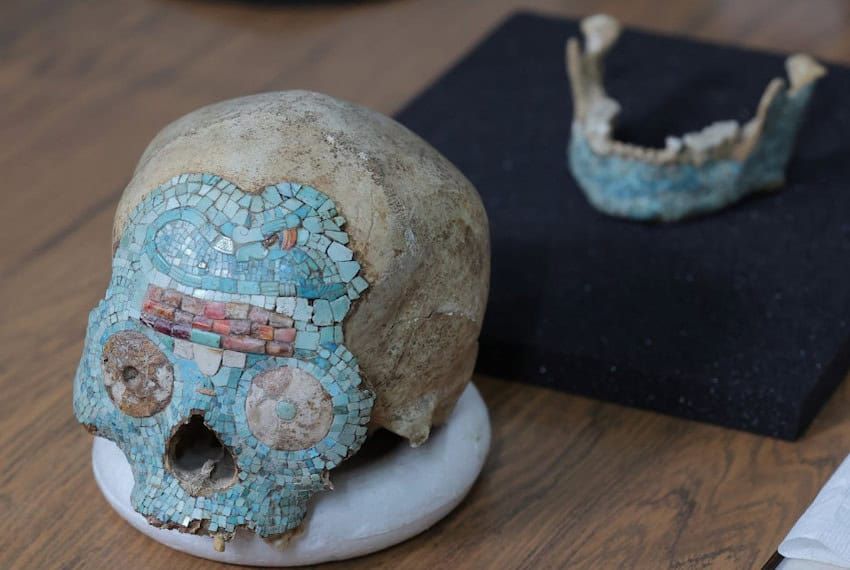
After 60 years abroad, Mexico confirms turquoise-adorned skull is pre-Columbian treasure
The National Institute of Anthropology and History (INAH) has confirmed that a human skull adorned with turquoise mosaic, recently returned to Mexico from the Netherlands, is an authentic pre-Columbian artifact from Mexican territory.
The skull—decorated with a striking mosaic of turquoise, shell, jadeite and rock crystal—was repatriated in May 2025 after spending approximately 60 years at the World Museum (Wereldmuseum) in Leiden. Although its exact origin remains undetermined, INAH specialists believe the artifact likely dates to the Late Postclassic period (1200 to 1521 AD) and possibly originated from regions that now include parts of Puebla and Oaxaca states.
The object represents one of approximately ten similar turquoise mosaic skulls known to exist worldwide, most of which are modern combinations of ancient components. Remarkably, only one such skull has ever been found in an archaeological context—the specimen discovered in Tomb 7 of Monte Albán in the 1930s, one of the richest tombs ever excavated from the ancient world. The Mixtecs used this abandoned Zapotec site as a burial place for rulers after Monte Albán collapsed around 800 AD.
A complex history of authenticity
Research conducted between 2011 and 2013 revealed that while both the male skull—from an individual estimated to have died aged 25 to 40—and the mosaic materials are pre-Hispanic, twentieth-century adhesive was detected beneath some tesserae. This indicates the skull was assembled or reworked in its present form relatively recently, likely in the 20th century.
INAH described the skull as "partially covered with tesserae, like a mosaic, forming the schematic design of a snake on the frontal bone." The presence of modern adhesive substances may result from decorative rearrangement or reuse by a previous owner before the museum acquired it.
In 1964, the Wereldmuseum's then-director Pieter Hendrik Pott acquired the skull from American dealer Robert Stolper. The museum had purchased it on the art market in 1962 without reliable archaeological provenance, and no detailed information about its original discovery accompanied the acquisition.
Mixtec craftsmanship and cultural significance
The finest turquoise mosaic works from the Late Post-Classic period were probably fashioned by highly skilled Mixtec craftsmen who excelled in both stone and metal work. Historical records show that ten turquoise mosaic masks made by skilled Mixtec artisans were sent each year as tribute from a province in Oaxaca to Aztec emperor Moctezuma II.
Turquoise mosaic objects were sent to Tenochtitlan, the Aztec capital, as tribute from provinces including those in present-day Veracruz, Guerrero and Oaxaca. The materials included both raw turquoise chunks and finished mosaic tiles decorating masks, shields, staffs, discs, knives and bracelets, which were used to adorn images of gods, priests and nobility.
The British Museum holds nine Mexican turquoise mosaics in its collection, including a famous skull believed to represent the god Tezcatlipoca. These mosaics were among objects sent to Spain by conquistador Hernán Cortés, with 25 turquoise mosaic shields alone listed in shipment inventories.
Future research and display
INAH specialists have created the first three-dimensional digital record of the skull since its arrival in Mexico. The institute plans to conduct radiocarbon dating and ancient DNA studies, with possible samples to be obtained from teeth or the temporal bone, one of the densest parts of the human skull and an important source of preserved ancient DNA.
Physical anthropologist Olaf Bello Cardoso expressed hope that further studies can serve to identify the person behind the turquoise mosaic and to understand whether it was part of an offering dedicated to a principal figure.
The skull will likely be displayed at the Yucu Saa Community Museum in Villa de Tututepec, Oaxaca, which has expressed interest in safeguarding and exhibiting the artifact. INAH is in discussions with the museum about this possibility.
Broader repatriation efforts
Culture Minister Claudia Curiel de Icaza said that the recovery of the skull "demonstrates that collaboration between authorities and civil society can translate into actions of historical justice." She praised the Nohivi Ñuu Savi collective—an Indigenous grassroots group that focuses on protecting Mixtec rights, history and culture—for their contributions to the repatriation effort.
The repatriation process began in late 2023 after the Dutch museum contacted the Mexican Embassy in the Netherlands. A decade earlier, the Wereldmuseum had begun working with the French Center for Research and Restoration of Museums to determine the skull's authenticity, prompting the decision to contact Mexican authorities.
This repatriation forms part of Mexico's broader cultural heritage recovery campaign. Between 2018 and 2024, former President López Obrador's government repatriated 14,048 archaeological artifacts to Mexico. In 2025 alone, over 2,000 cultural objects returned to Mexico, primarily through voluntary handovers from private individuals in countries including Canada, Denmark, the United States, France, Italy and the Netherlands.