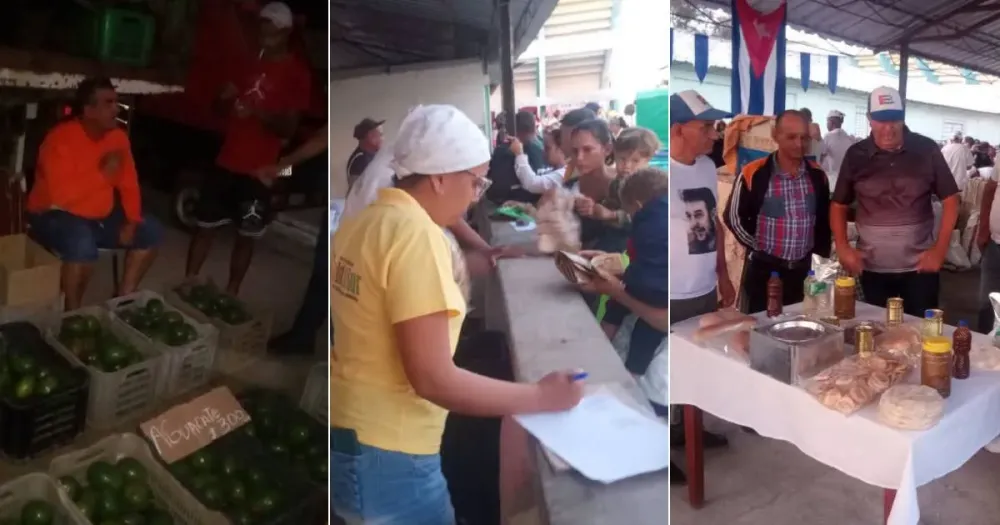
Promotion meets frustration
Tiempo 21, the news outlet of provincial broadcaster Radio Victoria, promoted the November 21 fair on Facebook as "A Feast that Invites." Its post also acknowledged two limits: supplies fell short of demand, and prices reflected inflation.
"The prices at the fair are so high that you have to climb stairs to reach them," one user wrote. Another described the offerings as "Inaccessible for state workers who earn meager salaries and retirees with ridiculous pensions." A separate complaint concerned payment: a vendor said electronic transfers were accepted but had no QR code available to receive one.
The frustration has also found an audience through satire. Weeks earlier, improvisational poet Yordan Quintero, known on television and social media as El Yayito Ranchuelero, drew attention with a viral décima titled "A backpack and a bag to be able to go to the fair." The poem mocked how much money shoppers need to bring to these markets.
Food costs far outpace monthly incomes
Since July, Cuba's monthly minimum wage has been 3,210 pesos; the average state salary is about 7,354 pesos. Economist Javier Pérez Capdevila puts the monthly cost of meeting one person's basic needs at roughly 96,000 pesos.
Official figures put annual inflation at 32.70% in October, while the food and nonalcoholic beverage category rose 50.72%. November rice prices ranged from 390 to 500 pesos a pound, and black beans reached 700 pesos. In just weeks, pumpkin went from 30 to 300 pesos a pound.
Rice had previously been subject to a ceiling of 155 pesos a pound. Decree 156/2026, signed by Prime Minister Manuel Marrero Cruz and published in the Official Gazette in July, eliminated that cap.
Earlier editions of the Las Tunas fair drew similar complaints. On the eve of Father's Day in June, yogurt cost 490 pesos and a tub of ice cream cost 1,460 pesos. By July, an egg carton was priced at 2,600 pesos, or 85% of the minimum monthly pension. In October, individual bananas cost 60 pesos, more than at some informal outlets.
Access is not only a question of price. Several stalls refused electronic payments in October, and the fair's noon closing time leaves a short shopping window as goods sell out early. "There's everything, but when you go, there's nothing left," a Las Tunas resident wrote that month.
Supply shortages and a shrinking economy
Transport problems have interrupted the fair itself. The provincial government canceled an edition in May because it lacked fuel to bring products from the municipalities. During the same weekend, it mobilized dozens of buses to take people to a political event in Havana supporting Raúl Castro.
National production has also fallen sharply. Data from Cuba's National Office of Statistics and Information (ONEI) show that bean output dropped 60.2% between 2020 and 2024, while rice output declined 62.3%. Production was hampered by shortages of fuel, seeds, fertilizer and electricity for irrigation. The United Nations World Food Programme estimates that imports account for about 80% of the food Cuba consumes.
The broader economic outlook remains bleak. In November, economist and former University of Havana professor Omar Everleny Pérez forecast a 10.2% contraction in GDP at constant prices for 2026. That would be the largest decline since 2008 apart from the 11% drop in 2020. ECLAC's forecast of a 10.3% contraction would place Cuba last among Latin American and Caribbean economies for the year.
Meanwhile, the informal exchange rate reached 935 pesos to the U.S. dollar by mid-November, compared with around 40 pesos in January 2021. Forecasts suggest it could pass 1,000 pesos before year-end.
Limited assistance for vulnerable households
In October, the government announced monthly food allocations for people classified as vulnerable: five pounds of rice, one pound of sugar and one pound of beans. The measure runs until January 2027.
Retirees' difficulties were documented in a September-October 2025 survey by the Independent Trade Union Association of Cuba (ASIC). Among 506 retirees surveyed across five provinces, 99% said their pensions could not cover basic food, housing and medication needs, and 90.7% were still working after retirement.
Cuba has the oldest population in Latin America and the Caribbean. People age 60 and older represented 26.7% of its population at the end of 2025; official projections put their share at 36% by 2040.
An Associated Press report published by the Los Angeles Times described growing lines at Havana's charity-run community kitchens and food pantries, including retirees, workers and families unable to afford enough to eat. Quisicuaba, a religious organization receiving support from U.N. agencies and European aid groups, has identified about 12,500 vulnerable people in the capital.
Pension changes due to take effect November 25 do not provide an immediate across-the-board increase or guarantee automatic, periodic adjustments for rising prices. Published in Official Gazette No. 97, Decree-Law 140/2026 and Decree 186/2026 instead revise the calculation formula and allow up to 10 years spent caregiving to count toward service time.