Growers say payments fall short of costs
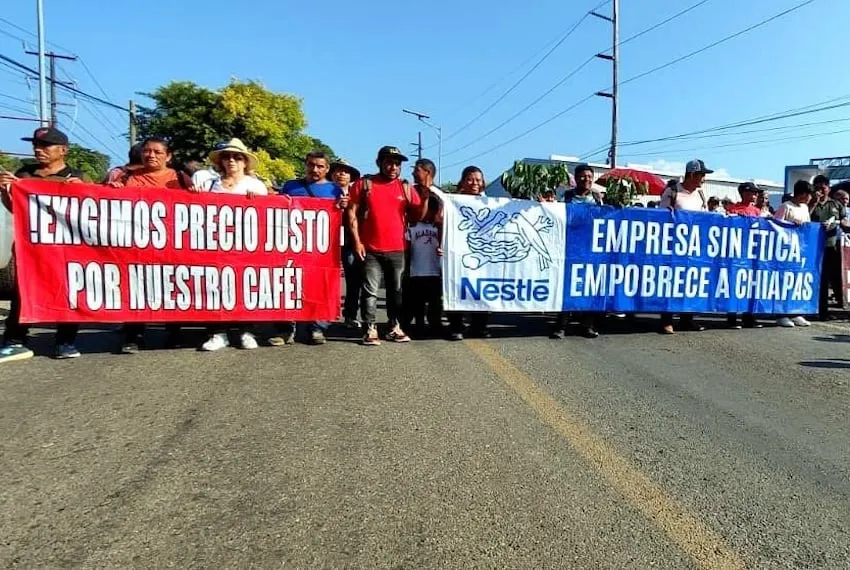
The demonstrators came from Chiapas' Costa, Sierra and Frontera regions and gathered outside Tapachula's municipal government building after marching through the city's main streets. Journalist Gabriela Coutiño reported on X that close to 400 growers took part.
Producers say they receive about 43 pesos (US$2.20) per kilogram despite tending their crops throughout the year. Producing that amount costs about 45 pesos, according to growers cited by Lado.mx, leaving payments below production costs.
The protesters contrasted their earnings with a supermarket price of 580 pesos (US$29) for the same quantity of coffee. They want at least 60 pesos (US$3) per kilogram.
Farmer Eduardo Camarena told La Jornada that dissatisfaction spans at least 20 municipalities and that the pricing issue affects 165,000 families. Producers do not benefit from the gap between what Nestlé pays and what coffee sells for at retail, he said.
According to Camarena, talks with Nestlé have not persuaded the company to adjust payments to reflect growers' rising costs. He also accused Nestlé of concentrating control of the coffee market in the border region.
The growers called for state officials to facilitate negotiations. "The cost of production, plus a decent profit for the producer — that is what we are asking for; it's only fair," Camarena said.
Nestlé outlines purchasing goals without specific prices
Responding to the November protests, Nestlé said its 2026-2027 purchasing plan would seek to pay above the London and New York exchanges' international benchmarks for green robusta and arabica coffee. It also aims to purchase more coffee than in the previous year, giving priority to local purchases to benefit southeastern Mexico's producers.
Lado.mx reported that the statement left several details unanswered: the price for each variety, the premium over international quotations, the size of the planned increase in purchases and the share of any increase that would reach growers directly.
Nestlé says its Nescafé Plan has supported producers since 2010 through technical assistance, training, financing for fertilizer and the provision of coffee plantlets. The program operates in Chiapas, Veracruz, Oaxaca, Puebla and Guerrero. The company says it also promotes agroforestry practices intended to improve productivity and climate resilience.
Earlier negotiations and supply-chain concerns
Pricing disputes between Nestlé and Mexican growers predate the latest march. In April 2024, the company responded to the report "High hopes, low prices. How Nestlé is driving Mexican coffee farmers to ruin" by saying the matter had been resolved.
Nestlé said a working session in late February 2024 had brought together federal and state officials, the Mexican Coffee Institute, suppliers, representatives of Chiapas coffee farmers and Nestlé Mexico. In that April response, it also put its investment in Mexico's Nescafé Plan since 2010 at more than 600 million pesos, or about US$36 million.
A separate February 2025 report by Empower, Coffee Watch and ProDESC examined farmers' position in the supply chain. Titled "Exploitation and Opacity: The Hidden Reality of Mexican Coffee in Nestlé and Starbucks Supply Chains," it named ECOM Agroindustrial, Neumann Kaffee Gruppe (NKG) and Louis Dreyfus Company (LDC) as major intermediaries supplying multinational companies. The authors argued that this structure weakens small farmers' ability to negotiate prices, quality requirements and certification terms.
International prices and Mexican production
Market figures cited by Lado.mx put arabica at 260.40 to 263.93 US cents per pound on November 24, 2026. Robusta traded at US$2,851 to US$2,882 per metric ton.
The USDA's July 2026 "Coffee: World Markets and Trade" report projected record global output of 189.7 million 60-kilogram bags for 2026/27. It also reported a 25% decline in coffee prices over the preceding seven months as additional supplies became available, using the International Coffee Organization's monthly composite price index.
Within Mexico, Agriculture and Rural Development Ministry (Sader) figures show coffee cultivation covers approximately 701,735 hectares in 10 states. National production is expected to surpass one million metric tons by the end of 2026.
Chiapas is Mexico's largest coffee-producing state, with annual output of 392,000 metric tons of beans. Veracruz follows at 256,000 metric tons and Puebla at 225,000.