The killings and the letters
The film draws on the case of a blond-haired woman known as "Diana, Huntress of Bus Drivers." She shot and killed two drivers in Ciudad Juárez in separate attacks on the A-4 highway on August 28 and 29, 2013. The victims were José Roberto Flores Carrera and Fredy Zárate Morales, who was 32.
On August 30, the local daily La Polaka said it had received an email signed "Diana, the bus driver hunter." The writer claimed she was punishing drivers who had raped women, particularly factory workers traveling at night to the maquiladoras. "I am the instrument of vengeance for several women," she wrote.
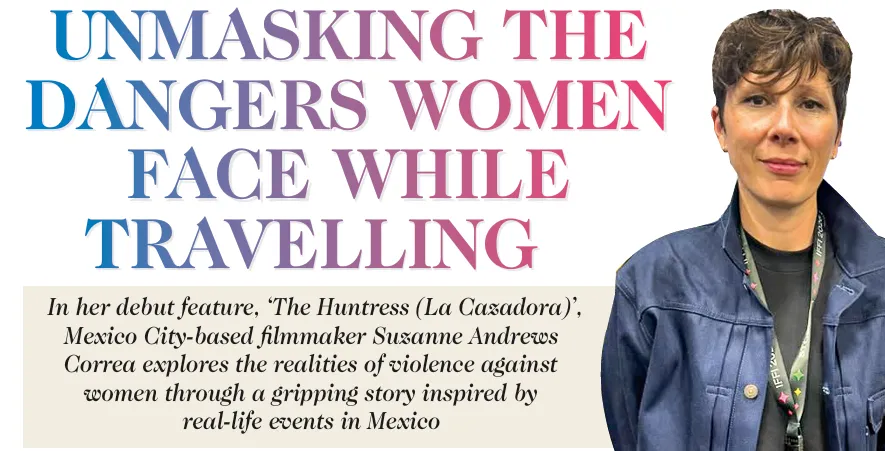
For Correa, reading Diana's letters to the media prompted conflicting reactions: rejection of the killings, but also a sense that someone was responding to the violence women faced. Speaking to Herald Goa, she described the tension this way: "But at the same time, I felt that someone was doing something about it. And that conflict was really something that created a fire in me." The Mexico City-based director spent ten years bringing the film to the screen.
Building the film around Juárez and Adriana Paz
Production started in November 2024 and extended into 2025, with filming in the border city of Ciudad Juárez, Mexico City, the state of Mexico and the eastern coastal state of Veracruz. Correa considered Juárez essential to the story, describing the city as a character in its own right. Every extra came from Juárez, as did performers in smaller speaking roles.
Adriana Paz plays Luz, the protagonist. Correa pictured Paz in the role from the time she began writing nearly a decade earlier, keeping the actor's photograph above her desk without Paz knowing. Paz also appeared in "Emilia Pérez," which received 13 nominations at the 97th Academy Awards.
Correa says Paz "works from instinct." Their preparation centered on discussing the script and making sure the character's emotions were clear at every stage.
The 91-minute Mexico-U.S. co-production was made by Zafiro Cinema's Gabriela Maire and Edher Campos alongside Mynette Louie of the U.S.-based company The Population. Maria Sarasvati Herrera handled cinematography, and Tomás Barreiro composed the score.
Women's responses and the question of justice
While the crew was working in Juárez, women approached Correa to thank her for making the film. She says she has encountered the same gratitude after each festival screening. Recalling the reaction to the original killings, she said: "When it happened, bus drivers became afraid of women." To her, the responses reveal how urgently women want their experiences told.
Correa says many of the government officials she spoke with during production were trying to improve conditions. Nevertheless, she described women in Juárez and Mexico as still facing serious danger, citing her assessment that fewer than 10% of cases reach trial. "If there's no justice system to hold people responsible, then it will keep happening," she said. The film's searchers and other characters, she added, seek ways to change their circumstances "with an absent government."
UN News reported in December 2024 that more than 2,526 women had been murdered in Ciudad Juárez from 1993 through 2023. Across Mexico, it put the impunity rate for such killings above 95%, with only about 2% of cases resulting in a criminal sentence. It also reported that only one in 10 victims reports their aggressor.
Correa sees the fear surrounding everyday travel as an experience that crosses national and economic boundaries. She recalled concerns about women being assaulted by Uber and cab drivers in New York, where she lived for many years, and described her own awareness of who is behind her when walking after dark. "So this transportation of getting from one place to another is not about the global south or north. It happens everywhere, unfortunately. It's a universal feeling," she said.
Festival screenings and distribution
"The Huntress" made its world debut at Sundance on January 22, 2026, as the festival's only selected Latin American film. A European premiere was scheduled for October 18 at the Leiden International Film Festival. Its Mexican premiere followed on October 19 in competition at the Morelia International Film Festival, also known as FICM.
Morelia also marked the launch of Mexican distributor Caos Cine, founded by Regina Serratos and Eduardo Diaz Casanova. The company chose "The Huntress" as its first acquisition.
The film's festival travels have included screenings in the United States and Mexico, as well as a recent stop in Cairo before IFFI in India. Correa says a Mexican theatrical release is planned for 2027, while the team continues seeking distribution in other territories. "I hope that the film will come to India through some platform," she said.