
A proposal, not an agreement
Indigenous Yoreme communities surrounding Ohuira Bay in northern Sinaloa state are preparing to deliberate on a federal proposal that could determine the fate of a controversial ammonia plant that has sparked one of Mexico's longest-running environmental conflicts.
The proposal, unveiled last week after six days of roundtable discussions, offers environmental safeguards and community investment around the German-engineered GPO-Proman facility. But it leaves the plant's core operations intact — a reality that has left opponents like Melina Maldonado Sandoval feeling defeated rather than hopeful.
"They didn't listen to our reasons for saying no," said Maldonado, a rural sociologist, law student and Indigenous Yoreme activist whose community has opposed the project for 12 years. "They listened for a way to make it a yes."
No agreement has been reached
Federal officials have characterized the plan as a path toward resolution, but movement leaders emphasize that no agreement has been reached. The representatives who participated in the talks lack authority to accept terms on behalf of their communities, which govern through traditional Indigenous consensus-based assemblies.
The proposal must now be explained and discussed in assemblies in Ohuira, Paredones, Lázaro Cárdenas and Topolobampo — four communities that would bear the plant's most direct impacts. These villages surround the Santa María-Topolobampo-Ohuira lagoon system, a Ramsar wetland of international importance designated in 2009 that supports 84% of the migratory waterfowl distributed across Mexico during winter months.
"We have to hold our own internal assemblies," said Claudia Susana Quintero, a Yoreme educator from Ohuira and a leader of the ¡Aquí No! (Not Here!) collective that has spearheaded opposition. "We have to explain it to the community, analyze it and decide how we are going to reach consensus."
The blockade outside the plant entrance — now in its 72nd day — remains in place while communities deliberate.
A project the government considers strategic
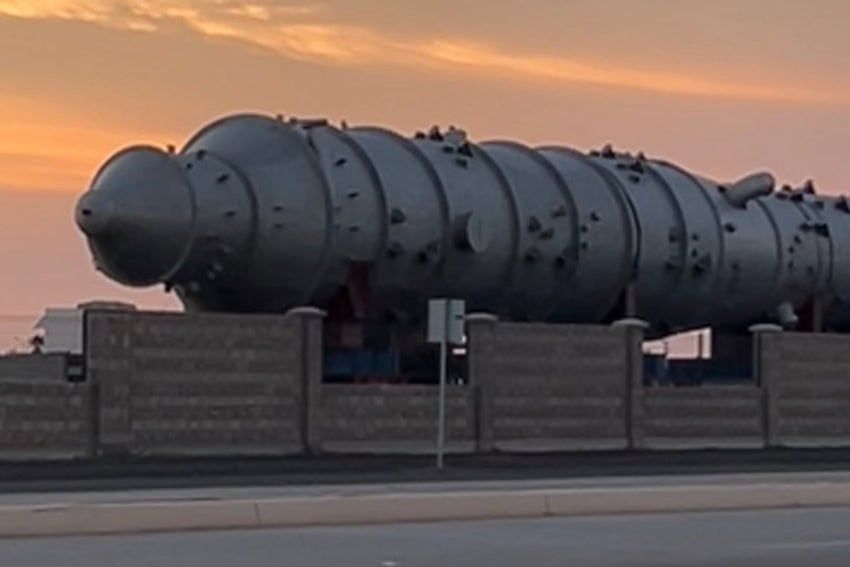
The US $1.6 billion facility, designed by thyssenkrupp Uhde and approximately 88% complete, would produce 2,200 metric tons of ammonia daily — totaling approximately 800,000 tonnes annually. Operations are scheduled to begin in the first half of 2027, according to company statements.
President Claudia Sheinbaum has defended the plant as critical to Mexico's food sovereignty goals. The country currently imports approximately 65-75% of its fertilizers, primarily from Russia, China and other international sources. The Economy Ministry projects the plant could reduce fertilizer imports by as much as 70% and keep approximately US $500 million now spent on imports within the Mexican economy.
Sheinbaum has also noted that the facility underwent environmental review and received majority support in a government-led Indigenous consultation — a process the four communities closest to Ohuira Bay continue to dispute as fundamentally flawed.
What the government put on the table
The proposal would leave the ammonia plant operational but significantly alter how it functions. Most notably, GPO-Proman would stop drawing water directly from Ohuira Bay and instead use water discharged through a nearby Federal Electricity Commission canal. Wastewater would be carried offshore rather than returned to the lagoon system.
Opponents have long warned that the originally authorized system would pull large volumes of seawater from the lagoon and return warmer, saltier water, potentially disrupting fish and shrimp nurseries in an ecosystem where the Yoreme people — whose name translates as "people who respect tradition" in the Mayo language — have sustained themselves primarily through fishing and agriculture for generations.
The plan also proposes a new environmental baseline study, continuous water-quality monitoring and an oversight body comprising community members, scientists, government officials and company representatives. Additional measures would address existing sewage and agricultural runoff entering the bay, along with emergency preparedness and civil protection.
Other commitments focus on longstanding community needs, including housing, education, fishing infrastructure and assistance in certifying local shrimp and crab products for higher market prices. The package would also give communities a voice over future petrochemical development in Topolobampo, which the federal government has designated as an economic development hub.
The risk that remains
For opponents, the most troubling unresolved issue is the danger of a catastrophic ammonia release. While the proposal includes new safeguards — an emergency-response center, joint industrial-risk monitoring, water curtains around pipelines and storage tanks, and a regional civil-protection plan — movement leaders say these measures cannot eliminate the underlying danger documented in the company's own risk assessment.
According to that assessment, a five-minute leak could create a high-impact zone extending roughly 15 kilometers from the plant, encompassing Topolobampo and nearby Yoreme communities. A broader impact zone could extend as far as 45 kilometers, reaching toward Los Mochis and surrounding areas.
Anhydrous ammonia poses severe health risks: industrial accidents involving the chemical have resulted in deaths, injuries and community evacuations, with exposure causing blindness, respiratory damage, severe burns and in extreme cases death. The plant is designed to store up to 75,000 metric tons of anhydrous ammonia near populated communities.
"That risk is still there, and it is still not clear to us," said Ulises Pinzón, Topolobampo's municipal representative. "The first people affected would be those of us who live in Topolobampo."
Quintero said the proposal may reduce certain environmental impacts, but cannot eliminate the consequences of a major industrial accident. "You can remediate many things," she said. "What you cannot remediate is the loss of life."
A decision made under threat
The communities will not deliberate in a political vacuum. Several of the movement's most visible leaders, including Maldonado, Quintero and Ohuira traditional governor Felipe Montaño, have received threats related to their opposition and now live under federal protection measures that include bulletproof vests and government-issued panic buttons.
Quintero worries the proposal could recast defenders as obstacles to jobs and economic development, increasing pressure on people who have already faced years of intimidation. The company projects the facility — which would be the largest merchant ammonia plant in Latin America — has created approximately 3,000 direct jobs during construction and would generate 10,000 total direct and indirect jobs once operational.
"A bulletproof vest and a panic button are not going to help me much if someone decides to act tomorrow," Quintero said. The experience has gradually consumed their other identities, she added. "We are no longer mothers, daughters or sisters. We are nothing more than defenders."
From shock to strategy
By Thursday evening, the mood inside the movement had begun to shift. Enrique Ayala, a longtime activist staying at the blockade, said movement leaders spent six hours analyzing the proposal with scientists and lawyers and plotting next steps.
"The government proposal is one-sided," Ayala said. "They are pushing ahead with their project."
But after years of being ignored, Ayala sees the government's willingness to negotiate as progress. "We have to get up, keep going and make proposals of our own," he said. "After 12 years when they paid us no attention, now we have them sitting at the table."
Despite the government's apparent intention to move the plant toward operation, Ayala said the movement has not abandoned its original goal. "We still believe we can get the company to leave," he said. "Sometimes you have to dream."