
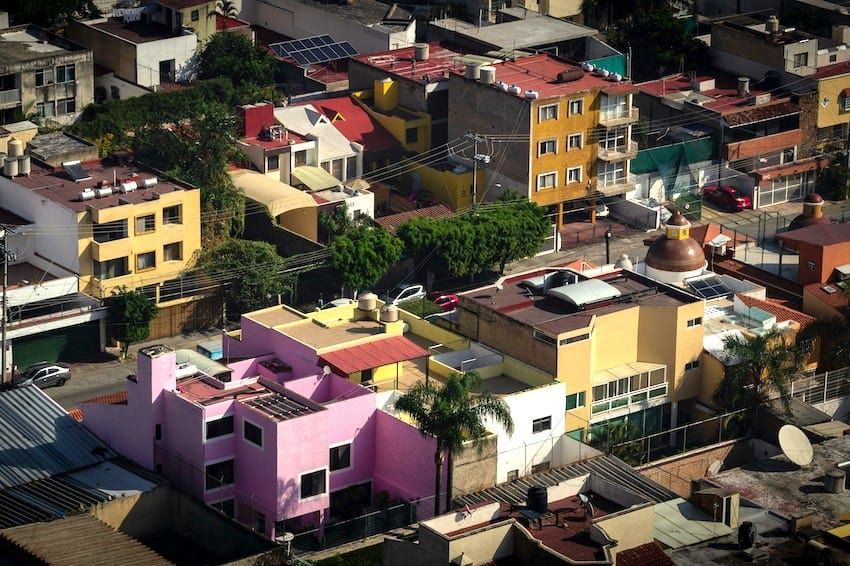
Supply-demand squeeze could push Mexico home prices up 8% by the end of 2026
Mexican home prices are on track to increase between 7% and 8% by the end of 2026, driven by a persistent supply-demand imbalance, according to Fitch Ratings' latest Global Housing and Mortgage Outlook. High construction costs continue to restrict new development while mortgage rates remain elevated, limiting borrowers' access to credit.
The Federal Mortgage Society (Sociedad Hipotecaria Federal, SHF), a government-owned development bank established in 2001 to promote mortgage market development and facilitate housing finance access, reported that Mexico's national housing price index increased 8.7% in the first quarter of 2026 and 7.3% in the second quarter compared to the same periods last year. The cumulative growth for the first half of the year reached 7.9%, down from historical peaks of 10.4% in 2022 and 10.06% in 2023. In the fourth quarter of 2025, prices rose 8.9% year-on-year, with full-year 2025 growth of 8.7% marking the slowest annual pace in four years while still indicating solid momentum.
Construction costs averaging between 8,500 and 25,000 Mexican pesos per square meter in 2026 vary significantly by region, quality of finishes, and location. Cities like Mexico City and Monterrey experience costs up to 40% higher than southern states, creating substantial barriers to new housing development in high-demand urban areas.
Property type and income segment performance
During the first half of 2026, single-family homes appreciated by 8.4%, while condominiums and apartments increased 7.4%. Public or subsidized housing saw the strongest appreciation at 10%, compared to 6.7% for middle-income housing. The national average home value stood at 1,960,032 pesos (US $114,709), with three-quarters of homes valued below 2,226,101 pesos ($130,289).
Regional market variations
Guadalajara led metropolitan areas with an 11% price increase, followed by Monterrey at 8.3% and Puebla-Tlaxcala at 8.5%. At the state level, Tamaulipas experienced the greatest increase at 11.8%, followed by Quintana Roo at 11.5% and Jalisco at 11.2%. Tourism and growth-led markets showed particularly strong performance in late 2025, with Benito Juárez (Cancún), Solidaridad (Playa del Carmen), and Los Cabos all posting annual gains of around 14% to 15%.
Mortgage rate pressure on affordability
As of mid-2026, mortgage interest rates for peso-denominated loans range from approximately 9% to 14%, with average fixed mortgage rates for households near 11% to 12%. These rates remain well above the Bank of Mexico's benchmark rate of around 6.5%, creating significant affordability challenges for prospective homebuyers and restricting credit access across the market.
Mexico City rental market dynamics
Mexico City's rent control law, implemented in August 2024 and upheld by the Supreme Court in February 2026, caps annual residential rent increases to the previous year's inflation rate. The measure eliminated landlords' ability to impose arbitrary increases that previously could reach 20% to 30% annually in popular neighborhoods like Roma Norte and Condesa.
Despite the rent control measures, average rent in the capital has increased 9.6% year-on-year, more than three times the current inflation rate. The highest rents concentrate in the boroughs of Cuauhtémoc and Miguel Hidalgo, particularly in neighborhoods including Hipódromo Condesa, Juárez and San Rafael.
Infrastructure improvements related to the 2026 FIFA World Cup have driven up prices in some areas. Mexico City secured MX$4 billion (approximately US $234 million) in private funding from BBVA Mexico for renovation and remodeling of urban infrastructure to promote tourism, with the city set to host five World Cup matches including the tournament's opening match. The World Cup is expected to bring more than 5.5 million tourists to Mexico City.
The average cost of a two-bedroom, 65-square-meter apartment reached 21,921 pesos ($1,283) per month, equivalent to almost 70 days of minimum wage. A three-bedroom, 100-square-meter apartment stood at 30,618 pesos ($1,792), or more than 97 days of minimum wage, according to data from the Inmuebles24 real estate listings platform.