
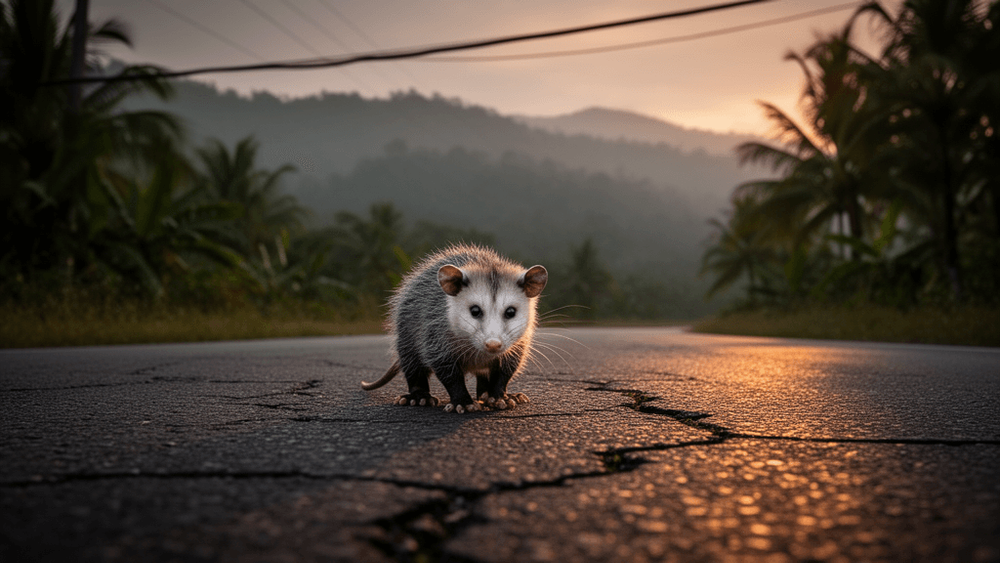
Field records add localities for two opossum species in southern Mexico
Researchers documented six observations of Derby's woolly opossum and the gray four-eyed opossum in southern Mexico between 2016 and 2023, establishing new municipal and locality records for both species. The observations, gathered through photographic cameras and smartphones with GPS coordinates, revealed significant conservation threats facing these marsupials in increasingly human-modified landscapes.
Derby's Woolly Opossum Observations
Derby's woolly opossum (Caluromys derbianus) naturally inhabits deciduous and moist evergreen forests from southern Mexico to western Ecuador and Colombia, at altitudes up to 2,600 metres. Conservation assessments specifically identify deforestation as a primary threat to populations in Ecuador and Mexico. Three observations of this species were recorded in Veracruz state, two involving deaths caused by human infrastructure.
In May 2016, a female woolly opossum was found dead at a roadside in Cuichapa municipality at 415 metres elevation. The animal, discovered in a patch of high evergreen forest surrounded by sugarcane crops and human settlements, was accompanied by two young. A local villager recovered the offspring, though only one survived in captivity. This represented the first municipal record for the species in Cuichapa; the nearest previous documentation was 8.28 kilometres away in Tezonapa municipality, dating from 1943.
In December 2023, researchers photographed an individual electrocuted on high-tension power lines approximately five metres above ground in Las Lajas, Tezonapa, at 435 metres elevation. The site consisted of high evergreen forest associated with coffee and banana plantations. Power lines constitute one of the main anthropogenic causes of wildlife mortality in Mexico, where the electrical grid included 746,911 kilometres of power lines in 2004, a figure that has continued increasing with new power plants and urban expansion. A 2022 study at three Mexican wind farms documented 579 bird carcasses from 65 species killed by power line collisions and electrocutions, including 12 species within risk categories according to Mexican legislation and the IUCN Red List.
A third woolly opossum, an adult male with difficulty moving, was found near a rural road in Tlilapan, Veracruz, in December 2017 at 1,200 metres elevation. Local villagers took the animal into captivity. The observation site, surrounded by high evergreen forest, human settlements and irrigated agricultural land, constituted the first municipal record for the species there.
Gray Four-Eyed Opossum Observations
Three observations of the gray four-eyed opossum (Philander opossum) were also documented. This species ranges from northeastern Mexico in Tamaulipas to southeastern Brazil, typically inhabiting tropical forested areas below 1,000 metres elevation, though it can occur up to 1,600 metres. The species is notably found in highly disturbed habitats near human structures and within agricultural areas such as orchards and sugar cane fields, preferring damp areas near swamps and streams.
An adult gray four-eyed opossum was observed at 00:30 on July 10, 2017, in a tree approximately 3.5 metres high in Cuichapa, Veracruz, at 420 metres elevation. The site was surrounded by sugarcane fields and irrigated agricultural land. This marked the first recorded individual for the municipality; the closest previous record was 9.57 kilometres away in Tezonapa municipality from 1943.
On March 17, 2022, at 22:13, an individual was photographed walking among trees approximately three metres high on a riverbank in La Esperanza, Santiago Comaltepec, Oaxaca, at 500 metres elevation. The location lay between mountain cloud forest and high evergreen forest. This represented the first record for Santiago Comaltepec municipality, approximately 50.28 kilometres northeast of the nearest vouchered occurrence in San Juan Bautista Tuxtepec, Oaxaca, from 1947.
A third gray four-eyed opossum was observed at 23:00 on March 23, 2022, among Guazuma ulmifolia trees in the canopy at Rancho El Cacao, Mapastepec, Chiapas. The site, intended for intensive cattle farming and grassland cultivation, stood at 29 metres elevation. The closest earlier record for Mapastepec was 7.14 kilometres east, dated from 1943.
Conservation Status and Regional Context
Both species are classified as Least Concern globally by the International Union for Conservation of Nature, but their national treatment differs. Mexico's official environmental standard, NOM-059-SEMARNAT-2010, which establishes four risk categories for endangered species—extinct, endangered, threatened, and subject to special protection—lists C. derbianus as Threatened, while P. opossum is not included.
The observations occurred in anthropized settings including sugarcane fields, rural roads and high-tension cables. Roadkill poses a substantial conservation challenge across the region. In Latin America, an estimated 5 million mammals die from roadkill annually, with mammals showing the highest vulnerability to vehicle collisions in southern Mexico studies. A 2023 study in southeastern Mexico documented 142 wild vertebrate roadkills across 156 kilometres of roads, with at least 14 percent of recorded species protected by Mexican legislation, and identified 19 roadkill hotspots along the route.
Research has found that most mammal roadkill collisions in southern Mexico occur in sites with less than 20 percent tree cover and less than 350 metres from water bodies, with distance to water bodies and closeness to human settlements significantly related to road collisions. These patterns align with the settings where the current observations were made.
Ecological Roles and Study Limitations
Derby's woolly opossum maintains a varied diet including fleshy fruits, insects, small vertebrates, plant material, nectar, pollen and possibly carrion. The gray four-eyed opossum acts as a predator and contributes to seed dispersal. Both species play important ecological roles in their forest habitats.
The researchers used Garmin GPSMAP 65 devices in the WGS84 datum to record coordinates and identified animals using taxonomic references. They compared observations with vouchered records from the Global Biodiversity Information Facility and published records of both species in Mexico. Using R version 4.2.3 with Species Occurrence Data Sources and CoordinateCleaner packages, they removed duplicate occurrences and records lacking coordinates before mapping distribution data with SimpleMappr.
The study is limited by its small number of opportunistic observations and did not employ systematic sampling to infer species distribution across all suitable habitat. The findings establish additional documented localities and provide conservation context but do not demonstrate population changes, quantify mortality rates or establish causal effects of roads, power lines, agriculture, predators or human activity on either opossum population. The researchers note that occurrence records can inform distribution maps, estimated potential distributions, conservation priorities and assessments of population status, while helping identify landscape threats such as habitat loss, fragmentation and interactions with natural predators or introduced species.