
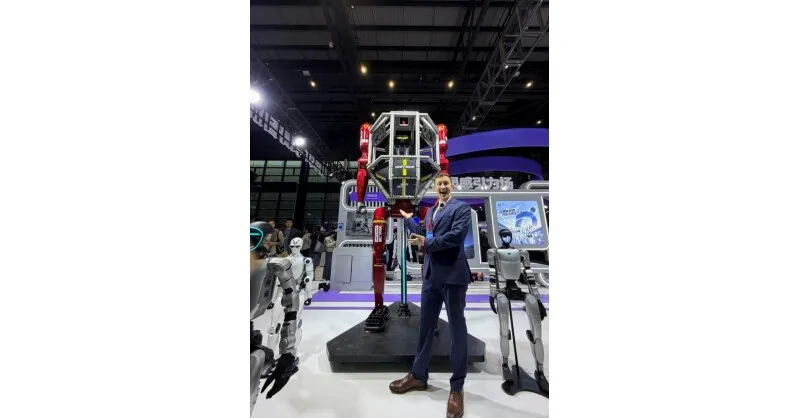
Robotics beyond the exhibition hall
The Light of Internet Expo brought Unitree Robotics, AgiBot, UBTECH and other robotics companies to the canal town of Wuzhen. Their displays ranged from choreographed mock fights to machines intended for practical assignments outside the venue.
Unitree's GD01, designed for emergency-response scenarios, caught the attention of American content creator Evan Kail. He contrasted its potential for disaster response and search-and-rescue work with the televised gala dances that had made Unitree robots widely recognizable a few years earlier.
"The leaps of technology in China are very impressive," Kail said. "As climate change gets worse and worse, robots like this can make a difference if they are used to save lives."
The expo, the summit's flagship event, opened November 2 with 671 companies representing 54 countries and regions and more than 1,000 new products and technologies, according to RobotHOT. China Daily, in a report carried by PR Newswire APAC, counted more than 30 embodied-intelligence robots from exhibitors including AgiBot, UBTECH, Unitree and Zhongke Fifth Era.
That report described a centerpiece as the world's first bipedal humanoid capable of playing badminton autonomously with a human. The same robot has mastered table tennis, with its reactions becoming faster as the ball's speed increases.
What street deployments require
China Mobile's booth offered an example of robots already working outside an exhibition: Hangzhou's traffic-management squad. The city, which hosted the 2023 Asian Games, placed 15 robots at major intersections in tourist areas and downtown districts during the 2026 May Day holiday. Under the Hangzhou Police Smart Mobility program, they answer questions, direct pedestrians and vehicles, and remind people about traffic violations.
Known as "Hangjing Zhixing," the squad received upgrades in September that added panoramic motion control and autonomous patrol. Hangzhou traffic police said that over its first four-plus months, it averaged more than nine working hours a day, delivered over 11,000 public services and issued more than 230,000 traffic-violation reminders.
The robots currently rely on 5G and 5G-Advanced connectivity, with the system typically supporting one camera per machine. Planned versions could have up to six cameras and greater independence within designated areas. Those capabilities will require upload speeds above 100 Mbps, latency below 10 milliseconds and positioning accurate to within centimeters.
Such requirements are helping guide 6G development. Reliable operation in busy streets, disaster areas and industrial settings depends not just on a robot's hardware, but also on rapid data exchange and access to nearby AI processing.
At the summit itself, an existing network supported patrol robot dogs. A 5G-Advanced "super uplink" service covered the conference venue for the first time, offering upload speeds of up to 1,000 Mbps. The dogs sent live 4K video and location data over the network. China has already widely deployed 5G-Advanced, which improves on 5G's speed and performance.
6G trials and the path to commercialization
Commercial 6G service remains years away. A China Mobile Zhejiang staff member said at the summit that a launch is expected around 2030, describing the technology as a further development of 5G. The staff member identified three priorities: space-ground integration, integrated sensing and communication, and integrated communication and intelligence.
"With 6G, networks will effectively gain radar-like eyes — the ability to sense and understand their surroundings — while AI will give them a brain," said Liang Zeshuai, a network optimization engineer at China Mobile Zhejiang.
Industry plans would combine communications, sensing, edge computing and satellite links. In that vision, a base station could sense a drone nearby or an obstacle around a blind corner, giving autonomous machines more information about their surroundings. Edge computing would handle AI work nearer the user instead of routing every request to a remote data center.
China Mobile presented its 6G open innovation trial platform at Wuzhen. Jintai Information reported that it had been recognized among the "Top 10 Central SOE National Heavy Equipment." The field trial connects 17 sites, more than 30 industry partners and more than 10 typical scenarios, with Beijing serving as its main node.
The same report said China Mobile has led 19 international 6G standard projects. In September 2026, the company and Qualcomm completed what was described as the world's first interconnection test between a 6G prototype base station and a terminal prototype in the 3GPP-defined U6G band.
Satellite links for disrupted networks
Satellite service could help maintain connectivity when earthquakes, typhoons or other disasters damage terrestrial infrastructure. China Mobile has launched a direct-to-handset dual-satellite communications service using Tiantong and BeiDou.
The company has also put 41 low-orbit narrowband Internet of Things satellites into orbit, completing its first-phase global constellation. Construction of a second phase is planned to begin in 2027. The planned improvements cover capacity, speed, frequency bands and inter-satellite links, with seamless global IoT coverage as the goal.
Industrial uses and Zhejiang's AI sector
Beyond robotics, China Mobile and Sinopharm, China's state-owned pharmaceutical and healthcare conglomerate, have developed an AI-enabled platform for cold-chain logistics. It has lowered delivery costs by 65% and shortened delivery times by 70%. The platform manages shipments of temperature-sensitive products, for which delays or inadequate monitoring can cause waste.
At Ningbo-Zhoushan Port, China Mobile says it has built the world's largest private 5G network for port operations. Private networks can coordinate cranes, vehicles, cameras and control systems in real time across large industrial sites. The company is also using AI and connected systems for flood-control planning and drone-based building inspections, aiming both to improve emergency response and to spot risks before a crisis develops.
China Daily's report also outlined the scale of Zhejiang's AI sector. During the first eight months of 2026, enterprises above designated size in the province's core AI industry recorded revenue of 582.87 billion yuan, about $87.2 billion, a 26.9% increase from a year earlier. The number of core-industry enterprises rose to 2,112. By the end of September, Zhejiang's total computing power had reached 197 EFLOPS.