A reciprocal loan for the anniversary
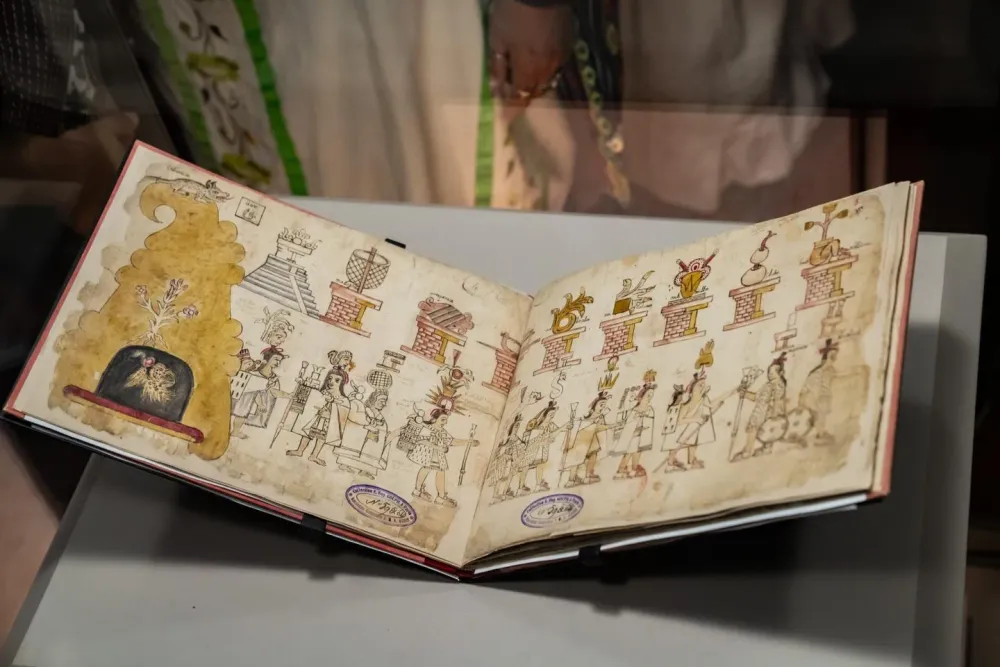
The Codex Azcatitlan has been on view at the National Museum of Anthropology since September 2026, its first exhibition in Mexico in 186 years. France's national library, the Bibliothèque nationale de France (BNF), lent the manuscript as the two countries sought to ease tensions over cultural restitution and appropriation.
The arrangement also sends a Mexican manuscript to France. President Claudia Sheinbaum and French President Emmanuel Macron agreed to the temporary exchange during Macron's November 2025 visit to Mexico: Mexico would lend the Codex Boturini in return for the Azcatitlan loan.
The anniversary program extends beyond the manuscripts. La Gran Fiesta Franco-Mexicana brings more than 250 French artists to events across Mexico from September through November 2026. France is also the guest of honor at Guanajuato's Festival Internacional Cervantino.
The history on the pages
The Codex Azcatitlan recounts the history of the Mexica people in pictograms. Its narrative begins with their mythical origins, follows the establishment of Tenochtitlan where Mexico City now stands, and continues into the early period of Spanish colonization.
Visitors can see two original pages under subdued lighting, with the colors still strikingly fresh; reproductions of other pages cover the walls. Baltazar Brito, who directs the National Library of Anthropology and History, guides viewers through the pictograms and their details. Two armed police officers guard the entrance to the exhibition, which is free and remains open through the end of December.
The manuscript's age has been reassessed. Once thought to have been made in the mid-16th century, it was dated by scholar María Castañeda de la Paz in 2017 to the second half of the 17th century.
After leaving Mexico, the codex came into the collection of French collector Eugène Goupil. His widow gave it to the BNF in 1898, and the library has held it ever since.
The unresolved question of ownership
The exhibition is intended both to mark warmer relations and to ease the dispute over Mexico's request for the codex's return. The temporary exchange does not amount to restitution.
France's framework restitution law passed its final parliamentary vote in April 2026, but its scope is limited to cultural objects illegally taken between June 1815 and April 1972. Members of Parliament noted that the cutoff leaves out earlier transfers from the Americas, including Aztec and Maya codices sought by Mexico.
A separate claim concerns the Codex Borbonicus. Purchased at auction in 1826, it has remained at the Bibliothèque de l'Assemblée Nationale in Paris. Since 2023, the Nahñu people, of Otomi origin in Mexico's Hidalgo state, have petitioned for its return, asserting that they are its rightful owners.
Mexico has also challenged sales of archaeological objects in France. In February 2026, its government began legal action seeking to force the Paris auction house Millon to stop a planned sale of 40 pre-Columbian artifacts that Mexico regards as its cultural heritage. Mexico's ministry of foreign relations says more than 2,000 objects were repatriated to the country in 2025.