
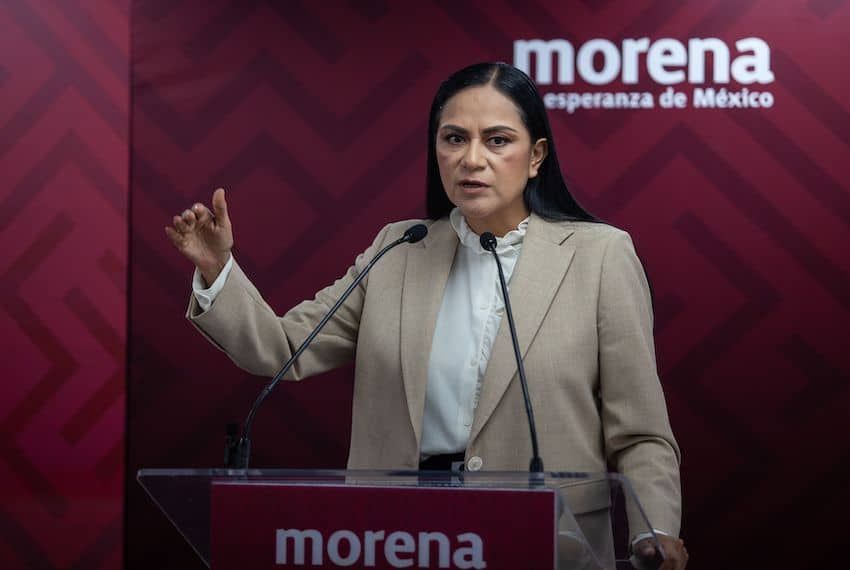
Morena rolls out anti-corruption screening for 2027 candidates
Mexico's ruling party Morena will subject all potential candidates for the 2027 elections to a rigorous two-stage screening process designed to detect criminal links and past offenses before allowing them to contest for office, party President Ariadna Montiel announced Tuesday.
The initiative comes in the wake of a historic U.S. indictment unsealed on April 30, 2026, charging Sinaloa Governor Rubén Rocha Moya and nine other Mexican officials with drug trafficking and weapons offenses—marking the first time the United States has charged a sitting Mexican governor with such crimes. According to the indictment, cartel operatives allegedly kidnapped and threatened opposition candidates and stole ballot papers during Rocha Moya's 2021 gubernatorial campaign.
Montiel, who assumed the Morena presidency on May 3, 2026, explained at a press conference that the party will conduct its own internal review of candidates while also requesting assistance from the federal government's Security Cabinet for a second layer of scrutiny. The screening will apply to everyone seeking to represent Morena in federal, state, and municipal races—a pool of just over 20,000 primary and substitute candidates competing for positions ranging from governor to municipal council member.
How the screening process works
The first stage will involve Morena officials examining open-source information, including candidates' social media accounts and correspondence sent to party leadership.
"In open sources you can have access to a good part of all of our lives,"Montiel said, noting that party members often send letters alerting leadership to concerns about specific individuals.
For the second stage, Morena will ask the Security Cabinet to conduct reviews within the framework of its legal powers, utilizing an online platform containing information on all individuals who have been arrested and convicted of crimes in Mexico.
Candidates who pass both party-administered checks will then face a third screening conducted by the National Electoral Institute (INE), Mexico's autonomous electoral authority established in 1990 and restructured in 2014 with expanded oversight powers over local political parties and sub-national elections. The Federal Attorney General's Office and the Finance Ministry's Financial Intelligence Unit will assist INE in this final review stage.
"If someone has done improper things, he or she won't be allowed to contest an election as a Morena candidate,"Montiel stated, emphasizing that the filters will examine both criminal conduct and other behavior inconsistent with party principles.
Electoral context and timeline pressures
The screening measures must be implemented swiftly, as the formal electoral process for the June 6, 2027 elections begins in September 2026. The elections will renew all 500 seats in the Chamber of Deputies for the LXVII Legislature, alongside contests for 17 governorships, hundreds of mayoralties, and more than 1,000 local legislative seats.
The high stakes are evident given Morena's current political dominance. The party governs at the federal level and in 23 of Mexico's 32 states. In the 2024 elections, Morena's coalition "Sigamos Haciendo Historia" secured approximately 73% of Chamber of Deputies seats—364 of 500 total—achieving a supermajority by winning 256 single-member districts and 108 seats through proportional representation.
This is not the first time Morena has faced candidate eligibility issues. In 2021, the INE canceled the registration of 49 Morena candidates for failing to report pre-electoral campaign expenses, affecting races for two governorships, 25 federal deputy seats, six state legislative seats, twelve mayoralties, and four borough presidencies.
While all Mexican political parties have the option of requesting INE to conduct background checks on their candidates, Morena's decision to implement mandatory internal screening represents an additional layer of scrutiny beyond legal requirements.