
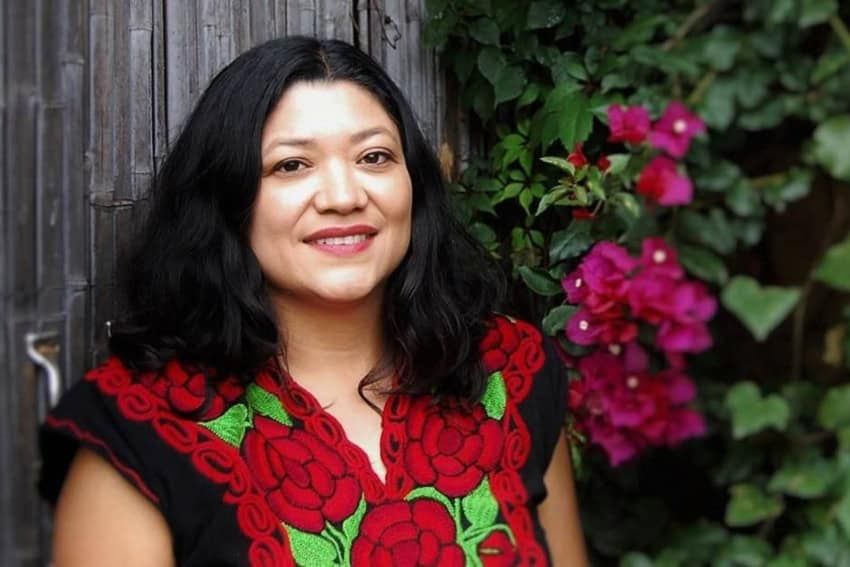
Putting down the crown of misery
Reading stories about crossing a border you have also crossed—but in the opposite direction and under vastly different circumstances—creates a particular unease. Ann Marie Jackson experienced this while reading Reyna Grande's new memoir, "Migrant Heart: Essays About Things I Can't Forget," from her home in San Miguel de Allende, Guanajuato, a colonial town known for its architecture, arts scene, and thriving expat community of approximately 10% of its 140,000-175,000 residents, including over 10,000 Americans.
Grande's story began only a day's drive away in Iguala, Guerrero—a town most people now recognize, if at all, as the site where 43 students from the Ayotzinapa Teachers' College were forcibly disappeared on September 26, 2014. Six people died at the scene when local police attacked the students, and the 43 who were kidnapped have never been found, with only one student's remains definitively identified. A 2022 Mexican government report concluded the vanished students were victims of "state sponsored crime," with investigations revealing that Mexican security forces at multiple levels collaborated in the disappearance. This atrocity continues to haunt Mexican public consciousness.
Published on May 12, 2026 by Atria/Primero Sueño Press, "Migrant Heart" marks a deliberate shift for Grande, who has built her literary career on devastating memoirs. Her earlier works, "The Distance Between Us"—a 2012 National Book Critics Circle Awards finalist that has been adopted as a common read by schools, colleges, and cities across the United States—and "A Dream Called Home" shared the traumas of her childhood and young adulthood so powerfully that a friend once suggested, half-jokingly, that publishers should bundle tissues with each copy.
Grande, who immigrated to the United States from Iguala at age nine in 1985 and became the first person in her family to graduate from university, earning a BA from UC Santa Cruz and an MFA from Antioch University, opens this new collection by recounting her coronation as the "queen of misery." The entire book can be understood as her working through what it might mean to set aside that crown without abandoning the truths that earned it.
The 18 essays spanning 256 pages venture into territory beyond her previous work: failing eyesight, gardening, motherhood, menopause, and the peculiar vertigo of raising American children who will never fully comprehend her scars or shoulder her burdens. She addresses the Ayotzinapa disappearances not as distant news but as a wound in her hometown's soul. She examines losing fluency in Spanish as the price of gaining English, and confronts the complicated inheritance of colorism within Mexican and Mexican American communities—including, in one unflinching passage, her own mother's hope that her grandchild would have blue eyes.
Beyond immigrant trauma narratives
Grande has expressed concern in interviews about repeating herself, about her writing hardening into "immigrant trauma porn." In these essays, readers can sense her actively resisting that fate, reaching instead for the more challenging, less commercially viable material of an ordinary life continuing after the extraordinary parts conclude. This is a writer who has spent two decades making readers weep—she was even featured on Oprah's Book Club television special in March 2020—but here, she seems more interested in proving she can allow herself, and her readers, to breathe.
The author's literary achievements extend beyond her memoirs. She has received an American Book Award, the El Premio Aztlán Literary Award, the 2015 Luis Leal Award for Distinction in Chicano/Latino Literature, and a 2023 Barnes & Noble Writers for Writers Award from Poets & Writers. As a member of the Macondo Writers Workshop, founded by Sandra Cisneros, and as a faculty member who has taught creative writing at UCLA Extension, VONA, and Antioch University, Grande has helped shape a new generation of Latino/a writers.
An uncomfortable mirror for expats
In "Migrant Heart," Grande again demonstrates that pain can be transformed into power. But she finally permits herself to establish careful boundaries, no longer feeling obligated to reexamine every wound for the reader's benefit.
For expats reading this book in any of Mexico's beautiful, sunny towns that serve as havens for people fleeing not violence and brutal poverty but cold winters, polarized politics, and high property taxes, "Migrant Heart" offers uncomfortable reading—and Jackson argues it should be. It is essential reading precisely because the comfort many expats enjoy was built on a complicated history that these essays insist readers confront directly. Living in San Miguel de Allende, Jackson could not read this without feeling implicated, gently but unmistakably, in the very economic and political inequities that produced both the author's and her own radically different migrant experiences.
Grande has written a book about what it costs to leave home when you have no choice. The least those who have enjoyed that choice can do is read it all the way through and wrestle with some hard truths along the way.