Training programs and medical proposals
The WBC's November 9 report outlined the certifications and a separate program for those who train trainers. The university said its educational work seeks consistent professional standards throughout boxing.
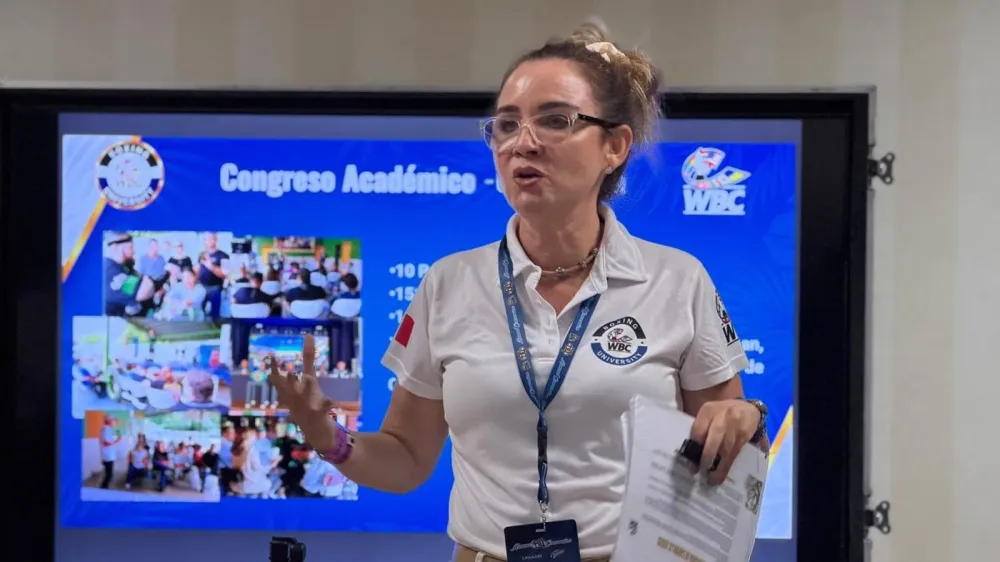
Director Xóchitl Lagarda coordinated the general and medical sessions. Dr. Wallace and Ricardo Monreal headed the medical panel, where discussions covered nutrition education, hydration and weight-cutting protocols. Participants came from countries in Europe, the Americas, Asia and Australia.
Delegates also considered adding Rocky Herron's Champion of Change program to the health agenda. Herron serves as the WBC's drug-awareness educator. In a December 2025 profile, the council said he had spent 31 years as a DEA agent and reached roughly 280,000 young people across 18 countries through his WBC-backed anti-narcotics work.
A virtual exchange with representatives in Geneva examined a proposed first-responder algorithm for punches and knockdowns. That proposal remains under discussion; the report did not describe an adopted ringside medical rule. The general session also included updates on WBC Talks and Remote Scoring.
The convention is scheduled for November 8-13, 2026, at the Palacio Mundo Imperial in Acapulco, Guerrero, Mexico, according to the WBC's registration announcement. Other agenda items include the Mandatory Bouts Session, a Ratings Committee review of world rankings, training for ring officials and WBC Cares community outreach.
Weight-loss review does not change existing limits
WBC president Mauricio Sulaiman used a separate convention report to highlight concerns about dehydration and how fighters reach their division's weight limit. His emphasis was on losing weight gradually and safely, rather than announcing a new weigh-in system.
Sulaiman told the WBC: "it is a problem, weight cutting, weight loss, dehydration so we are looking into it with a very large interest."
The council's published weight-management requirements already call for a weight recording when a bout is confirmed and further checks at 30, 14 and seven days before the fight. At those three checkpoints, fighters may be no more than 10 percent, five percent and three percent above their division's limit, respectively.
An additional check in the arena dressing room is intended to restrict excessive rehydration. Under the published program, a fighter's weight at that check cannot exceed the official weigh-in figure by more than 10 percent. These requirements predate the Acapulco discussions. Neither convention report sets out new numerical limits or a timetable for implementing changes.
The WBC announced Weight Management Program 2.0 in July 2024. It introduced automatic fines for failing to comply with safety weigh-ins, with enforcement beginning in August 2024, and added the WBC BoxMed mobile app to create individual boxer profiles. The council also says its expansion from the original eight weight categories to 18 divisions was intended to limit advantages between opponents.
Earlier responses to weight cutting
Fight-day checks were the subject of a June 2018 summit in Los Angeles organized by the California State Athletic Commission. All major boxing sanctioning bodies agreed there to incorporate such weigh-ins to address weight cutting and rapid rehydration.
According to the Los Angeles Times, a California study presented at the meeting found that 164 of 754 boxers had regained more than 10 percent of their official day-before weigh-in weight. Ringside physician Dr. Paul Wallace warned that some fighters shed 20 to 25 percent of their weight and put it back on before championship bouts.
The newspaper's June 2018 report also described the IBF's fight-day weigh-in system. A champion can lose a belt, or a challenger can become ineligible to win one, for weighing 10 pounds over the limit in divisions at 140 pounds or below. For divisions at 147 pounds and above, the threshold is 7½ pounds.
Japanese boxing bodies adopted stricter safeguards in August 2025 after Shigetoshi Kotari, a super featherweight, and Hiromasa Urakawa, a lightweight, died following separate August 2 bouts at Tokyo's Korakuen Hall. Both were 28. The measures included urine testing to assess dehydration, tighter restrictions on rapid weight loss and mandatory ambulances at venues. The World Boxing Association regards dehydration caused by rapid weight cutting as a factor that makes the brain more susceptible to bleeding.
A wider review of boxing administration
Sulaiman described the Mundo Imperial gathering as a working review of the previous year and the year ahead, with participants submitting reports. The convention's business extends beyond honoring champions to examining how boxing is administered.
Asked about confrontations at press conferences, weigh-ins and after bouts, he placed responsibility with the relevant specialists and event organizers while saying the WBC would continue monitoring the issue. His account did not announce a new disciplinary measure.