Organizers confident as negotiations proceed
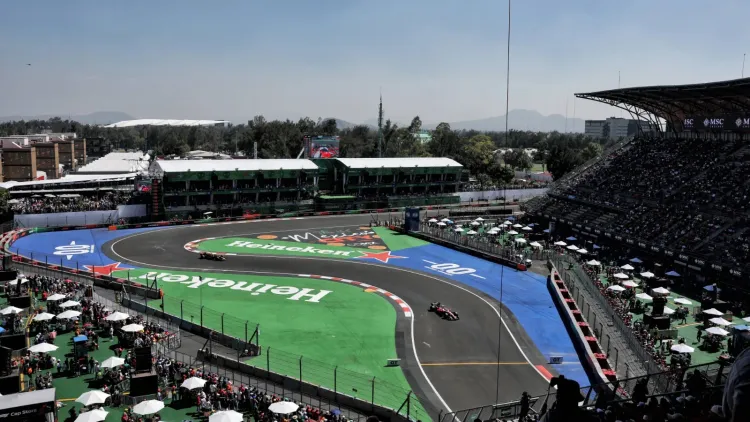
The talks come after Formula 1 announced a three-year renewal in April 2025, securing the race through the 2028 season. That agreement ended uncertainty over the Autódromo Hermanos Rodríguez's place on the calendar, with Liberty Media retaining an event valued for its spectator atmosphere.
González told Spanish news agency EFE that the relationship among Formula 1, the organizers and Mexico City gives him confidence in another renewal.
"I think we have a very good chance of renewing, although we will confirm it at the end of this year or the beginning of next year. We are in a good position with F1, they are very happy with the Mexican Grand Prix, and the city is happy too. It is a platform for promoting tourism, it provides economic benefits and gives Mexico greater visibility. It works for us," he said.
He also pointed to Formula 1's appreciation of the event's organization, including spectator reception and transportation. "Formula 1 sees us as a benchmark for our organisation and for the way we welcome people. I think that gives us peace of mind in believing that we will continue to have a race in the years to come," González added.
Local government has the final say
A renewal also depends on political support. The Race reported on October 28, 2026, that the event relies on government funding, with Mexico City's government taking over support after federal backing ended with the original contract in 2019. That federal funding had supported Formula 1's return in 2015.
The local funding agreement also brought the official name "Mexico City GP". It was assembled by Claudia Sheinbaum, now Mexico's president, during her tenure as Mexico City's head of government from 2018 to 2023. Her successor as mayor, Clara Brugada, has a fixed term ending in 2030, putting a potential renewal after 2028 within her time in office.
González told The Race that local politicians make the final decision. "The mayor's term goes every six years, so that's more or less how long we can go," he said.
The economic case includes an assessed annual impact of about $1 billion for Mexico City, according to the same report. Studies covering 2015 through 2025 point to $8.4 billion in economic benefits to Mexico and media exposure. The race has also helped create more than 90,000 jobs.
For 2025, The Race reported another $176 million in economic activity in Mexico City in addition to the $1 billion impact.
A broader audience and Formula 2 addition
The Race expected a sellout crowd of more than 400,000 for the 2026 weekend, the event's 11th edition since Formula 1 returned in 2015. The previous year's race also sold out despite the absence of Mexican driver Sergio Pérez from the grid.
The audience has changed over that period. Roughly 90% of spectators were male in 2015; the crowd is now younger and includes more women, a shift the report attributed to the Liberty Media era and the "Drive to Survive" effect.
The event has added Formula 2 support races for 2027. González described the addition as a way for Mexican fans to see "the path to F1", with Mexican drivers competing in Mexico City.
Circuit work preserves the existing layout
Promoter CIE announced a 202 million peso investment, about $12 million, on May 12, 2026, for renovation and maintenance at the Autódromo Hermanos Rodríguez ahead of the 2026 Grand Prix. The official MexicoGP release said work began on Monday, May 11.
The program includes resurfacing selected sections of the race course with a 6.5 cm layer of asphalt, maintaining the U-drains and curbs around the 4.304 km circuit, and improving the pit building facade and paddock asphalt.
Tilke is involved in the project, which is being conducted under FIA supervision to maintain the venue's Grade 1 homologation. The track layout remains unchanged.
More hosts competing for calendar space
Mexico City's negotiations are taking place amid growing competition for race dates. Rwanda is expected to become a Formula 1 host during the next decade, while Argentina is pursuing a return to the World Championship. If F1 maintains its 24-race annual limit, an additional event would require another race to give up its place or some other calendar adjustment.
Rotation is already being used for some established European venues. Spa-Francorchamps and Barcelona have a biennial arrangement spanning the next six years, with the Belgian Grand Prix running in odd-numbered seasons and Barcelona in even-numbered years.
For Mexico City, the unresolved questions are whether the current talks produce an extension and how many additional seasons it would cover. Organizers hope to have an agreement ready for confirmation by the end of 2026 or in early 2027.