The National Autonomous University of Mexico (UNAM) is dealing with one of the biggest crises in its recent history after its first-ever online entrance exam produced results widely suspected to have been inflated by cheating, including the use of artificial intelligence tools such as ChatGPT. More than 158,000 aspirants sat the exams, and the university has since suspended enrollment, ordered an in-person retake for about 58,000 applicants and seen its exam platform provider come under federal scrutiny.
An online exam for the first time
UNAM's admission exams were previously held in large auditoriums and stadiums. In 2026, for the first time, applicants completed them online, with the aim of saving them the time and money involved in traveling to an exam center and making the tests more accessible across Mexico and abroad. The online exam ran from 23 May to 10 June, and applicants included those seeking places in highly competitive programs such as medicine and law.
The software was supplied by the Mexican company Territorium Life. It included AI-powered anti-cheating features, such as a function that blocked additional computer tabs, and a camera- and microphone-assisted surveillance system overseen by human behavior experts. It could not, however, physically prevent test-takers from using a second computer or a smartphone. Territorium Life said its platform "operated as planned." Around 2% of exams were nullified after the surveillance system detected cheating.
Unusually strong results
UNAM published the results on 17 July, and the first suspicions emerged on social media, according to El País. The concern was that scores were unusually good. Historically, the share of test-takers answering more than 100 of 120 multiple-choice questions correctly was below 10%. According to Times Higher Education, 16.3% of candidates overall scored 100 or more this year, compared with roughly 3% historically.
The jumps were sharp in individual programs:
- Medicine: 29.3% of candidates got more than 100 correct, up from 9% in 2025.
- Law: almost 19%, up from 3.7%.
- Sciences: 30.4%, up from 9.7%.
The BBC reported that the higher scores drastically raised the thresholds required to enter UNAM degree programs.
Cheating allegations
Infobae reported that before the exams, TikTok videos offered what it called a "cheating instruction manual," including advice to run ChatGPT on a second monitor outside the camera's frame. Education assessment expert Eduardo Backhoff wrote on social media that:
"either the exams were easier, the students were smarter, or they cheated,"
adding that the first two possibilities were highly unlikely.
Raul Rojas, who teaches AI at the Free University of Berlin and statistics at the University of Nevada, Reno, told NPR that after looking at the scores he concluded:
"almost half of the students were cheating when taking the exam online."
NPR's Eyder Peralta said the tests were open for 17 days, giving friends or internet entrepreneurs ample chance to leak or sell questions, and that technological blind spots allowed some students to have someone else take their test. UNAM later said some entrants had cheated using phones, companions and identity theft, according to CNN.
UNAM's response
Rector Leonardo Lomelí Vanegas ordered a detailed report on 21 July, and a technical commission of 16 experts in fields including education, AI and law was installed on 27 July. Lomelí said fair access to the university cannot be compromised by "those aspirants who may have had some kind of help." UNAM also suspended enrollment of new students and filed criminal complaints against people and companies offering fraudulent services related to the exams.
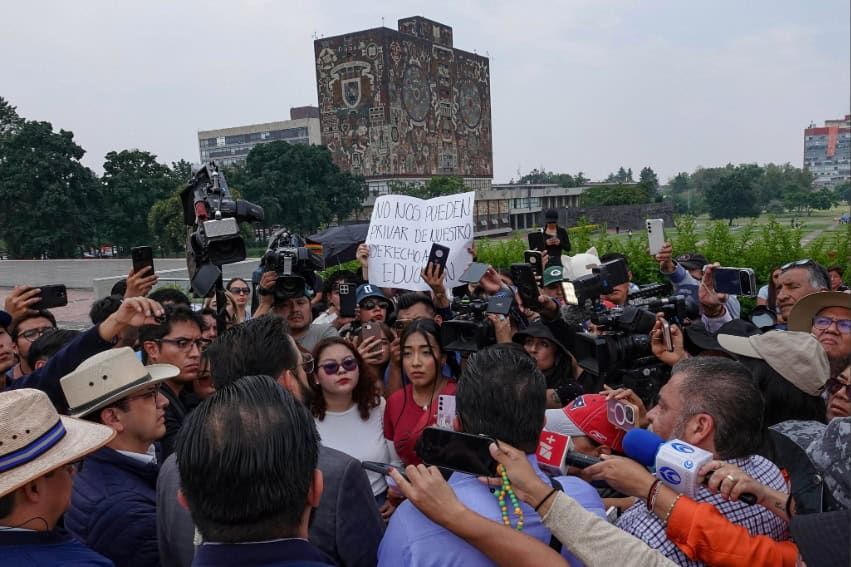
Dozens of applicants marched at Ciudad Universitaria on 28 July. Some demanded an in-person exam, chanting "We want honesty, not artificial intelligence," while others wanted their results honored. One would-be applied mathematics student, Leonardo Ruiz, told NPR his exam had been invalidated and that, although he assumed it was flagged because he scored too well, he had achieved his score by studying.
President Claudia Sheinbaum said the Federal Attorney General's Office could assist the investigation if required.
"They have to see how this fraud was committed,"
In-person retake
On 31 July, following the commission's recommendation, UNAM announced a pen-and-paper "control exam" for roughly 58,000 applicants. Those eligible had met this year's passing mark or scored at or above the lowest passing score of the past five admission rounds (2021–2025). The results of the in-person exam were to override the online scores.
The retake was held from 12 to 19 August at four venues: Mexico City, León (Guanajuato), Oaxaca and Tijuana. UNAM declined to change venues despite complaints from applicants who had to travel long distances.
On 28 August, UNAM published the results and admitted 49,074 first-year undergraduates: 28,151 through the Pase Reglamentado, the automatic admission route from UNAM's own high schools, and 20,923 through the competitive selection contest. Classes began on 31 August rather than on the originally planned 10 August.
Contract and audits
On 5 August, according to ITSitio, UNAM announced the early termination of its contract with Territorium Life and said audits would establish what happened. The termination does not amount to a finding of fault by the company. According to procurement documents reviewed by El Universal, UNAM had paid Territorium Life more than double the 49 million pesos that the 2025 in-person exam cost.
The technical commission concluded that the atypical results had multiple causes and that individual responsibilities could not be established from the data analyzed alone. It then began a new stage examining how the decision to move from in-person to digital testing was made and preparing recommendations for future selection processes. A commission member said "everything is on the table," including Territorium's role.
On 30 October, Mexico's Federal Superior Audit Office (ASF) said it had precautionarily seized Territorium Life's data repositories and servers to preserve evidence. Auditor Aureliano Hernández Palacios Cardel told the Chamber of Deputies that the ASF is investigating possible irregularities in the contracting and administration of the exam platform, and that it was the first time in the agency's history it had taken such a measure. UNAM authorities, led by the rector, asked the ASF to intervene. Reports indicate the exam process will face three audits — by the ASF, UNAM's internal oversight body and an independent firm — with no results yet. The investigations are ongoing and no findings of wrongdoing have been announced.