France pushes for deeper Mexico trade ties as USMCA uncertainties mount
France is actively courting Mexico to deepen economic ties and diversify away from heavy reliance on the United States, as bilateral trade negotiations between Washington and Mexico City grow increasingly complex.
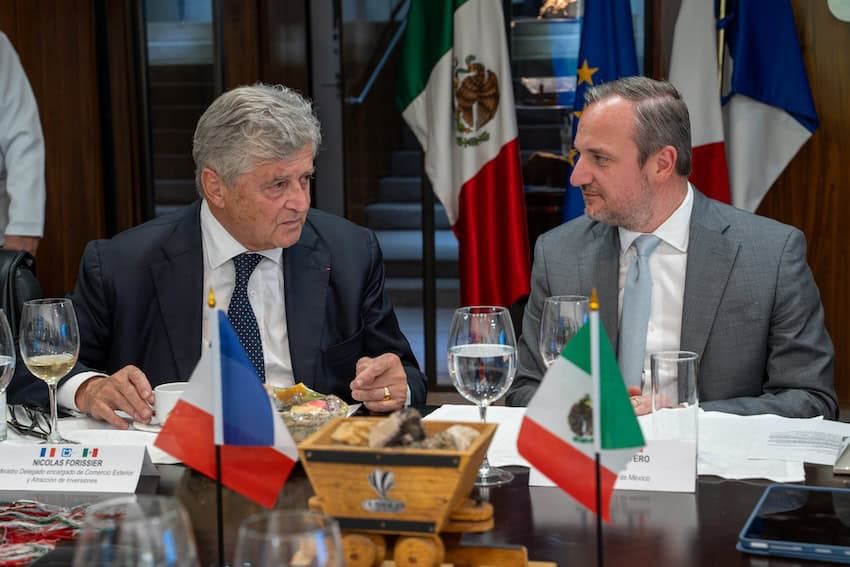
French Minister Delegate for Foreign Trade and Economic Attraction Nicolas Forissier made the pitch Tuesday during the presentation of the France-Mexico Economic Report 2026, emphasizing shared commitments to multilateralism and rules-based trade. The event marked 200 years of economic relations between the two nations, a partnership that formally began in 1826 when France and Mexico established commercial ties—four years before Paris even recognized Mexican independence. By the 1830s, French merchants already operated 438 retail shops across Mexican territory.
USMCA review creates opening for France
Forissier's message comes at a critical juncture for Mexico. The United States-Mexico-Canada Free Trade Agreement entered its first joint review on July 1, 2026, with Washington declining to renew the pact in its current form. The USMCA remains in force until July 2036, but the Trump administration is leveraging the review process to extract concessions on both trade disputes and non-trade priorities including migration, drug trafficking and continental defense—transforming what should have been a routine assessment into high-stakes negotiations.
Against this backdrop, France is positioning itself as a reliable alternative. The French minister stressed the importance of securing supply chains, particularly for critical minerals and rare earth elements, warning that these resources could become tools of economic coercion. The newly modernized EU-Mexico trade agreement addresses these concerns directly, with provisions that eliminate export restrictions and ban dual pricing practices where export prices exceed domestic rates.
Modernized EU-Mexico agreement awaits ratification
The modernized agreement, signed in May 2026 and approved by the European Parliament in July, awaits only Mexico's ratification to enter into force. Building on an original pact from October 2000—making Mexico one of the EU's longest-standing trade partners—the updated deal eliminates tariffs on 99% of traded products after nearly a decade of negotiations that began in May 2016.
The timing aligns with broader European-Mexican economic integration. In 2025, total trade between Mexico and the European Union reached $88.3 billion, with the EU serving as Mexico's third-largest trading partner and second-largest export market after the United States. French President Emmanuel Macron underscored this growing relationship during his November 2025 visit to Mexico—the first official trip by a French president in over a decade.
Current trade relationship shows imbalance
Currently, France ranks as Mexico's 15th largest trading partner globally and fourth in Europe, trailing Germany, Spain and Italy. For France, Mexico represents the second-largest partner in Central and South America after Brazil. Yet the relationship shows significant asymmetry: in 2025, Mexico exported $1.271 billion to France while importing $4.838 billion, creating a trade deficit of $3.567 billion in France's favor.
Forissier sees this imbalance as an opportunity for mutual growth. He described France as a gateway for Mexican companies seeking access to the European Union, North Africa, Sub-Saharan Africa and the Middle East, while Mexico could serve as France's platform to the Americas. He called on French firms to increase their Mexican presence and urged Mexican companies to invest more actively in France.
Substantial French business presence in Mexico
French businesses have already established a substantial footprint in Mexico, with roughly 700 companies operating in the country, including 37 of France's 40 largest corporations. These firms support 215,000 direct jobs, according to the French Embassy report. Between 2006 and 2025, cumulative French investment in Mexico totaled $13.6 billion, while bilateral trade reached $7.9 billion last year. The report indicates that over half of surveyed French companies source more than 50% of their purchases from Mexican suppliers.
French Ambassador to Mexico Delphine Borione told the gathering that the bicentennial celebration meant
looking back with pride on the journey we have traveled, but also looking ahead with the conviction that our relationship will continue to strengthen.
As the USMCA review process continues through 2026 and beyond, France's intensified economic courtship of Mexico reflects a broader European strategy to capitalize on trade policy uncertainty in North America—and Mexico's corresponding interest in reducing dependence on its northern neighbor.